

A Useful and Free Resource for Viewing Economic Trends
by Charles Rotblut | March 17, 2022
Yesterday, the Federal Open Market Committee (FOMC) voted to raise interest rates by 0.25%. The quarter-point hike was the first increase since December 20, 2018. The hike was made in response to both continued signs of economic growth and inflation remaining higher and stickier than the Fed had expected.
Among the contributors to inflation has been gasoline prices. AAA calculates the national average as being $4.289 per gallon for regular unleaded. Depending on where you live, the price may be higher. (It’s certainly higher here in the Chicago area.) 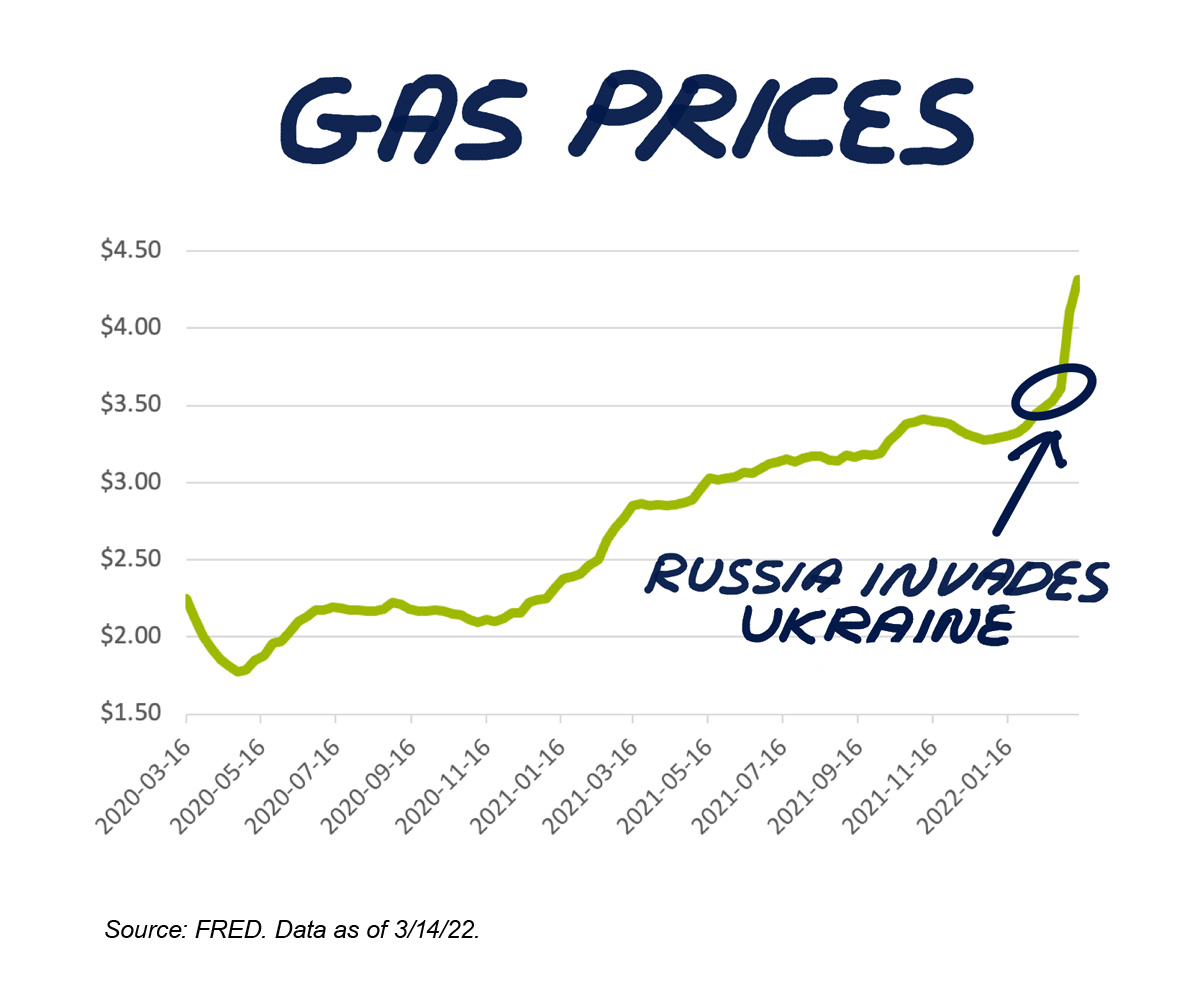
A Putin premium is being reflected in the prices at the pump. But as the chart I’ve included shows, gasoline prices were rising prior to Russia attacking Ukraine. The reopening global economy, a rebound in the number of miles driven and supply chain issues have all contributed to the increase. Russia’s invasion sent gas prices to another level.
The chart is from FRED Economic Data (simply referred to as FRED). FRED is a comprehensive economic database run by the Federal Reserve Bank of St. Louis. For those of you interested in looking at economic data, it is a very useful tool. I personally have it bookmarked in my web browser as I find it useful to look at the actual trends in the data.
As my colleague Derek Hageman wrote in the March AAII Dividend Investing newsletter, FRED tracks more than 800,000 data points from over 100 sources. It is a one-stop shop for people trying to understand the economy.
One of the great things about FRED is the wide variety of data it includes. If you go to the website and click on the category icon and then click on money, banking and finance as Derek suggested as an example, you will find data on banking, business lending, exchange rates, financial indicators, interest rates, monetary data and foreign exchange intervention. Derek thinks most investors will find the financial indicators subcategory most valuable; it provides information on indicators such as stock market indexes, volatility indexes and financial activity measures. The interest rates subcategory provides interest rates for a wide range of financial instruments, which individual investors may find handy.
Derek also did a search for “dividend” on FRED. He found data on net corporate dividend payments, the dividend yield of common stocks on the New York Stock Exchange (NYSE) and household dividend income.
For those of you concerned about inflation, FRED has more than 15,000 datasets on prices. If the threat of a recession has you worried, you can find data like bond yield curves and smoothed recession probabilities. (Neither suggests that a recession is forthcoming, though the 10-year minus two-year bond yield curve has been getting flatter. Keep in mind that no indicator—and certainly no forecaster—is flawless.)
One thing FRED cannot do is make you a better forecaster or market timer. The data can only give you insight into what has happened in the past or is currently occurring—not what will happen in the future. But looking at the data can provide you with an objective context of the current economic trends.

- For additional insights on what you can gain from reading the economic tea leaves, see this 2020 AAII Journal article from contributing editor Brian Haughey.
- Those of you who are near or in retirement may find the interview I recently did with Wade Pfau helpful. We discussed withdrawal and allocation strategies for retirees.
- Our assistant editor Anine Sus explains why she is passionate about sustainable investing at her My Investing Discoveries blog.
- In our next Individual Investor Show, we’ll compare and contrast the discount brokers. You can subscribe to the Individual Investor Show here. For a sneak peak, see our updated discount broker guide.
- Finding the right mutual fund or exchange-traded fund (ETF) for your portfolio doesn’t have to be difficult. We compiled a PDF checklist of every AAII resource we offer on our website for members to utilize when searching for funds to invest in. Complete Lesson 3 of “S” in the PRISM Academy.
“Would you specifically choose a mutual fund for being deemed ‘socially responsible’ and, if so, what ESG factors would you focus on?”
Click here and then choose the Join Community button on the right to answer this question or read other responses.
AAII Sentiment Survey
The results from the latest AAII Sentiment Survey show decreases in bullish and neutral sentiment. In addition, the number of investors describing their outlook for stocks as “bearish” rose.
Bullish sentiment, expectations that stock prices will rise over the next six months, declined 1.5 percentage points to a four-week low of 22.5%. The breakpoint between typical and unusually low levels of optimism is 28.0%. Bullish sentiment levels are below the historical average for the 17th consecutive week.
Neutral sentiment, expectations that stock prices will stay essentially unchanged over the next six months, decreased by 2.5 percentage points to 27.8%. This is the fourth consecutive week with neutral sentiment below the historical average of 31.5%.
Bearish sentiment, expectations that stock prices will fall over the next six months, rose 4.0 percentage points to 49.8%. The breakpoint between typical and unusually low levels of pessimism is 40.1%. This is bearish sentiment’s 17th consecutive week above its historical average of 30.5%.
Most of this week’s results were recorded prior to yesterday’s decision by the Federal Open Market Committee to raise interest rates.
Bullish sentiment remains unusually low and bearish sentiment remains unusually high for the ninth time in 10 weeks. Historically, the S&P 500 index has gone on to realize above-average and above-median returns during the six- and 12-month periods following unusually low readings for bullish sentiment and for the bull-bear spread. (This week’s bull-bear spread of –27.3% is also unusually low.) Unusually high bearish sentiment readings historically have also been followed by above-average and above-median six-month returns in the S&P 500.
The ongoing invasion of Ukraine by Russia, stock market volatility, inflation, interest rates, the coronavirus pandemic and politics are all influencing individual investors’ outlook for stocks. Other factors include the economy and corporate earnings.
For this week’s special question, we asked AAII members to share their thoughts on fourth-quarter earnings.
About one-third of respondents (33%) have a positive view of earnings, stating that many results were stronger than expected. In contrast, 31% of respondents express neutral or negative viewpoints. One prevalent reason for this isn’t earnings but rather the conflict between Russia and Ukraine. These respondents specifically pointed to the resulting market uncertainty as well as overall concern. Around 17% have a mixed outlook, stating that although earnings were stronger, they are worried in the long term about rising prices. Roughly 12% of respondents are neutral about fourth-quarter earnings.
Here is a sampling of the responses:
- “These earnings were strong, and an investor looking at a new business should review the company’s view forward.”
- “Future earnings are likely to be worse than expected as higher wages and materials costs and labor shortages dampen production.”
- “Putin and Ukraine are just too large of an unknown to allow me to think of the market moving higher at this time.”
- “More or less in line with expectations.”
Bullish: 22.5%, down 1.5 points
Neutral: 27.8%, down 2.5 points
Bearish: 49.8%, up 4.0 points
Bullish: 38.0%
Neutral: 31.5%
Bearish: 30.5%
See more Sentiment Survey results.

March 10, 2022 Key Considerations When Adding Commodities to Your Portfolio
March 3, 2022 Warren Buffett's Comments on Allocation
February 24, 2022 Stock Market Returns Following Military Conflicts
February 17, 2022 The Small-Cap Premium Is Below Its Historical Median

Discussion
Rob from NC posted over 4 years ago:
Thank you, Charles! Excellent information!
Paul from CO posted over 4 years ago:
You forgot to mention the administration’s executive orders causing the rise in gas prices.
Mike DeCenzo from Florida posted over 4 years ago:
Your analysis of the cause of "increased prices at the pump" omits the chilling effects of the Biden Administration's hostility to U.S. oil and gas production. Cancelling pipeline construction and interfering with drilling (and fracking) projects on public lands are definitely contributing to our current shortages and resulting high prices. The fact is that our economy will need to continue to use hydrocarbons until some future time when abundant "clean" energy can be economically supplied to meet our needs. In the meantime, it makes no rational sense for the U.S. to curtail drilling here and then, when shortages and price increases result from this failure to recognize reality, to produce and then transport hydrocarbons from countries whose environmental stewardship is inferior to our own. This illogical behavior results in more not less of that environmental damage that the current administration. through its shortsighted energy policies, is hoping to prevent!
Rob from NC posted over 4 years ago:
I agree with Mike and Paul. I appreciate the direction to the FRED data, but I skipped over the "gaslighting" about gas prices. If it weren't the administration's intent to increase gas prices, there would have been no logical reason to cancel the Keystone pipeline, deny leases on public land, and throw regulatory roadblocks in the way of oil producers. Our high gas prices are rooted in such insane policies.
Mark from SD posted over 4 years ago:
I agree with the other commentors. This administration has done nothing but hurt our economy. Now I have to question your agenda since you omitted the true, original cause of our gas price increases, along with the whole inflation problem.
JohnW from NC posted over 4 years ago:
Gas prices follow oil prices, right? This is happening all over the world. US WTI crude prices have tracked almost exactly with Brent and OPEC crude, so it's a stretch to assume these US policies are having that large enough impact. https://fredblog.stlouisfed.org/2020/05/wti-vs-brent-oil-prices-when-and-why-do-they-diverge/?utm_source=series_page&utm_medium=related_content&utm_term=related_resources&utm_campaign=fredblog&fbclid=IwAR0FSP2S7e83a20ft2K82bc5Roi6PTUkVCMF_iy88PRSkbXQ-1ATlXVvDnQ I'm not here at AAII to get political commentary or "folk economics", simple and usually biased explanations for very complex situations.
Rob from NC posted over 4 years ago:
As the world moves back to “normalcy” after the big government-instituted shutdowns, demand for oil is naturally increasing. That in itself would tend to bring about higher prices UNLESS there is a concomitant increase in supply. When the largest oil producer in the world puts the brakes on oil production, it tends to CAUSE higher prices worldwide. No one is suggesting that the factors Charles mentioned are not important, but the FACT that the current administration has actively hobbled oil production and delivery systems is a big factor in increasing prices at the pump, and that should not be overlooked. This isn’t “folk economics;” it is basic, real-world economics.
James from Texas posted over 4 years ago:
Agree with Rob and others. President Biden is begging dictators and terrorist countries to replace the oil he shut off in the US. So the people running his administration obviously recognize the problem they caused.
Charles Rotblut from Illinois posted over 4 years ago:
Baker Hughes publishes widely followed North American rig count data (https://rigcount.bakerhughes.com/na-rig-count). The rig count fell to a near-term bottom of 172 in 2020 in response to the coronavirus pandemic and the related drop in miles driven. The rig count has since rebounded and currently is at 524. When comparing it to the March 2020 level of 683, keep in mind that there are still shortages for supplies and workers.
-Charles
Rob from NC posted over 4 years ago:
I wonder how many rigs would be available in the absence of government hostility. I wonder how many more employees would be "available" if not for government handouts, money printing, and mandates. If not for onerous regulations on domestic manufacturers, and if foreign manufacturers were not permitted to "compete" in our markets without complying with the same regulations, I wonder how much of a shortage of supplies we'd have. I wonder what the supply chain would be like if government had not forced businesses to shut their doors for so long. Life and markets will never be perfect, but excessive government meddling generally does not make things better.
You need to log in as a registered AAII user before commenting.
Create an account