

A Costly Example of Why Asset Location Matters
by Charles Rotblut | April 21, 2022
Featured Tickers: DIV
VMGRX
VTHRX
VTWNX
DIV
VMGRX
VTHRX
VTWNX
With taxes still fresh on many people’s minds, I wanted to share an example of why paying attention to asset location matters. Asset location refers to the tax characteristics of the account you place an investment in.
A rule of thumb is to put your least tax-friendly investments in tax-preferred accounts such as individual retirement accounts (IRAs), Roth IRAs, 401(k) plan accounts and health savings accounts (HSAs). Your most tax-efficient investments should be held in taxable accounts, like a traditional brokerage account. Corporate bonds—whose coupon payments are fully taxable—are suited for tax-preferred accounts. Traditional stock index funds, which have low levels of turnover, are suitable for taxable accounts.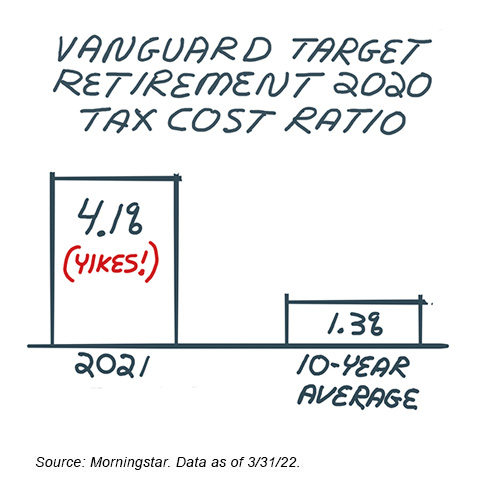
This brings us to Vanguard’s target-date funds. Target-date funds adjust their allocation over time to coincide with the date their shareholders expect to retire. They are frequently offered as the default investment option in workplace retirement plans like 401(k) and 403(b) plans. For an investor who knows little about allocation strategies and glide paths, they can work well.
As discussed in a New York Times article forwarded to me by a longtime AAII member, Vanguard lowered the minimum investment for its institutional target-date funds to $5 million from $100 million near the end of 2020. “The lower minimum made an additional 8,500 401(k) plans with approximately 3.2 million participants eligible to invest in the institutional share class,” according to Morningstar. Since the average expense ratio for these funds was 0.09% versus 0.14% for the retail version of the same funds, many retirement plans switched.
The change benefited investors participating in those retirement plans who made the switch. Their investment expenses were reduced. No taxes were incurred by these investors since their target-date fund shares were located in tax-preferred accounts.
Investors who held retail shares of the target-date fund in taxable accounts had a much different experience. They were saddled with an unexpected tax bill.
Any time there is a sizable increase in redemption requests from shareholders, a fund’s manager must sell assets to fund the outflows. To the extent this selling leads to capital gains being realized in excess of any offsetting losses, it becomes a taxable event for shareholders holding the fund in taxable accounts.
You can see where I’m going with this. The Vanguard Target Retirement 2020 Fund’s  (VTWNX) tax-cost ratio last year was 4.1%. Vanguard Target Retirement 2030 Fund (VTHRX) had a tax-cost ratio last year of 3.7%. To put these numbers in perspective, the 10-year average tax-cost ratios for the two funds are 1.3% and 1.1%, respectively. The higher the ratio, the more return investors lose to taxes.
Not surprisingly, both are among the funds listed in a lawsuit over the switch. The plaintiffs accuse Vanguard of violating its fiduciary duty.
This was an unusual event given the number of workplace retirement plans making the change. Morningstar says that only about 1% of the investors in the affected target-date funds had their shares located in taxable accounts. But for those people, the tax consequences were very real.
Vanguard mutual funds, as a group, tend to have very low tax-cost ratios. Though my wife and I own Vanguard mutual funds and exchange-traded funds (ETFs) in retirement accounts, they generally work well in taxable accounts too. There are exceptions. The Vanguard Mid Cap Growth Invest Class Fund (VMGRX) made CapGainsValet’s 2021 list of mutual funds with estimated distributions in excess of 20%. Its tax-cost ratio last year was a whopping 7.5%. Vanguard Mid Cap Growth is an actively managed fund.
You can see the current and historical tax-cost ratios for a given mutual fund or ETF by using the respective evaluators on AAII.com. Simply type the name or ticker of a mutual fund or ETF in the search bar located at the top of most pages on AAII.com. The tax-cost ratio is located just below the trailing total returns chart.
Just like you should never judge a fund by its name, neither should you assume it is tax-friendly based on its fund family or type. Even ETFs are capable of delivering nasty tax surprises. The Global X SuperDividend US ETF (DIV) has a one-year tax-cost ratio of 2.2%. This high ratio is down from the five-year average of 2.8%.
If you like the fund but not its tax-cost ratio, locate it in a tax-preferred account. The IRS is pretty hands-off when it comes to asset location (with some exceptions), so use it to your advantage. Tactically locating your investments can boost your aftertax returns.

- For more about the importance of asset location, see this 2013 AAII Journal article.
- An alternative to using target-date funds is to create your custom allocation out of mutual funds. AAII contributing author Craig Israelsen demonstrates how to do it using Vanguard funds.
- Mutual funds and ETFs also work well for gaining exposure to international markets.
-
For Lesson 13 of Step S in the PRISM Academy, utilize the guidelines checklist to create your own buy and sell rules for individual bonds as well as bond funds.
“What is your threshold for market underperformance with an approach that follows your ESG preferences, either in the short or long term?”
Click here and then choose the Join Community button on the right to answer this question or read other responses.
AAII Sentiment Survey
The results from the latest AAII Sentiment Survey show bullish sentiment staying below 20% for a second consecutive week. Neutral sentiment increased, while the percentage of individual investors with pessimistic expectations decreased.
Bullish sentiment, expectations that stock prices will rise over the next six months, increased by 3.0 percentage points to 18.9%. This is the first time that optimism has been below 20% on consecutive weeks since May 18 and 25, 2016. This week’s reading is also just the 33rd time in the history of the survey that bullish sentiment has been below 20%. (The survey was started in 1987.) Optimism is below its historical average of 38.0% for the 22nd consecutive week and is at an unusually low level (below 27.9%) for the 12th time out of the last 15 weeks.
Neutral sentiment, expectations that stock prices will stay essentially unchanged over the next six months, rose 1.5 percentage points to 37.3%. This is the fifth consecutive week that neutral sentiment is above its historical average of 31.5%.
Bearish sentiment, expectations that stock prices will fall over the next six months, decreased by 4.5 percentage points to 43.9%. Pessimism is above its historical average of 30.5% for the 21st time out of the last 22 weeks. Bearish sentiment is also at an unusually high level (above 40.1%) for the 12th time out of the last 14 weeks.
Historically, the S&P 500 index has gone on to realize above-average and above-median returns during the six- and 12-month periods following unusually low readings for bullish sentiment and for the bull-bear spread. (This week’s bull-bear spread of –25.0% is also unusually low.) Unusually high bearish sentiment readings historically have also been followed by above-average and above-median six-month returns in the S&P 500.
Continued high rates of inflation, the ongoing invasion of Ukraine by Russia, rising interest rates and Washington politics are influencing individual investors’ outlook for stocks. Other factors include supply chain issues, monetary policy and corporate earnings.
In this week’s special question, we asked AAII members to share which industries or sectors they think are attractive buying opportunities in the current market environment. Many members responded with more than one sector or industry.
A little less than one out of four (22%) respondents view the commodities sector—including oil, gas and metals—as an attractive buying opportunity. In addition, 17% of all responses favor the energy sector.
Around 10% like industrials and defense sectors right now. Roughly 9% of respondents say that the financial industry has good investment potential. The technology sector was mentioned by 8% of respondents, while 7% mentioned health care. The consumer staples and utilities industries were named by 6% of respondents each. The real estate sector was listed by 5%.
Here is a sampling of the responses:
- “Consumer staples, cyclicals, minerals, possibly insurers. That’s where I’m at, lightly invested and up on the year.”
- “Energy, utilities and staples. Maybe gold. I noticed that commodities seem much more manipulated in pricing, however I do hold wheat.”
- “Utilities and health care are doing well right now. Given the international environment, one would think that defense industry stocks would be worth a look.”
- “Companies that benefit from inflation and defensive companies with solid earnings/dividends: energy, health care, consumer staples, real estate.”
- “I don’t believe any particular industry or sector is categorically more attractive than any other. There may be attractive individual securities in any industry or sector.”
Bullish: 18.9%, up 3.0 points
Neutral: 37.3%, up 1.5 points
Bearish: 43.9%, down 4.5 points
Bullish: 38.0%
Neutral: 31.5%
Bearish: 30.5%
See more Sentiment Survey results.

April 14, 2022 Don't Let Fear Cause You to Miss the Best Days in the Stock Market
April 7, 2022 Five Key Investing Concepts
March 31, 2022 The Yield Curve Is Flattening, but Has Yet to Signal a Recession
March 24, 2022 Seeking a Truly Active Fund Is Not Enough

Discussion
Robert from Missouri posted over 4 years ago:
I would add that if you hold speculative securities that might end up at a loss those are best held in tax advantaged accounts. If you take loss there you are never taxed on the loss while in taxable accounts you can only use to offset gains and then $3000 in ordinary income. Of course better not to take a loss! Also any stocks you might feel are going to advance sharply in price and if so would want to sell those too best in tax advantaged as you will not have capital gains to pay on those when sold. But overall the advice here is sound on what to put in which accounts. Traders (which I am not) obviously can make use of tax advantaged accounts to avoid both taxes and reams of paper showing transactions. Assumes of course they have assets in those accounts making that possible. As investor vs trader that is only observation.
Rob from NC posted over 4 years ago:
The main point of this article, that the unexpected realization of gain in taxable accounts is generally not a good thing, is well taken. However, I have to take this opportunity once again to point out that target-date funds suffer from a fatal flaw – chronic underperformance. That underperformance comes primarily from the inclusion of fixed-income assets in their portfolios. For anyone with 20 years or more to go before retirement, it is CRAZY to be holding fixed income right now. (Forget for the moment my usual contention that bonds, under most market conditions and including current market conditions, do not belong in any individual investor’s portfolio.) Yes, I understand that the stock market is going to crash. It is always “going to crash.” But then it will come back and continue its upward march. If it doesn’t, then we’re all in deep doo-doo no matter what assets we’re holding (except maybe gold). I’d also like to pose a question: Why in the world would anyone choose to hold a mutual fund over an analogous ETF? I just don’t get it. Maybe somebody can educate me.
You need to log in as a registered AAII user before commenting.
Create an account