

Five Key Investing Concepts
by Charles Rotblut | April 07, 2022
April is Financial Capability Month. Since our focus at AAII is investor education, we always seek to include content specifically tied to the month. You can see this in the new issue of the AAII Journal, where I talk about key retirement dates investors should be aware of.
 Continuing the theme of financial capability, I’m going to focus on five key investing concepts. Understanding them will help those of you who are newer to investing. Those who are more experienced investors will be familiar with these concepts, but I encourage you to share the list with someone you think can benefit from seeing it.
1. Time and Compounding Are a Saver’s Friend—The best way to grow wealth is to invest savings for a long period of time. A $1,000 investment earning a 10% annualized return will grow to $1,100 if invested for just one year. Keep the amount invested for seven years, and it will grow to nearly $1,950. Double the period to 14 years and the balance will reach nearly $3,800. The wealth created after the first year is greater than $100 per year because of the power of compounding. Returns are being realized both on the original balance AND on all gains (e.g., in year 2, a 10% return is again realized on the $1,000 investment and on the $100 gain from year 1.) A simple rule for calculating how long it will take to double a sum of money is to divide 72 by the rate of return (e.g., 72 ÷ 10 = 7.2 years to double a sum of money given a 10% annual return).
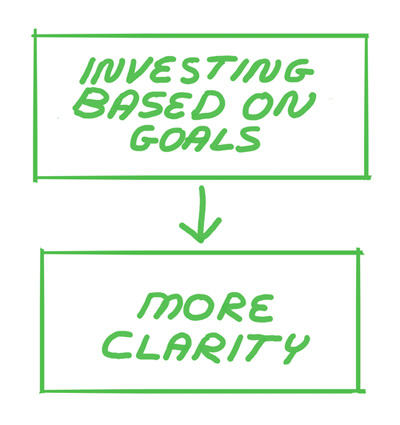 2. Think in Terms of Goals—One of the biggest advantages individual investors have is being able to invest based on personal goals. Your goal may be funding retirement. It might be paying for a child’s or grandchild’s college. Perhaps you want to leave a financial legacy to your heirs. Prioritizing your goals, estimating their costs and identifying their timing gives you a tremendous amount of clarity as to how you should invest. Shorter-term goals require emphasizing preservation of wealth by limiting exposure to volatile assets like stocks. Long-term goals require emphasizing growth of wealth by accepting higher levels of volatility to capture the higher returns offered by stocks. Our PRISM Wealth-Building Process provides a framework for aligning your investment decisions to your goals.
3. Process Matters More Than Returns—You have no control over whether your investments will rise or fall in price. What you can control is how much you save, how you allocate and what you to buy and sell. Establishing a systematic process for all three based on research about what has been shown to work over the long term will greatly increase the odds of achieving your goals. Focusing on and reacting to the headlines of the day will not. In investing, discipline—not forecasting abilities—is one of the biggest drivers of success.
4. History Is a Useful Guide—While history doesn’t fully repeat, it can often rhyme. There are usually enough similarities between now and what has happened in the past to draw useful analogies and guidelines. Having the ability to apply past lessons to the future can help you to control emotions, look past the noise, put downturns into perspective and even identify potential opportunities when they appear.
5. Ask Questions—This seemingly simple concept is a very powerful one. Asking questions can protect you against scammers, unravel “advisers” who don’t fully understand the products and services they are pushing and identify risks and potential pitfalls that may not be initially apparent. Asking questions will also increase your level of knowledge, helping you to become a better investor. A good rule of thumb to follow is that the less you understand the answer to your questions, the more tightly you should grip your wallet.

- So you do not have to scroll upward, here are the 11 key retirement dates you should pay attention to.
- When it comes to saving for retirement, younger workers benefit the most from seeking higher returns while older investors benefit more from increasing how much they save.
- Historically, small stocks have realized higher long-term returns than large-cap stocks. And right now, small-cap stocks are still cheap relative to large-cap stocks.
- John Bajkowski, Wayne Thorp, our new Stock Superstars Report editor Matt Markowski and I will discuss some of the stocks held in the AAII model portfolios and answer questions from AAII members in a live roundtable this Wednesday. Come join us.
- Adhering to well-defined buy and sell rules can help you achieve long-term portfolio success. In these next few lessons, the PRISM Academy provides guidelines based on popular investing styles. You can incorporate them directly into your strategy or modify them as necessary. Complete Lessons 7–9 and watch the PRISM Webinar Replay in Lesson 10.
“Which large-cap tech ETFs are on your radar and why? Do you think many large-cap ETFs are typically overvalued and overbought or do you think there is still opportunity?”
Click here and then choose the Join Community button on the right to answer this question or read other responses.
AAII Sentiment Survey
The results from the latest AAII Sentiment Survey show optimism about the short-term direction of the stock market falling back to an unusually low level. At the same time, pessimism rose back to an unusually high level.
Bullish sentiment, expectations that stock prices will rise over the next six months, decreased by 7.2 percentage points to 24.7%. The drop puts optimism at unusually low level (below 27.9%) for the 10th time out of the last 13 weeks. Bullish sentiment levels are also below the historical average of 38.0% for the 20th consecutive week.
Neutral sentiment, expectations that stock prices will stay essentially unchanged over the next six months, pulled back by 6.7 percentage points to 33.9%. Even with the decline, this is the third consecutive week that neutral sentiment is above its historical average of 31.5%. The decrease follows last week’s neutral sentiment reading that was the highest since the week of January 1, 2020.
Bearish sentiment, expectations that stock prices will fall over the next six months, jumped by 13.8% percentage points to 41.4%. The increase puts pessimism at an unusually high level (above 40.1%) for the ninth time out of the last 12 weeks. Bearish sentiment is also above its historical average of 30.5% for the 19th time out of the last 20 weeks.
Historically, the S&P 500 index has gone on to realize above-average and above-median returns during the six- and 12-month periods following unusually low readings for bullish sentiment and for the bull-bear spread. (This week’s bull-bear spread of –16.7% is unusually low too.) Unusually high bearish sentiment readings historically have also been followed by above-average and above-median six-month returns in the S&P 500.
In this week’s special question, we asked AAII members to share which factors are most influencing their six-month outlook on stocks.
Many respondents listed more than one factor in their responses. Topping the list is inflation, noted by one out of four respondents. Second was the Russia-Ukraine conflict, cited by 21% of all respondents. Around 15% say interest rates are influencing them. Roughly 9% of responses discuss politics, including the upcoming elections and current government administration. Supply chain issues and Federal Reserve decision-making are each named by 5% of respondents. Earnings as a factor is cited by 4%. Coronavirus-related concerns make up only 2% of responses and oil and gas price concerns contribute only 1%.
Here is a sampling of the responses:
- “The war in Ukraine and Russian sanctions are going to continue to cause disruptions in the supply chains of many industries and drive up the prices of many commodities, which will either squeeze profits or fuel even more inflation. Continuing inflation will lead to higher long-term and short-term interest rates additionally putting pressure on stock prices.”
- “High inflation along with the corresponding interest rate increases and inverted yield curve are the biggest headwinds against the market. The Russian-Ukrainian war doesn’t help. It will continue to keep energy resources tight.”
- “The uncertainties of the war in Ukraine and continuing supply shocks combine to cause more inflation and the inevitable demand destruction of rising interest rates.”
- “I think that inflation is increasing faster than anticipated. The Fed may have to get very aggressive with interest rate increases in an attempt to subdue inflation. I think this is very bearish for stocks overall.”
- “Higher interest rates and inflation will dampen economic performance, in spite of tight employment trends. I expect second-quarter earnings reports will show flat to declining profits due to higher production costs.”
- “Reasonable price-earnings (P/E) ratios, economy coming back from the pandemic, summer season, people want to get out and travel. I believe inflation will moderate.”
Bullish: 24.7%, down 7.2 points
Neutral: 33.9%, down 6.7 points
Bearish: 41.4%, up 13.8 points
Bullish: 38.0%
Neutral: 31.5%
Bearish: 30.5%
See more Sentiment Survey results.

AAII Asset Allocation Survey
Cash allocations grew in March while fixed-income and equity allocations both fell. Fixed-income allocations dropped to their lowest level in three and a half years.
Stock and stock fund allocations decreased by 0.1 percentage points to 68.4% in March. Equity exposure was last lower in February 2021 (67.7%). Despite this, last month was the 22nd consecutive month that AAII members’ exposure to equities was above the historical average of 61.0%.
Bond and bond fund allocations fell by 0.5 percentage points to 14.2%. Allocations were last lower in October 2018 (13.3%). Fixed-income exposure remains below its historical average of 16.0% for the 13th consecutive month.
Cash allocations increased by 0.7 percentage points to 17.4%. They were last higher in November 2020 (18.4%). March was the 23rd consecutive month that cash allocations have been below their historical average of 23.0%.
Though equity allocations pulled back, they remain near the upper end of the typical historical range. The breakpoint of typical and unusually high equity allocations is 69.0%.
Issues from February persisted throughout March, with continued issues in supply chains, inflation and interest rates. Plus, issues stemming from Russia’s invasion of Ukraine, such as higher oil prices and economic sanctions, are ongoing. The major stock indexes remain below their record highs.
Optimism among individual investors about the short-term direction of the stock market has recovered from last month’s lows but still remains below the historical average of 38.0%. Pessimism remained above its historical average for 18 consecutive weeks, before retracting below the historical average to 27.5% in the final week of the month. Neutral sentiment was the highest it has been since January 2020 at 40.6%, above both the historical average and upper end of the range.
- Stocks and Stock Funds: 68.4%, down 0.1 percentage points
- Bonds and Bond Funds: 14.2%, down 0.5 percentage points
- Cash: 17.4%, up 0.6 percentage points
- Stocks: 31.4%, up 0.7 percentage points
- Stocks Funds: 37.0%, down 0.8 percentage points
- Bonds: 2.5%, up 0.4 percentage points
- Bond Funds: 11.7%, down 0.9 percentage points
- Stocks/Stock Funds: 62.0%
- Bonds/Bond Funds: 16.0%
- Cash: 22.0%
Take the Asset Allocation Survey.
March 31, 2022 The Yield Curve Is Flattening, but Has Yet to Signal a Recession
March 24, 2022 Seeking a Truly Active Fund Is Not Enough
March 17, 2022 A Useful and Free Resource for Viewing Economic Trends
March 10, 2022 Key Considerations When Adding Commodities to Your Portfolio

Discussion
No comments have been added yet. Add your thoughts to the discussion!
You need to log in as a registered AAII user before commenting.
Create an account