

A Playbook for When the Stock and Bond Markets Are Down
by Charles Rotblut | May 12, 2022
There’s a simple measure I use to determine how volatile the stock market is: the number of days the S&P 500 index has closed up or down by at least 1% during the current calendar year.
Through yesterday’s close, there have already been 46 trading days this year with a daily gain or loss of at least 1% in the S&P 500. This compares to a calendar-year average of 53 days for the period of 2011 through 2021.
Looking at just 2% days is more telling. So far, there have been 15 days in 2022 when the S&P 500 has closed up or down by at least 2%. The last 11 full calendar years have averaged just 13 days with a change of at least 2%. Already, 2022 has the fourth-highest number of 2% days since 2011. The only calendar years with more 2% daily changes are 2011 (35), 2018 (16) and 2020 (44). 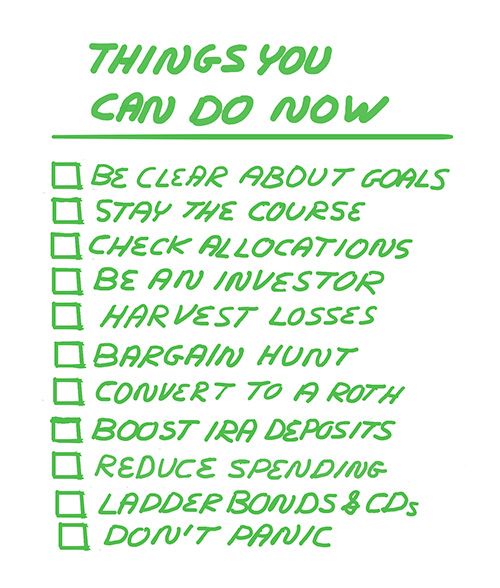
Volatility refers to the fluctuation in returns, not the direction. But the overall direction of stocks this year has been down. The S&P 500 is near the bottom of what counts as a correction. A further decline below 3,855 (down 20% from its previous record high) would put the index into bear market territory. Already, the Nasdaq composite and the Russell 2000 index are well into bear market territory (down 30% and 29%, respectively).
Given this, I’m going dust off the down market playbook I shared back in January. A few additions are included in this updated list. The ultrashort version is the timeless advice given in The Hitchhiker’s Guide to the Galaxy: “Don’t panic.”
What Can Investors Do Now?
Be clear about your investing goals. If you’re an investor, there is something you hope to do with the money you’re investing. It could be funding retirement, buying a house, leaving an inheritance or amassing a large amount of wealth. Whatever your goals are, there are estimated target dollar amounts, expected times for when they will be reached and durations over which you will spend on the goals. These things should govern your investment decisions—not what the market is doing on a short-term basis. Our PRISM-Wealth Building Process is based on this concept.
Stay the course. If you’ve set up your portfolio to reach your long-term goals, then continue to stick to your strategy. The risk of making a mistake by acting on what you think might happen is greater than the risk of what will actually happen.
Check your allocations. Down markets can cause your portfolio allocations to stray far off target. If they have, adjust your portfolio back to your targeted allocation. You can do this either through rebalancing, targeting certain asset classes/asset class categories for receiving new savings contributions or as sources to fund withdrawals, or a combination of the two.
Be an investor, not a speculator. Being an investor means thinking like a business owner. If there is a reasonable expectation that the prospects of the companies you hold shares of have not changed, then don’t sell just because the price has declined. The exceptions to this statement would be the specific and prior use of price in your strategy, meaning technical analysis and predefined stops.
Harvest losses for tax purposes. While we don’t think you should sell a stock if its long-term fundamental outlook hasn’t changed, there can be an opportunity to “sin a little” for tax purposes. This would involve realizing a capital loss by selling a stock or other investment [mutual fund, exchange-traded fund (ETF), etc.]. In doing so, be sure to wait more than 30 days before repurchasing it or buying a substantially identical investment to avoid violating the wash-sale rule.
Go bargain hunting. A lack of optimism among other investors creates an opportunity for you to open your wallet. If the business is sound and you don’t have any reason to believe that its longer-term prospects have changed, you may be able to pick up some bargains.
An alternative suggested by Lauren Templeton of Lauren Templeton Capital Management is to place limit orders to buy stocks at significant discounts to their intrinsic value (based on discounted cash flow or valuation multiples). If the price falls to your target, the order is executed. As a safeguard, she advises looking for companies with little to no debt. She said her great uncle, Sir John Templeton, used this strategy throughout his career.
Consider doing a Roth IRA conversion while prices are down. The IRS only cares about the dollar amount converted from a traditional IRA, a 401(k) or similar type of tax-deferred account to a Roth IRA, not the number of shares converted. So, when prices are down—as they are now—you can move more shares over to a Roth IRA for the same tax impact.
Accelerate the timing of IRA contributions. While I’m a big proponent of dollar-cost averaging, downturns are an opportune time to be a bit tactical. Downturns give you the opportunity to buy more shares for the same dollar amounts you would have contributed anyway. By accelerating, you’re simply shifting the timing of those contributions to take advantage of the cheaper prices.
If retired, reduce your spending. Retirees can boost the odds of not outliving their savings by reducing spending to the extent possible during down markets. Doing so reduces the amount you need to withdraw from your portfolio. Floors (minimum spending amounts) and ceilings (maximum spending amounts) help to make fluctuations in spending more tolerable.
Ladder bonds and CDs. If it’s rising interest rates that have you concerned, consider diversifying the duration of your cash and bond allocations. Buying bonds, defined maturity bond funds and certificates of deposit (CDs) of varying maturities allows you to pivot to future rate environments without relying on potentially incorrect forecasts. As your shorter-term investments mature, you’ll be able to reinvest the proceeds at the then-prevailing yields while still having exposure to the current longer-term rates. Though the monetary policy is being tightened now, it will likely be loosened whenever the next recession occurs. (The Treasury’s Series I bonds are another option for those worried about interest rates. We discuss them in next month’s AAII Journal.)
Turn off the TV, stop visiting financial news websites and just breathe. If your investment horizon is not one week, one month or one year, then there is no advantage to watching the market on a minute-by-minute or day-by-day basis. Paying constant attention to the market can cause you to become more nervous. As long as your cash flow needs are covered—salary if working; pension, Social Security benefits, portfolio income and/or two to four years of cash savings if retired—there is no need to react to the market’s short-term moves. Rather, find something more calming to engage in. Even spending a few minutes simply focused on your breathing can help.

- Not only is downside volatility normal, it can also provide opportunities. Those who bought stocks whenever the market dropped by a multiple of 7% would have looked like terrific market timers, according to Sam Stovall.
- The concept of a floor and ceiling approach to spending in retirement is discussed by Wade Pfau in the current issue of the AAII Journal.
- If the current downturn has you bargain-hunting for environmental, social and governance (ESG) investments, realize that the world is not simply green and brown as assistant editor Anine Sus explains in her My Investing Discoveries blog.
- Our new Stock Superstars Report editor Matt Markowski will talk about combining value and growth strategies into a single portfolio in a live webinar open to all on Monday afternoon.
- In Lesson 3 of Step M in the PRISM Academy, we will be going over how to effectively monitor your progress regarding your overall savings. The goal for Lesson 3 is to determine if you have enough saved relative to what you should have saved according to your goals. Complete Lesson 3 today!
Participate
Members are looking for your input. Can you help with this question from the Mutual Funds & ETFs Community?
“ What is your perspective on the impacts of war and inflation on first-quarter mutual fund and exchange-traded fund (ETF) returns? How have they impacted your portfolio? ”
Tap the button and then choose the Join the Community button on the right to answer this question in the AAII Community.

AAII Sentiment Survey
The results from the latest AAII Sentiment Survey show neutral sentiment rebounding from last week’s 18-month low. In addition, optimism continues to be unusually low and pessimism continues to be unusually high.
Bullish sentiment, expectations that stock prices will rise over the next six months, decreased by 2.5 percentage points to 24.3%. The decline keeps optimism below its historical average of 38.0% for the 25th consecutive week. Bullish sentiment also remains at an unusually low level for the 15th time out of the last 18 weeks.
Neutral sentiment, expectations that stock prices will stay essentially unchanged over the next six months, increased by 6.4 percentage points to 26.6%. The rise puts neutral sentiment back within its typical historical range but was not enough to put it above the historical average of 31.5%.
Bearish sentiment, expectations that stock prices will fall over the next six months, decreased by 3.8 percentage points to 49.0%. This is the 24th time out of the last 25 weeks that pessimism is above its historical average of 30.5%. It is also the 14th time out of the last 17 weeks that bearish sentiment is at an unusually high level.
At current levels, bullish sentiment and the bull-bear spread (bullish minus bearish sentiment) are all unusually low. Meanwhile, bearish sentiment is unusually high.
Historically, the S&P 500 index has gone on to realize above-average and above-median returns during the six- and 12-month periods following unusually low readings for bullish sentiment and for the bull-bear spread. Unusually high bearish sentiment readings historically have also been followed by above-average and above-median six-month returns in the S&P 500.
In addition to the downward volatility in the stock market, the ongoing invasion of Ukraine by Russia, stock market volatility, inflation, interest rates, the coronavirus pandemic and politics are all influencing individual investors’ outlook for stocks. Other factors include the economy and corporate earnings.
In this week’s special question, we asked AAII members to share their thoughts on how the Federal Reserve’s 50-basis-point interest rate hike and the likelihood of further rate hikes are impacting their sentiment toward stocks.
One out of three respondents (33%) express a bearish outlook. They believe the Fed waited too long to raise interest rates to curb inflation. Furthermore, many respondents in this group believe the rate hikes will lead to a recession. Conversely, 24% of respondents say that they are bullish and the rate hikes will create buying opportunities in the stock market. Around a quarter of respondents either took a neutral stance or express no change in their sentiment due to the news. Additionally, 11% of respondents have a mixed outlook, noting both the positives and negatives of rate hikes.
Here is a sampling of the responses:
- “The rate hikes are for the wrong reasons. They don’t correct supply chain problems or price monopolies. Along with the credit tightening, price hikes will likely create a recession and a sharp market drop.”
- “No change, I’m bullish on equities (especially since they are currently on sale).”
- “Has no impact.”
- “Necessary to blunt inflation but painful wealth destruction is well underway.”
- “Neutral to slightly negative. The change reflects reality but there is too much uncertainty in the economy for the rate change to help.”
Bullish: 24.3%, down 2.5 points
Neutral: 26.6%, up 6.4 points
Bearish: 49.0%, down 3.8 points
Bullish: 38.0%
Neutral: 31.5%
Bearish: 30.5%
See more Sentiment Survey results.

May 5, 2022 Don't Abandon Diversification Because of This Year's Rough Patch
April 28, 2022 Remembering Geraldine Weiss and Her Winning Dividend Strategy
April 21, 2022 A Costly Example of Why Asset Location Matters
April 14, 2022 Don't Let Fear Cause You to Miss the Best Days in the Stock Market

Discussion
R. Fere from CA posted over 4 years ago:
I just have to say that your recommendations are spot on. Specifically 2 standout as far as actual investing: 1) Staying the course if you feel the stocks, ETFs, mutual funds, bonds, and CEF solid. 2) Bargain hunt - as always, certain stocks get oversold in a market like this. Now is the time to start taking advantage of them. If you trade on your own and do not incur fees for trading a strategy is to buy much smaller quantities as the market goes down. Last, take a look at many beaten down preferred shares. Many are trading well below par value. In 2009 I took advantage of the same situation when some preferred when as low as $6 a share. My only mistake was selling those share before they hit par value (and all the ones I had bought did eventually). I ended up selling them at around $18 to $20 per share.
R. Fere from CA posted over 4 years ago:
I just have to say that your recommendations are spot on. Specifically 2 standout as far as actual investing: 1) Staying the course if you feel the stocks, ETFs, mutual funds, bonds, and CEF solid. 2) Bargain hunt - as always, certain stocks get oversold in a market like this. Now is the time to start taking advantage of them. If you trade on your own and do not incur fees for trading a strategy is to buy much smaller quantities as the market goes down. Last, take a look at many beaten down preferred shares. Many are trading well below par value. In 2009 I took advantage of the same situation when some preferred when as low as $6 a share. My only mistake was selling those share before they hit par value (and all the ones I had bought did eventually). I ended up selling them at around $18 to $20 per share.
George from Florida posted over 4 years ago:
The list is a good one and should be followed to stay sane in this crazy market. The one that few investors take advantage of is "tax harvesting" where you sell stocks, mutual funds or ETF's when they are way down from what you paid and buy something similar (but not the same). This keeps your portfolio in balance but allows you to get a bit of an edge on taxes. This strategy can pay off "big time" at tax time. However, the timing is critical and none of us is really very good at timing, so one has to be careful not to buy the same fund (like an ETF after selling a mutual fund) when the fund or ETF is essentially the same composition. If you violate the Wash Rule, then all you hard work is lost. Try it and you might like it.
Barry from TX posted over 4 years ago:
#1 Check. #2 Check. #3 Check. #4 Check. #5 Check. #6 Check. #7 Check. #8 Check. #9 Check. #10 Check. #11 Check. Three bags full, Sir. But can't I at least be grumpy about it? This checklist reminds me of a story we tell in Texas about when someone saying they are helping you. If you are drowning 20 feet from the shore in a tank on the ranch and a stranger comes along and throws you an 11 foot rope, you are still gonna drown. At your service, the stranger will tell all your friends they tried to help you. Your wife will tell everyone you were a damn fool for falling into the tank in the first place. But we don't call that help ... in Texas anyway.
John L from NJ posted over 4 years ago:
The first four items should be done before investing and not revised when the market is down. The rest are just bottom fishing tactics. And bottom fishing is really tough as no one knows the bottom until it has passed and the market could easily drop further making today's opportunity; tomorrows regret. The market isn't crazy. What is insane is all the speculators that want to time the market without having any special knowledge other than it is down a lot.
You need to log in as a registered AAII user before commenting.
Create an account