

Suggestions for Customizing the 60/40 Portfolio (and Other Allocations)
by Charles Rotblut | May 26, 2022
The 60/40 allocation has historically proven to be a good overall allocation for many investors. It has generally cushioned some of the blow from large drops in stock prices.
A traditional 60/40 portfolio comprises 60% large-cap stocks and 40% investment-grade bonds. Though this approach holds two historically uncorrelated asset classes, there are ways to diversify it further. In this week’s Investor Update, I offer suggestions for how you can customize it—or any other allocation mix of stocks and bonds. In other words, the suggestions here can be applied to various allocation mixes of stocks and bonds (or stocks and so-called safe assets).
Customizing the Equity Side of a 60/40 Portfolio
Diversify the Equity Categories—The moderate AAII Asset Allocation Model, which uses a 60/40 mix, diversifies away from solely holding large-cap stocks. Rather, it holds a mix of large-cap, mid-cap and small-cap domestic stocks as well as international developed and emerging market stocks. This diversifies the equity across both size and country. (Our aggressive and conservative allocation models also diversify across asset class categories.) 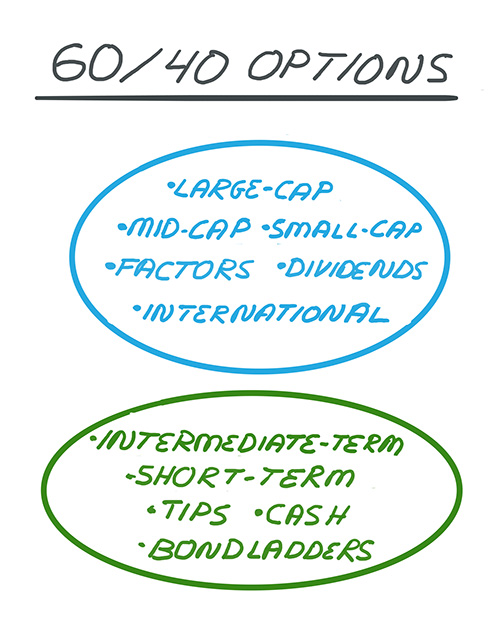
Use Factors—The 60% portion can also be adjusted by using factors. This would involve incorporating value, momentum, size and/or quality factors. Rather than holding a traditional S&P 500 index fund, you would hold, say, a value-oriented fund or use a value-oriented approach to selecting stocks. You could also tilt your portfolio toward a certain factor by mixing a traditional index fund with a factor-based approach.
Boost the Yield—If realizing a higher level of portfolio income matters, dividend stocks can be emphasized. Likewise, real estate investment trusts (REITs) or master limited partnerships (MLPs) could be utilized. This would maintain the equity allocation at the desired level while supplementing the portfolio income generated by the fixed-income side.
Customizing the Bond Side of a 60/40 Portfolio
Change the Maturities—The moderate and conservative AAII Asset Allocation Models allocate to both short-term and intermediate-term bonds. Doing so results in less interest rate sensitivity than a traditional 60/40 approach, which typically borders between intermediate-term and long-term bonds.
Get Some Inflation Protection—Those concerned about inflation can opt for Treasury inflation-protected securities (TIPS). The principal of TIPS changes with inflation. It rises when the consumer price index (CPI) increases and falls when the CPI decreases. The Treasury’s Series I bonds also adjust to inflation, but the $10,000 limit on purchases (per person, per year) makes it difficult for investors with significant savings to have a meaningful allocation to them.
Build a Bond Ladder—A bond ladder involves holding bonds with different maturities. This helps to offset the timing risk of interest rates. In rising interest environments, it also can provide you with proceeds to reinvest at higher rates. Defined-maturity bond funds can be used instead of individual bonds.
Allocate to Cash—You won’t earn much interest income, but cash provides liquidity and does not lose value on a nominal basis. (It does lose value on a real, meaning inflation-adjusted, basis.) Allocating some of the 40% portion to cash can be particularly useful to retirees as a buffer asset to tap when other asset classes are down.

- A four-asset class allocation model incorporating both TIPS and commodities was discussed as an alternative to a traditional 60/40 portfolio in this 2015 AAII Journal article.
- Values-based investors can seek out companies or exchange-traded funds (ETFs) with favorable environmental, social and governance (ESG) ratings to populate their allocation mix. Just realize that ESG ratings vary significantly by provider.
- AAII makes it easy to identify if a mutual fund or ETF is classified as having an ESG or socially responsible investing (SRI) focus. Senior financial analyst Wayne Thorp explains how.
- In her latest My Investing Discoveries blog post, assistant editor Anine Sus discusses how she is strategically and responsibly using a cash-back credit card.
- In Lesson 5 of Step M in the PRISM Academy, we show you how life stage changes can potentially alter your goals and/or tolerance for risk and how to be prepared for when they occur so you can adjust and monitor your portfolio accordingly. Complete Lesson 5 today!
Participate
Members are looking for your input. Can you help with this question from the Mutual Funds & ETFs Community?
“What screening criteria are you currently using to find quality exchange-traded funds (ETFs) to invest in to provide portfolio padding against market volatility? Have you found a strategy that works for you?”
Tap the button and then choose the Join the Community button on the right to answer this question in the AAII Community.
AAII Sentiment Survey
Optimism about the short-term direction of the stock market is below 20% for the fourth time in seven weeks according to the latest AAII Sentiment Survey. Pessimism, meanwhile, is above 50% for the fourth time in five weeks.
Bullish sentiment, expectations that stock prices will rise over the next six months, pulled back by 6.1 percentage points to 19.8%. The decline keeps optimism below its historical average of 38.0% for the 27th consecutive week and at an unusually low level for the 17th time out of the last 20 weeks.
Neutral sentiment, expectations that stock prices will stay essentially unchanged over the next six months, rebounded by 3.0 percentage points to 26.7%. Even with the increase, neutral sentiment levels are below the historical average of 31.5% for the fifth consecutive week.
Bearish sentiment, expectations that stock prices will fall over the next six months, rose 3.1 percentage points to 53.5%. This is the 26th time out of the past 27 weeks that pessimism is above its historical average of 30.5% and the 16th time out of the last 19 weeks that bearish sentiment is unusually high.
As noted above, bullish sentiment remains unusually low while bearish sentiment continues to be unusually high. The bull-bear spread (bullish minus bearish sentiment) is also unusually low.
Historically, the S&P 500 index has gone on to realize above-average and above-median returns during the six- and 12-month periods following unusually low readings for bullish sentiment and for the bull-bear spread. Unusually high bearish sentiment readings historically have also been followed by above-average and above-median six-month returns in the S&P 500.
Besides the downward volatility in the stock market, the ongoing invasion of Ukraine by Russia, stock market volatility, inflation, interest rates, the coronavirus pandemic and politics are all influencing individual investors’ outlook for stocks. Other factors include the economy and corporate earnings.
Bullish: 19.8%, down 6.1 points
Neutral: 26.7%, up 3.0 points
Bearish: 53.5%, up 3.1 points
Bullish: 38.0%
Neutral: 31.5%
Bearish: 30.5%
See more Sentiment Survey results.

May 19, 2022 Guidelines for Contrarian Investors Going Bargain Hunting
May 12, 2022 A Playbook for When the Stock and Bond Markets Are Down
May 5, 2022 Don't Abandon Diversification Because of This Year's Rough Patch
April 28, 2022 Remembering Geraldine Weiss and Her Winning Dividend Strategy

Discussion
No comments have been added yet. Add your thoughts to the discussion!
You need to log in as a registered AAII user before commenting.
Create an account