

Remembering Daniel Kahneman
by Charles Rotblut | March 28, 2024
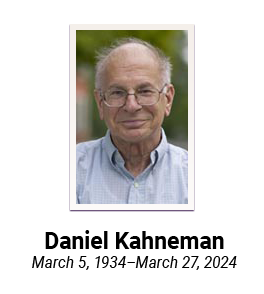
Nobel laureate Daniel Kahneman died yesterday. He was 90 years old.
Kahneman and his longtime research partner and friend Amos Tversky were groundbreakers in identifying how human judgment impacts decision-making. Their work laid the path for the modern era of behavioral finance.
Both had a big impact on how I think about investing. Though Tversky died before I became familiar with him, I was fortunate to have sat down and talked with Kahneman twice. Both times, I walked away a bit smarter.
Kahneman was also a Holocaust survivor. Like my mother, he lived in sourthern France as a hidden Jewish child during the Nazi occupation.
There isn’t enough room for me to even scratch the surface of all Kahneman and Tversky’s research. If I were asked to pick a starting point, I’d choose two.
The first is prospect theory. In a study published in the March 1979 issue of Econometrica (“Prospect Theory: An Analysis of Decision Under Risk”), Kahneman and Tversky concluded that people put more weight on losses than on gains when making decisions. The chart shown here plots this.
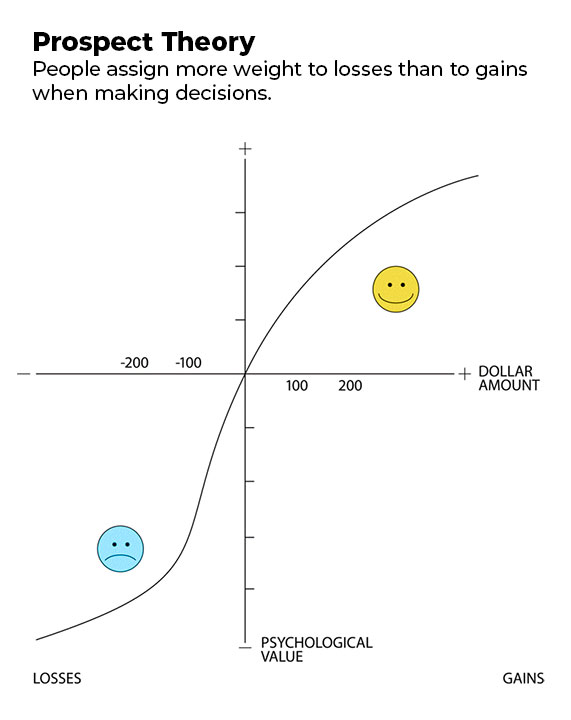
“Losses matter more than gains,” explained Kahneman to me in 2018 in response to a question I asked regarding prospect theory and loss aversion. (Loss aversion holds that people would rather avoid a loss than realize a gain.) “If I gave you a choice of losing $800 and an 80% chance of losing $1,000, most people would take the gamble. That’s because losing $800 for sure is very aversive … but if I’m facing a 50% chance to lose $100 and a 50% chance to gain $150, then the loss of $100 weighs more than the gain of $150.”
The other starting point I’d go with is System 1 and System 2 thinking. Here’s how Kahneman described the concept in 2012: “System 1 is intuitive thinking, which is most of what we do, I think. And System 2 is self-critical, reflective, deliberate thinking. And we feel we do a lot of that. But, in fact, much of what System 2 does is explain and rationalize and apologize for the choices and beliefs of System 1.”
We spend most of our day using System 1. An example I like to use is driving a car. We do not think through all the steps required to go from unlocking the car door to turning right at a red light. We just do those things automatically, which is System 1 thinking. When we are forced to think through a challenge, we are using System 2. System 2 requires a lot of energy, so our brain prefers System 1. Often, we think we’re using System 2 when, in actuality, our brain is just tapping System 2 to justify the System 1 decisions.
Later in his life, Kahneman turned his research efforts to the concept of noise. Noise is something that interferes with the decision-making process, particularly irrelevant factors. Noise can range from the weather to the order that information is presented in. It is anything that shouldn’t impact your decision-making process but still does. Systematic processes such as using algorithms and checklists reduce the impact of noise. (Kahneman described himself as being “a great fan of checklists.”)
For those who want to dig more into Kahneman and Tversky’s research, “The Undoing Project” by Michael Lewis (W.W. Norton & Co., 2016) is a great place to start. It tells the story of both men and provides a version of their research in lay terms. Kahneman’s “Thinking, Fast and Slow” (Farrar, Straus and Giroux, 2011) goes into more detail.

-
Behavioral Errors Hurt Your Returns
In a 2012 AAII interview with Daniel Kahneman, he discussed the dangers of buying and selling too often, picking the wrong securities to trade and being overconfident. -
Kahneman on Decision-Making, and Other Morningstar Conference Notes
Charles Rotblut shared his takeaways from hearing Kahneman speak at the 2018 Morningstar Conference when the Nobel laureate was involved in new research on decision-making. -
The Power of Holding Some Cash in a Portfolio
Read about how an allocation to cash can make sense in many portfolios both to reduce risk and, for retirees, to facilitate increased risk in the March 2024 AAII Journal feature article. -
Navigating Finances After Widowhood or Divorce
In honor of Women’s History Month, Anine Sus looks at how women can get their footing financially after a major change in life circumstances in her My Investing Discoveries blog.
AAII Sentiment Survey
Optimism among individual investors about the short-term outlook for stocks significantly increased in the latest AAII Sentiment Survey. Meanwhile, both pessimism and neutral sentiment decreased.
Bullish sentiment, expectations that stock prices will rise over the next six months, increased 6.8 percentage points to 50.0%. Bullish sentiment is unusually high and is above its historical average of 37.5% for the 21st consecutive week.
Neutral sentiment, expectations that stock prices will stay essentially unchanged over the next six months, decreased 2.1 percentage points to 27.6%. Neutral sentiment is below its historical average of 31.5% for the seventh time in nine weeks.
Bearish sentiment, expectations that stock prices will fall over the next six months, decreased 4.7 percentage points to 22.4%. Bearish sentiment is below its historical average of 31.0% for the 21st consecutive week.
The bull-bear spread (bullish minus bearish sentiment) increased 11.5 percentage points to 27.6%. The bull-bear spread is above its historical average of 6.5% for the 21st consecutive week.
This week’s special question asked AAII members how they would describe the current state of the economy.
Here is how they responded:
- Great: 9.0%
- Good: 43.6%
- Mixed: 38.8%
- Lousy: 8.0%
- Not sure/no opinion: 0.7%
Bullish: 50.0%, up 6.8 points
Neutral: 27.6%, down 2.1 points
Bearish: 22.4%, down 4.7 points
Bullish: 37.5%
Neutral: 31.5%
Bearish: 31.0%
See more Sentiment Survey results.

March 21, 2024 March Charts of Interest: The Equal-Weight S&P 500's Unusual Underperformance
March 14, 2024 A Luncheon With Cathie Wood of ARK Invest
March 7, 2024 Dividend Stocks Yielding 10% or More
February 29, 2024 Warren Buffett on Why You Shouldn't Trust Forecasts

Discussion
Barry from TX posted over 2 years ago:
Charles, thank you for your heartfelt tribute. Dan was a giant. Despite his recognition with a Nobel Prize (2001) and leading the creation of Behavioral Finance with Dick Thaler (1979), Kahneman’s research had only a superficial impact on the “professional” finance industry. #1 For example, the Prospect Theory graph in this article clearly shows that the relationship between loss aversion and the desire for gains is a sigmoidal “sine curve” that is concave for losses and convex for gains, not a linear (straight-line) function. Despite this information being widely available for 45 years (since 1979), EVERY brokerage firm still measures risk tolerance on a highly simplified 5-7 point linear scale as part of the “onboarding” process. Why do they do this way? This simplification of a complex psychological concept allows them to pigeonhole ALL 100 million individual investors into 5-7 categories of risk tolerance – from conservative to aggressive (with some “very’s” thrown in to “simulate” changes in overall gradient). This permits them to package investors in one of a few vast tranches so they can offer them a “tailored” portfolio that meets their “customized” investing needs. Then in a matter of seconds, a simple mean-variance optimizer (MVO) calculates a “customized risk-adjusted” portfolio that includes mostly the product offerings of the broker/vendor, many of which carry higher expense ratios and other hidden fees. Would it be too costly for “professionally trained” financial advisors to make this inelegant system more democratic? Not at all. A survey with less than 10 questions would provide enough factors (90 data points) to discriminate more granularly across such large samples. Because everyone uses the same system, it keeps broker training to an entry-level understanding of revolutionary Kahneman’s insights. #2 These rudimentary understandings of PT and BECON do not stop the finance industry pundits from writing hundreds of articles on the risks in “behavioral finance.” Again, they stoop to the use of formulaic approaches to demonstrate their knowledge of very complex psychological concepts. Every article mostly lists 5 to 10 (selected) biases they can warn against you “having” and then spew motherly bromides on how to avoid them. As if. #3 The finance industry took approximately this same approach to every innovation since (the also recently deceased) Harry Markowitz invented Modern Portfolio Theory in 1952. The finance industry did not take notice (actually ignored and fought) of MPT concepts until the late 1960’s when they realized how CAPM could help them price options – and all types of risk – to their advantage. William Sharpe’s CAPM model (1968) provides a methodology for quantifying risk and translating that risk into estimates of expected return on equity. #4 The finance industry has always been, and always will be, all about money – your money – a how to get it so they can make egregious profits. In the 1980s book, a broker was asked how he decides how much money to charge his clients, and he said, we throw all the money up in the air and everything that sticks to the ceiling belongs to the customers. Nothing has changed. The wheels go around and around but the scenery never changes.
Rob from NC posted over 2 years ago:
Thank you for this, Charles. It seems that there are too few people left who remember or even have a conscious historical awareness of the holocaust. In the crazy modern politics of this country and the UN, I sure hope we aren't going to see a repeat. Kahneman's research is valuable in helping us understand why we do the things we do. And understanding why we do the things we do is a good first step in learning how to do them better---or at least how not to do them worse.
Barry from TX posted over 2 years ago:
Jason Zweig wrote a tribute to DK in the WSJ today 3/29/24 entitled "The Psychologist Who Turned the Investing World on Its Head." Here is a Gift Link if yo want to read it -- https://www.wsj.com/finance/investing/daniel-kahneman-behavioral-economics-270c9797?st=p6qfsso95pyaqjm&reflink=desktopwebshare_permalink
Rob from NC posted over 2 years ago:
Thank you for the link, Barry. I love that quote at the end: "All of us would be better investors if we just made fewer decisions."
You need to log in as a registered AAII user before commenting.
Create an account