

Why Large-Cap Super Micro Computer Is Still in the Small-Cap Russell 2000 Index
by Charles Rotblut | April 11, 2024
Featured Tickers: CVNA
MSTR
SMCI
CVNA
MSTR
SMCI
Super Micro Computer Inc.’s  (SMCI) market capitalization of $52.9 billion ranks in the 96th percentile of all U.S.-listed companies. Given this market cap, it is not surprising to see that this stock is a member of the large-cap S&P 500 index.
What may surprise you is that Super Micro Computer is also part of the small-cap Russell 2000 index.
As of March 31, 2024, all 10 of the Russell 2000’s biggest companies have market caps ranking in the largest 16% of exchange-listed stocks. Two others besides Super Micro Computer rank in the top 10%. MicroStrategy Inc. (MSTR) has a market cap of $24.5 billion (93rd percentile) and Carvana Co. (CVNA) has a market cap of $16.9 billion (90th percentile). Seven of the Russell 2000’s 10 largest stocks are either in the S&P 500 or the S&P MidCap 400 index.
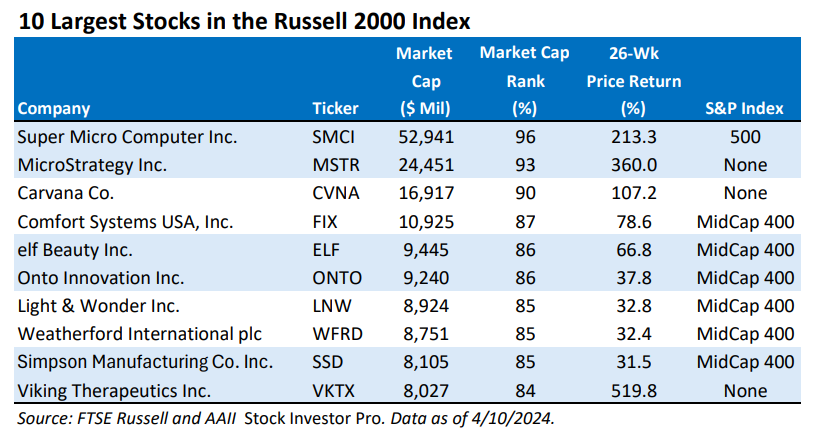
The paradox of these companies both being large in size and part of the Russell 2000 is a result of how the index is constructed and maintained. Even a small understanding of index construction will help you better select exchange-traded funds (ETFs), mutual funds and stocks for your portfolio.
The Russell 2000 tracks approximately the 2,000 smallest companies within the broader Russell 3000 index. The Russell 1000 index tracks the 1,000 largest U.S. companies. Both indexes—as well as the Russell 3000 (which includes both the 1000 and 2000 indexes)—are reconstituted annually. The reconstitution process completely rebuilds these Russell indexes.
Hence, when a company soars in value because of its ties to artificial intelligence (AI) or bitcoin—Super Micro Computer and MicroStrategy, respectively—no midyear adjustments are made to the indexes. While this does eventually lead to some style drift (a large-cap stock in a small-cap index), what we are seeing now is unusual. Super Micro Computer’s approximate 2% weighting in the Russell 2000 “is by far the biggest single-stock weight ever in the index” Jefferies Financial equity analyst Steven DeSanctis told The Wall Street Journal last week.
Barring big shifts in the 10 stocks’ market caps, they are expected to be moved up to the Russell 1000 this summer. The three Russell indexes’ reconstitution process will be finalized after the close of trading on June 28. Preliminary additions and deletions will be announced in the evening on May 24.
Changes to the S&P 500, the S&P MidCap 400 and the S&P SmallCap 600 index are “made on an as-needed basis” instead of on a recurring annual basis. Furthermore, the three S&P indexes are never reconstituted like the Russell indexes are. Rather, changes involving a very small number of companies are announced sporadically.
These differences in the timing of when stocks are added and removed explain why Super Micro Computer can be in both the S&P 500 and Russell 2000.
As to which indexes are better is a matter of opinion. The Russell 1000 and 2000 cover a broader number of stocks than the S&P 500, MidCap 400 and SmallCap 600 do. The S&P indexes account for considerations such as sector diversification, whereas the Russell indexes are more purely quantitative (and thereby more passive). The S&P indexes can be less prone to style drift with their ability to move companies between indexes or remove them completely at any point.
Perhaps the biggest deciding factor may be your desire to go large and small. The S&P 500 limits itself to larger companies than the Russell 1000 does. The Russell 2000 holds smaller companies than the S&P SmallCap 400.

-
Index Fund Options for AAII’s Asset Allocation Models
While we use Vanguard funds for tracking purposes, they are not the only option when using the allocation models as a guideline for your own portfolio. -
AAII’s Tax Guide
Those who waited until the last minute to file their taxes will want to keep our investor guide handy as a reference to 2023 tax changes. Others can still use the guide to plan for ways to reduce their tax liability in 2024 and beyond. -
Tempering the Risks of Market-Cap Weighting
Genuine diversification across the various segments of the U.S. equity market is a prudent investment philosophy, as described in the April AAII Journal. -
Financial Goals to Accomplish by Age 30
In her latest My Investing Discoveries blog post, Anine Sus grades herself on the most common financial goals people should achieve by the time they turn 30.
AAII Sentiment Survey
Optimism among individual investors about the short-term outlook for stocks decreased in the latest AAII Sentiment Survey. Meanwhile, neutral sentiment and pessimism increased.
Bullish sentiment, expectations that stock prices will rise over the next six months, decreased 3.8 percentage points to 43.4%. Bullish sentiment is above its historical average of 37.5% for the 23rd consecutive week.
Neutral sentiment, expectations that stock prices will stay essentially unchanged over the next six months, increased 2.0 percentage points to 32.5%. This puts neutral sentiment above its historical average of 31.5%.
Bearish sentiment, expectations that stock prices will fall over the next six months, increased 1.8 percentage points to 24.0%. Bearish sentiment is below its historical average of 31.0% for the 23rd consecutive week.
The bull-bear spread (bullish minus bearish sentiment) decreased 5.7 percentage points to 19.4%. The bull-bear spread is above its historical average of 6.5% for the 23rd consecutive week.
This week’s special question asked AAII members what impact the S&P 500 index’s 10.2% rise in the first quarter of 2024 had on them.
Here is how they responded:
- Made me greatly optimistic: 7.2%
- Made me somewhat optimistic: 39.9%
- No impact: 19.6%
- Made me somewhat pessimistic: 28.0%
- Made me greatly pessimistic: 4.7%
Bullish: 43.4%, down 3.8 points
Neutral: 32.5%, up 2.0 points
Bearish: 24.0%, up 1.8 points
Bullish: 37.5%
Neutral: 31.5%
Bearish: 31.0%
See more Sentiment Survey results.

April 4, 2024 Five Retirement Challenges and Solutions for Them
March 28, 2024 Remembering Daniel Kahneman
March 21, 2024 March Charts of Interest: The Equal-Weight S&P 500's Unusual Underperformance
March 14, 2024 A Luncheon With Cathie Wood of ARK Invest

Discussion
Steve from IN posted over 2 years ago:
Thanks for the info on the indexes. For some reason it never dawned on me that the 3000 index was just the 1000 and 2000 lumped into one bigger batch. It's always interesting to see a couple of smaller stock make some big moves when the changes are announced around the end of May.
Barry from Texas posted over 2 years ago:
Charles, This article is timely for me. Since mid-October 2024, as part of my annual portfolio “rebalancing” process, I have been creating an all-ETF portfolio that tries to capture a blend of key market anomalies/factors: size (market caps), value, and growth that seem to align with the 2024 market environment. This led me to investigate the impacts of market index construction on the selection of market benchmarks and thus on portfolio construction. So far, It appears that the creation of market index benchmarks is a growing business with several hundred to choose from ... and that many funds generate proprietary benchmarks and then compare their fund performance to these “black boxes.” This seems to be an attempt to “game” fund performance statistics. Any additional information on these topics would be appreciated.
You need to log in as a registered AAII user before commenting.
Create an account