

Five Retirement Challenges and Solutions for Them
by Charles Rotblut | April 04, 2024
Featured Tickers: BLK
BLK
“Time to rethink retirement” was the title of Larry Fink’s annual letter. The chairman of investment firm BlackRock Inc.  (BLK) characterized retirement as “a much harder proposition than it was 30 years ago.” He then added, “it’ll be a much harder proposition 30 years from now.”
I’m going to address some of the challenges Fink brought up as I think they are worth paying attention to—regardless of what your opinion of his stance on environmental, social and governance (ESG) is. Fink, for his part, admitted to “[not having] all the answers” regarding retirement.
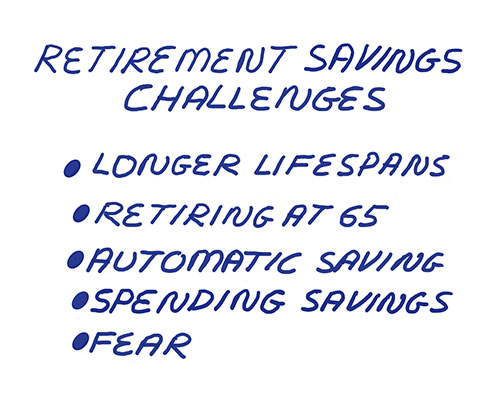
People Are Living Longer: Thanks to advancements in medicine and other changes (e.g., safer cars), life-spans have increased. Longer life-spans increase longevity risk—the chance of outliving your savings—because you will spend more money the longer you live. Saving more during your working years, delaying claiming Social Security benefits, earning income in retirement (e.g., a part-time or consulting job), annuities and being flexible with your withdrawal rates in retirement all help. Exercise and a healthy diet may help lower your medical bills.
Raising the Retirement Age: “I do think it’s a bit crazy that our anchor idea for the right retirement age—65 years old—originates from the time of the Ottoman Empire,” wrote Fink. Among the proposed solutions I’ve seen for solving Social Security’s funding problem is raising the eligibility age. The full retirement age for claiming benefits was last raised in 1983. Working past age 65 not only helps people from a financial standpoint but also a cognitive standpoint. Those who do retire at 65 can still slow cognitive decline by volunteering and engaging in other activities that involve social and thinking skills.
Make Investing (Almost) Automatic: Fink’s letter shows the word “almost” in parentheses. He called for expanded use of automatic employee enrollment into retirement savings plans. While this was a bit self-serving considering BlackRock’s business, he was also right to say so. We humans frequently go with the default option. When the default option is to have dollars automatically taken out of paychecks and set aside for savings, we tend to not change it. This is why automatic enrollment is a good thing. You can have dollars from your paycheck automatically deposited into individual retirement accounts (IRAs) or Roth IRAs regardless of whether your employer automates contributions to their retirement plan. All that is required is taking a few minutes to set it up. If retired, you can automate your required minimum distributions (RMDs) so you never forget to take them.
Spending Savings in Retirement: I doubt the average retiree has heard of the term “safe withdrawal rates.” If they try to do an online search for it, they’ll step into a world where there is a lot of disagreement. We’ve run a lot of articles on the subject over the years, including the well-cited “Retirement Savings: Choosing a Withdrawal Rate That Is Sustainable” that was published in the February 1998 AAII Journal.
There are three guidelines to spending money in retirement that have held true. The first is that a starting withdrawal rate equal to 5% or more of your savings invokes an increasingly high level of longevity risk. The possibility of outliving your retirement savings increases the higher your withdrawal rate is, especially when your inflation-adjusted withdrawal rate starts at 5% or more. The second is to make periodic adjustments. Your ability to not sell stocks during market downturns and/or adjust your withdrawal rate based on market conditions lowers your chance of longevity risk. Similarly, if your investment returns have been good, you may be able to increase your spending—but only by enough that a course correction can still be made if your financial situation changes. The third is that the sources of cash flow matter. The less you need to rely on portfolio withdrawals to fund retirement, the lower your longevity risk.
Fear: “Arguably the biggest barrier to investing for retirement—or for anything—is fear,” argued Fink. “No one lets their money sit in a stock or a bond for 30 or 40 years if they’re afraid the future is going to be worse than the present.” I bring this up because a Credit Karma survey conducted in late 2023 found that 35% of Generation Z and 43% of millennials are doom spending. Doom spending is “spending money despite concerns about the economy and foreign affairs to cope with stress.” This is not a new phenomenon as people of all ages have avoided investing or pulled out of the markets over fears of what might happen. It’s a hard problem to solve because it is rooted in emotion.
There are various strategies that may help those who have fear about future market conditions. A simple one is to have a safety valve, meaning a certain percentage of your savings that you can move out of the markets when you are scared. Is it perfect from a wealth-building standpoint? No. But it is much better than shifting all your savings out of the stock market because you are scared.

-
How Big Is Longevity Risk?
The uncertainty of how long a person will live poses negligible risk at younger ages and substantial risk at older ages. -
How Safe Retirement Withdrawal Rates Work in Practice
The 4% rule doesn’t guarantee safety, but combined with some judgment and adaptation based on market conditions, it gives a very high likelihood of success. -
How Investors Can Overcome Emotional and Social Biases
Though biases such as fear are ingrained in our emotional psyche, the really great investors follow strict investment disciplines to reduce the impact of their emotions. -
AAII Retirement Investing
If you are looking for focused content on planning for retirement as well as handling the issues involved in transitioning to retirement and managing your portfolio in retirement, consider our Retirement Investing service. Weekly and monthly articles plus a plethora of resources will keep you on track throughout your journey. -
New! Five Key Markers Pointing to Successful Stock Investing
The April issue of the AAII Journal discusses the factors that put institutional investors at a disadvantage to a disciplined individual investor who follows a consistent, well-defined approach to investing.
AAII Sentiment Survey
Neutral sentiment among individual investors about the short-term outlook for stocks increased in the latest AAII Sentiment Survey. Meanwhile, optimism and pessimism decreased.
Bullish sentiment, expectations that stock prices will rise over the next six months, decreased 2.7 percentage points to 47.3%. Bullish sentiment is above its historical average of 37.5% for the 22nd consecutive week.
Neutral sentiment, expectations that stock prices will stay essentially unchanged over the next six months, increased 2.9 percentage points to 30.5%. Neutral sentiment is below its historical average of 31.5% for the eighth time in 10 weeks.
Bearish sentiment, expectations that stock prices will fall over the next six months, decreased 0.2 percentage points to 22.2%. Bearish sentiment is below its historical average of 31.0% for the 22nd consecutive week.
The bull-bear spread (bullish minus bearish sentiment) decreased 2.5 percentage points to 25.1%. The bull-bear spread is above its historical average of 6.5% for the 22nd consecutive week.
This week’s special question asked AAII members how they would describe the current valuation of stocks.
Here is how they responded:
- Stocks, in general, are overvalued: 39.0%
- Stocks, in general, are fairly valued: 17.4%
- Valuations are mixed, with some stocks expensive and others cheap: 39.3%
- Stocks, in general, are undervalued: 2.7%
- Not sure/no opinion: 1.2%
Bullish: 47.3%, down 2.7 points
Neutral: 30.5%, up 2.9 points
Bearish: 22.2%, down 0.2 points
Bullish: 37.5%
Neutral: 31.5%
Bearish: 31.0%
See more Sentiment Survey results.

AAII Asset Allocation Survey
Individual investors’ allocations to equities increased in the March Asset Allocation Survey.
Stock and stock fund allocations increased 1.5 percentage points to 69.3%. Stock and stock fund allocations are above their historical average of 61.5% for the 46th consecutive month. Stock and stock fund allocations were last higher in April 2022 (69.8%).
Bond and bond fund allocations decreased 1.4 percentage points to 14.0%. Bond and bond fund allocations are below their historical average of 16.0% for the second time in five months.
Cash allocations decreased 0.1 percentage points to 16.7%. Cash allocations are below their historical average of 22.5% for the 16th consecutive month. Cash allocations were last lower in January 2022 (16.1%).
- Stocks and Stock Funds: 69.3%, up 1.5 percentage points
- Bonds and Bond Funds: 14.0%, down 1.4 percentage points
- Cash: 16.7%, down 0.1 percentage points
- Stocks: 30.4%, down 0.1 percentage points
- Stocks Funds: 38.9%, up 1.6 percentage points
- Bonds: 4.5%, down 0.5 percentage points
- Bond Funds: 9.4%, down 0.9 percentage points
- Stocks/Stock Funds: 62.0%
- Bonds/Bond Funds: 16.0%
- Cash: 22.0%
Take the Asset Allocation Survey.
March 28, 2024 Remembering Daniel Kahneman
March 21, 2024 March Charts of Interest: The Equal-Weight S&P 500's Unusual Underperformance
March 14, 2024 A Luncheon With Cathie Wood of ARK Invest
March 7, 2024 Dividend Stocks Yielding 10% or More

Discussion
John L from NJ posted over 2 years ago:
Larry Fink is talking his book. Black Rock benefits when people save more for retirement.
Barry from TX posted over 2 years ago:
I waited patiently to read AAII members' reactions to this article. Other than John L., none were moved enough by Mr. Fink's homilies to comment. Maybe John L. nailed it: Mr. Fink seeks to benefit from his book and the AAII crowd is too experienced and sophisticated in the worldly ways of multi-billionaires to be lulled into finding very much useful to them in Mr. Fink's book that they don't already know. -- they are aging; they have to work longer; they need to be nudged to plan and save; they will withdraw too much of their funds; and they fear the future because all this IS their future. Charles gave us a link and I decided to read Mr. Fink's "CEO's Letter to Shareholders" which is the main resource for his book because I have this curiosity to follow the provenance of stuff people throw in my face as "the truth." It was 30 pages long. I am sure this was never delivered to a live audience. It would have been an hours-long sermon with very little "new stuff" to learn. Mr. Fink tells us that capital markets are the reason the United States is so blessed and that he hopes the world will also become like us. His prime examples of success through investing in capital markets are his parents and himself. Quote "If my parents had $1,000 to invest in 1960, and they put that money in the S&P 500, then by the time they’d reached retirement age in 1990, the $1,000 would be worth nearly $20,000." In 30 years they saved $20,000. Meanwhile their profligate son "wanted to help people retire like my parents did. That’s why we started an asset manager — a company that helps people invest in the capital markets ..." as if there were no capital markets available to his parents from 1960 to 1990. Warren Buffet among others would beg to differ. Mr. Fink is proud that "in the late 1970s and early 1980s ... I played a role in the creation of the securitization market for mortgages." After Mr. Finkglosses over the impact of the S&L crisis in the 1990s" that "poor risk management and loose lending practices led to a raft of failures costing U.S. taxpayers more than $100 billion dollars," Mr Fink celebrates the miracle of mortgage securitization that "allowed banks not just to make mortgages but to sell them. By selling mortgages, banks could better manage risk on their balance sheets [by passing the risk on to others] and have the capital to lend to home buyers [to fund more bad quality mortgages ], which is why the S&L crisis didn’t severely impact American homeownership. Eventually, the excesses of mortgage securitization contributed to the crash in 2008, and unlike the S&L crisis, the Great Recession did harm home ownership in the U.S. The country still hasn’t fully recovered in that respect. But the broader underlying trend — the expansion of the capital markets — was still very helpful for the American economy." Wow! Somehow, I just can't get my brain to remember the 2008 Great Recession as a joyous time to celebrate how the "mortgage securitization" system [Mr. Fink proudly helped found earlier] saved America. I am starting to think Mr. Fink did read this speech that may have been prepared for him. First, he did not do his parents right by sharing his investing expertise. Next, he saved America by creating the very system that enabled banks [the same folks who helped his parents NOT invest] to generate poorly secured mortgages that were then securitized [bundled and sold off to pass the risk on to other greedy investors [like Deutsche Bank] so they could have "reinsurers" [like American International Group (AIG), Conseco, and Executive Life Insurance Company[ underwrite [insure them for a fee] and sell them off [in tranches] as "safe" investments. This shows just how unsophisticated I am. If this were a "The Titanic" remake, I see Mr. Fink in the Captain's lifeboat [smoking a Havana] and my ancestors "safely" in the water paddling for shore 150 miles away. I could quote even more examples of Mr. Fink's feigned noblesse oblige, but these few financial facts say the most to me. #1 Mr. Fink earns $27M as the CEO of BLK, the largest asset manager in the world. a year; by comparison, if you earn $100K a year, Mr. Fink makes the same amount as you do by 3 AM New Year's Day, before he goes to bed (or work Jan 2. #2Mr. Fink has a net worth of $1.2B; by comparison, if you have a net worth of $1M, Mr. Fink's net worth equals 1,200 AAII members with $1M new worth. I would guestimate that he is worth more than AAII members combined including ALL the AAII staff. #3 As BLK CEO he commands $12T [or $12,000,000,000,000] AUM; by comparison, the entire US GDP in 2023 is $27.36T -- about half as much as BLK -- and the US federal government spent $6.2T in FY23, or about one-half as much as BLK. To put Mr. Fink's position into a long-term historical perspective, no one entity or person has had more wealth than their sovereign country or residence since Henry VIII in the early 1500's. All Mr. Fink needs is 5 more wives and he can claim that record too, but, alas he probably won't. Larry has been married to his wife Lori Weider, his high-school sweetheart, since 1974 for almost 50 years.
You need to log in as a registered AAII user before commenting.
Create an account