

How Tariffs Could Affect U.S. Individual Investors
by Charles Rotblut | February 06, 2025
I went through the AAII Journal archives on Tuesday to see if we had published any articles about trade wars. The only thing I found was a note about the U.S. trade deficit in 1989.
Global trade has grown significantly since AAII started in 1978. While there have been trade disputes—particularly with China—the scale and size of the proposed and recently implemented tariffs are significant.
The risks of trade wars occurring on many fronts have increased over the past two weeks. An additional 10% tariff on Chinese goods has gone into effect. Higher tariffs on Mexican and Canadian products were levied and then paused, pending negotiations. Tariffs on products from other countries could be forthcoming, along with retaliation from those countries toward the U.S.
Given this week’s events, let’s talk about tariffs and how they could impact U.S. individual investors.
U.S. Importers Pay Tariffs: Tariffs are levies placed on imports from other countries. Importers pay tariffs based on the cost of the goods imported. Exporters could lower the prices of their products and/or a stronger dollar could make those goods cheaper for U.S. importers. Importers can also choose to pass along the higher costs to their customers.
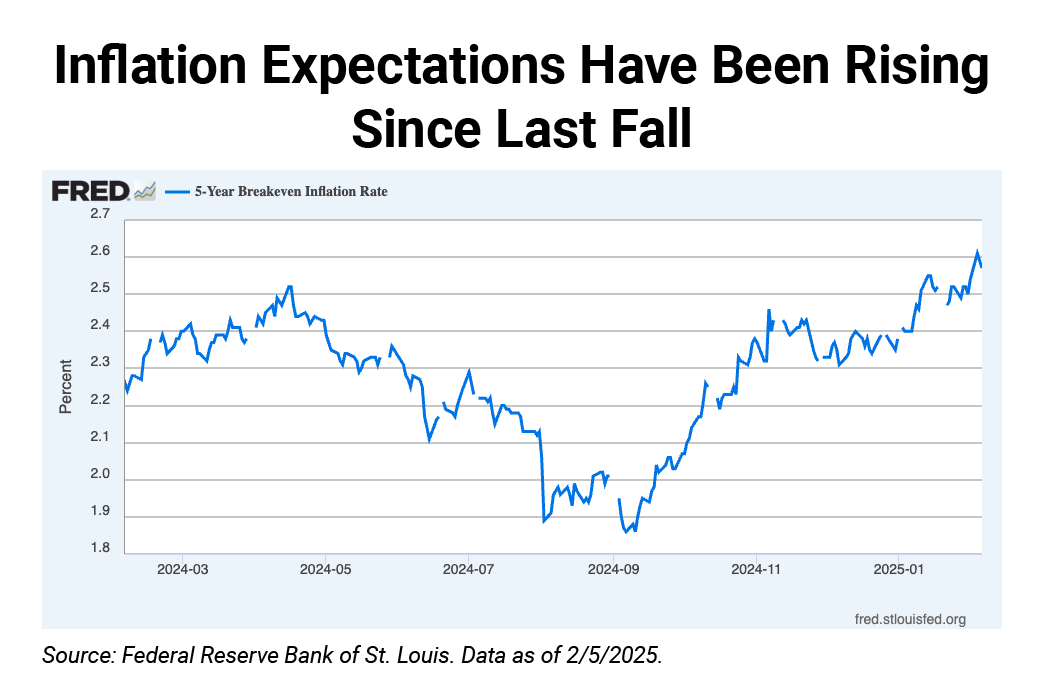
Tariffs May Reaccelerate Inflation: To the extent that higher and new tariffs are passed on to consumers, the rate of inflation could increase in the U.S. I use the word “could” because the actual impact is more complicated. Beyond the effect of a potentially stronger U.S. dollar, consumers may seek out lower-cost alternatives. The economy could slow down, lowering demand and thereby prices. A period of higher prices and slower economic growth is also a possibility. New trade deals, or even the possibility thereof, could alleviate inflationary pressures as well.
It is too early to determine the impact. The breakeven rate, shown in the chart, reflects what the bond market expects inflation to be in five years. The breakeven rate has been rising since last fall.
Gross Margins for Corporations Could Tighten: Gross margins are where the impact of tariffs would be most noticeable from an investing standpoint. Gross margin is gross profit (revenue minus cost of goods sold) divided by revenues. The less a company is able to pass along the costs of its imported goods and materials, the lower its gross margins are going to be.
Most Fund Managers Haven’t Experienced Large Trade Wars: The median tenure for active domestic and global mutual fund managers is 7.8 years. For active intermediate and long-term taxable bond funds, the median manager tenure is 7.0 years. The typical fund manager—and most other portfolio managers—lacks experience navigating a retaliatory trade war.
Institutional Investors Have Access to More Data Than We Do: Not only do mutual fund companies, hedge funds and other institutional investors have more data in their hands, they can process it more quickly and speak to both economists and foreign policy experts. Professional traders will have already started to price in any new information before it reaches individual investors like us. We individual investors can counter this by focusing on our long-term goals instead of reacting to the latest headlines, political commentary and other scuttlebutt.
Nothing Is Set in Stone: President Donald Trump has shown a willingness to ease up on tariffs when a trade deal viewed as favorable to the U.S. is reached. We’ve already seen Mexico and Canada quickly respond to the threat of new tariffs. Other countries are likely ready to negotiate if tariffs are levied on them. Thus, while the threat of a global trade war is real, it may not come to fruition. Time will tell.

-
Online Exclusive: Understanding the Breakeven Inflation Rate
The breakeven inflation rate is a helpful guide for determining minimal rates of return required to maintain wealth in real terms. -
Fundamental Analysis: A Closer Look at Gross Margins
Amid all the detailed numbers on the income statement, gross margin is one figure that may be worth obsessing over, because it sits at the middle of several of the key accounting formulas that determine business success. -
The Individual Investor's Guide to the Top ETFs 2025
Large growth, technology and digital assets ETFs topped the list in a year where most ETFs turned in positive performance. Find out more in the newly posted February 2025 AAII Journal.
AAII Sentiment Survey
Pessimism among individual investors about the short-term outlook for stocks increased in the latest AAII Sentiment Survey. Meanwhile, optimism and neutral sentiment decreased.
Bullish sentiment, expectations that stock prices will rise over the next six months, decreased 7.6 percentage points to 33.3%. Bullish sentiment is below its historical average of 37.5% for the fourth time in six weeks.
Neutral sentiment, expectations that stock prices will stay essentially unchanged over the next six months, decreased 1.2 percentage points to 23.8%. Neutral sentiment is below its historical average of 31.5% for the 29th time in 31 weeks.
Bearish sentiment, expectations that stock prices will fall over the next six months, increased 8.8 percentage points to 42.9%. Bearish sentiment is unusually high and is above its historical average of 31.0% for the 10th time in 12 weeks. Bearish sentiment was last higher on November 2, 2023 (50.3%).
The bull-bear spread (bullish minus bearish sentiment) decreased 16.5 percentage points to –9.5%. The bull-bear spread is below its historical average of 6.5% for the fifth time in seven weeks.
This week’s special question asked AAII members how they would describe the current valuation of stocks.
Here’s how they responded:
- Stocks, in general, are overvalued: 52.5%
- Stocks, in general, are fairly valued: 7.1%
- Valuations are mixed, with some stocks expensive and others cheap: 36.9%
- Stocks, in general, are undervalued: 1.4%
- Not sure/no opinion: 2.1%
Bullish: 33.3%, down 7.6 points
Neutral: 23.8%, down 1.2 points
Bearish: 42.9%, up 8.8 points
Bullish: 37.5%
Neutral: 31.5%
Bearish: 31.0%
See more Sentiment Survey results.

AAII Asset Allocation Survey
Individual investors’ allocations to cash increased while stock and bond allocations decreased in the January Asset Allocation Survey.
Stock and stock fund allocations decreased 0.7 percentage points to 69.1%. Stock and stock fund allocations are above their historical average of 61.5% for the 56th consecutive month.
Bond and bond fund allocations decreased 0.2 percentage points to 14.4%. Bond and bond fund allocations are below their historical average of 16.0% for the 12th consecutive month.
Cash allocations increased 0.8 percentage points to 16.4%. Cash allocations are below their historical average of 22.5% for the 26th consecutive month.
- Stocks and Stock Funds: 69.1%, down 0.7 percentage points
- Bonds and Bond Funds: 14.4%, down 0.2 percentage points
- Cash: 16.4%, up 0.9 percentage points
- Stocks: 30.4%, down 0.8 percentage points
- Stocks Funds: 38.8%, up 0.2 percentage points
- Bonds: 4.4%, up 0.1 percentage points
- Bond Funds: 10.1%, down 0.3 percentage points
- Stocks/Stock Funds: 62.0%
- Bonds/Bond Funds: 16.0%
- Cash: 22.0%
Take the Asset Allocation Survey.
January 30, 2025 What Investors Should Know From Monday's AI Sell-Off
January 23, 2025 January Charts of Interest: Presidential Stock Market Scorecard
January 16, 2025 Where Market Indicators Stand as We Start 2025
January 9, 2025 Stock Market History After Back-to-Back 20% Gains

Discussion
John Kiefer from Arizona posted over 1 year ago:
I highly recommend everyone read the book by Robert Lighthizer, "No Trade is Free". Lighthizer was the US Trade Representative during the first Trump administration. International trade relations and exports/imports are complex. There are many trade offs.
Eric Townsend from North Carolina posted over 1 year ago:
I think we have also seen how the USA responds to the threat of new tariffs. This goes both ways. Time will tell who wins and who loses. I just hope consumers are not further impacted given no plan, to date, to deal with the supposed "kitchen table" issues.
Monk Jr. Monk from texas posted over 1 year ago:
I keep reading that tariffs are going to reaccelerate inflation. This does not pass Econ 101. Tariffs are a form of taxation, that the citizens have to pay or the exporters have to absorb. In either case, this is money taken off circulation into the treasury of the country. Hefty tariffs therefore are deflationary in nature. Tariffs either limit the amount of money in the hands of consumer or the amount of profits in the hands of producers. Yes, tariffs may make things expensive, but this is not the definition of inflation. Inflation is when the supply of money is imbalanced with the amount of goods available, either because of commodities or wages soaring. Tariffs will actually cut the supply of money. Gone too far, and they may induce a chain reactions of businesses losing money, not able to pay debts, and layoff people. Instead of fretting about inflation, people should start to worry about a tariff-induced recession.
NewJoizey from NewJoizey posted over 1 year ago:
so it seems from the article that the tarriff war could impact individual investors by introducing uncertainty which leads to volatility which makes us little guys sort of prone to behave like seasick crocodiles
Barry from TX posted over 1 year ago:
#1 In 1944 John von Neumann (famous from the 2001 movie, ”A Beautiful Mind”) and Oskar Morgenstern published “Theory of Games and Economic Behavior.“ That short book introduced the first mathematical framework for analyzing strategic games and decision-making and established the field of Game Theory to study how real-world situations play out. Game strategists measure "Levels of Reasoning" -- the number of levels people can THINK AHEAD from the moves/decisions they face currently. Many people (85% or so) do not think beyond the 2nd level of outcomes. #2 The capability to think 3 levels or more separates world-class strategies from people who make "Level 1" decisions (they cannot predict past the next move they face) and "Level 2" decisions. #3 Let’s use some principles of Game Theory to think through the levels of decisions we face "to win" (or at least get to a Pareto equilibrium) with the tariff situation Charles outlined. #4 (The Good News) Many AAIIers may get through this hot mess “Even Steven.” #5 (The Bad News) Importers will likely pass the costs of tariffs onto US producers and distributors who will surely add their costs and pass the value-added costs along to customers. Thus, costs will rise for all consumers who buy imported products. Some customers are among the chosen few "educated" and experienced AAII life members. #6 The aggregated costs of TARIFFS and SUPPLY CHAIN costs will increase the rate of INFLATION for all consumers. #7 (The Really Good News) AAIIers are consumers, but they are also investors. They have the capability to recover a large portion of the costs of tariffs through their investments. #8 The other 70% of the market participants will have the same ability as AAIIers – some will stay invested in the market to benefit from stock appreciation. #9 Higher prices from inflation raises the price of stocks. #10 Fixed-income investments may not be able to recover as much as equities because their income distributions are generally “fixed” by the underlying contract of their assets. Some may be indexed to inflation which will help. #11 Now that we are at or beyond GT Level 3, we have thought through a strategy to win the tariff game. #12 OUR AAII aligned INFLATION STRATEGY: Stop kvetching. Stay invested. Defer large expenses like vehicles, home improvements, vacations, and services that will increase by the inflation rate. Buy on the dip if you can. Employ the same strategic skills you used to create the wealth you have and be thankful for being blessed to have acquired the skills you learned from AAII and other members to take advantage of this situation. As the master strategist, Warren Buffett would advise, “Be greedy when others are fearful.” If you want to learn more about Game Theory (and learn anew skill), look up "Keynesian Beauty Contest" on Wiki.
You need to log in as a registered AAII user before commenting.
Create an account