

Where Market Indicators Stand as We Start 2025
by Charles Rotblut | January 16, 2025
Featured Tickers: NVDA
NVDA
The S&P 500 index has experienced a lackluster start to 2025, especially considering the big gains it recorded in 2023 and 2024. Year to date, the index is essentially flat.
There are too many uncertainties to forecast how the financial markets will perform in 2025 based on what we have seen so far. Many people are making forecasts, but I see this year as being divided between what we know, our known unknowns and the events hardly anyone is talking about.
I’m using this week’s commentary to look at various market indicators to give you a sense of where we are at as 2025 is still in its infancy.
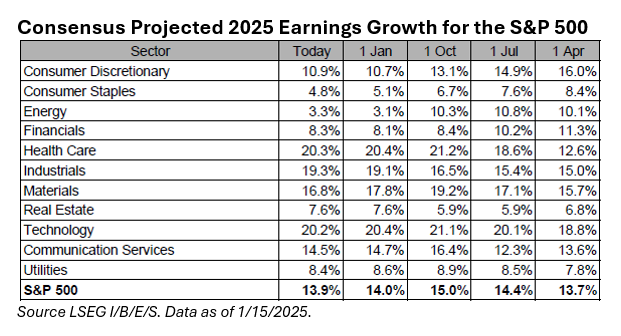
The U.S. Economy Is in Good Shape: Inflation has moderated (the recent readings not withstanding), unemployment remains low and the economy is expanding. The LSEG I/B/E/S consensus estimate calls for S&P 500 earnings to grow 13.9% this year. This earnings forecast has remained in a tight range since last April.
The Bond Curve Has Steepened: While there is still some inversion occurring at the short-end of the bond curve (one-month yields are higher than one-year yields), yields at the longer end of the yield curve are now higher than rates at the short-end of the curve. The yield on the benchmark 10-year Treasury bond was 4.66% yesterday, versus 4.35% for three-month Treasury bills. Three months ago, the 10-year bond was yielding 3.74%, versus 4.71% for the three-month bill.
Bond Yields Are Rising Across the Globe: The increase in yields is not just restricted to the U.S.; they have been rising in other countries too. A higher-for-longer interest rate is a drag on economic output. It is too early to tell if the recent jump in longer-term rates is a temporary blip or not.
Just One or Two Interest Rate Cuts Expected This Year: The CME FedWatch Tool shows traders pricing in a 65% probability of just one or two interest rates cut this year. The odds of interest rates being reduced by more than 50 basis points (0.50%) are less than 20% right now. These odds are subject to change, but the Federal Reserve does seem to be moving in the direction of “wait and see” in terms of future interest rate cuts.
The S&P 500’s Returns Are Skewed by a Small Number of Stocks: Nvidia Corp.  (NVDA) was responsible for over 22% of the S&P 500’s return last year. Just 10 companies accounted for 60% of the index’s total return. The market-capitalization-weighted index’s 2024 return of 25.0% was nearly double the S&P 500 Equal Weight index’s return of 13.0%. Simply put, last year’s S&P 500 returns were not representative of the typical large-cap stock.
The S&P 500’s Forward Price-Earnings Ratio Is Pricey: The S&P 500’s forward price-earnings (P/E) ratio was 22.5 as of Tuesday’s close, according to CFRA Research. The median forward price-earnings ratio for S&P 500 stocks was 20.1 as of Tuesday, based on data from S&P Global Market Intelligence.
Political Uncertainties Are High and Global: New tariffs could be put in place next week. Whether they ignite a new trade war remains to be seen. Tax legislation is on Congress’ agenda, though there is expected to be disagreement between Republican party members who want to cut taxes further and those who are concerned about the deficit. Outside of the U.S., several countries are facing political uncertainty of their own—including Canada, South Korea, Germany and France.
Individual Investors Don’t Have to Focus on Calendar-Year Returns: One of the advantages of being an individual investor is not having to worry about what the financial markets are going to do in any given year. We can patiently wait out shorter-term downside volatility while pursuing our long-term goals (as long as shorter-term spending needs are covered). This makes forecasts and market commentary interesting but not necessary for our investing success.

-
What You Can Gain From Reading the Economic Tea Leaves
Comparing changes in given metrics and their relative performance allows us to assess if economic activity is accelerating or decelerating and adjust our portfolio allocations if desired. -
Five Key Markers Pointing to Successful Stock Investing
Certain factors put institutional investors at a disadvantage to a disciplined individual investor who follows a consistent, well-defined approach to investing. -
18 Financial Ratios That Shed Light on a Company’s Strengths and Weaknesses
The January 2025 AAII Journal shows how financial ratios provide a powerful framework for assessing a company’s performance, efficiency and financial health across multiple dimensions and over time.
AAII Sentiment Survey
Optimism among individual investors about the short-term outlook for stocks decreased in the latest AAII Sentiment Survey. Meanwhile, neutral sentiment and pessimism increased.
Bullish sentiment, expectations that stock prices will rise over the next six months, decreased 9.2 percentage points to 25.4%. Optimism is unusually low and is below its historical average of 37.5% for the third time in seven weeks. Optimism was last lower on November 2, 2023 (24.3%).
Neutral sentiment, expectations that stock prices will stay essentially unchanged over the next six months, increased 6.0 percentage points to 34.0%. Neutral sentiment is above its historical average of 31.5% for the first time in 12 weeks.
Bearish sentiment, expectations that stock prices will fall over the next six months, increased 3.2 percentage points to 40.6%. Pessimism is unusually high and is above its historical average of 31.0% for the eighth time in nine weeks.
The bull-bear spread (bullish minus bearish sentiment) decreased 12.4 percentage points to –15.1%. The bull-bear spread is unusually low and is below its historical average of 6.5% for the fifth time in eight weeks.
This week’s special question asked AAII members what their performance forecast is for the S&P 500 index in 2025.
Here’s how they responded:
- Up 10% or more: 14.5%
- Up between 2% and 9%: 41.5%
- Flat between –1% and +1%: 14.1%
- Down between 2% and 9%: 21.7%
- Down 10% or more: 8.2%
Bullish: 25.4%, down 9.2 points
Neutral: 34.0%, up 6.0 points
Bearish: 40.6%, up 3.2 points
Bullish: 37.5%
Neutral: 31.5%
Bearish: 31.0%
See more Sentiment Survey results.

January 9, 2025 Stock Market History After Back-to-Back 20% Gains
January 2, 2025 2024's Most-Read Investor Updates: High Yields and Buying on Dips
December 19, 2024 December Charts of Interest: A Small-Cap Resurgence?
December 12, 2024 S&P 500 Stocks With the Potential to Outperform in 2025

Discussion
Barry J from TX posted over 1 year ago:
Charles, As we pass Epiphany, this issue greets us with the topic “Where Market Indicators Stand as We Start 2025” and provides 7 data trends (the economy, inflation, bond yields, interest rates, market valuations, forward P/Es, and a reminder that Ex-US markets are fragile) AND … a reminder not to watch the market. #1 I feel so guilty and conflicted because I follow the market in an attempt to understand how it is spewing all this money into my accounts, and all I have to do to earn this largess is stay invested. #2 As comparative data, I note this is better than any deal Monte Hall ever offered anyone in the 5,000 or so deals he curated. (But I do miss Carol Merrill (born Carol Hiller in Frederick WI in 1941). She was the real deal on that show.) #3 Do I detect a long-standing codependency between AAII members and AAII? Members depend on AAII to ask them for their opinions AND AAII makes money selling data on AAII member opinions. Yet, despite this symbiotic relationship, many articles continue to admonish AAIIers not to pay attention to the market AND AAII keeps asking them for their opinions EVERY WEEK on how the market will perform in the next six months. If you are a born-again buy-and-hold investor, why do you care? And more importantly, have you been peeking just a little? I guess this falls under hedging your bets by both parties. #4 This article dispatched me to check what I think I KNOW. Something troubling is happening on the internet with the deployment of AI. I was not uncertain that Robert McNamara coined the KNOWN-UNKNOWN analysis in the 60s and when Daniel Ellsberg leaked the Pentagon Papers to the New York Times in 1971, that concept was published. Now in 2025 Microsoft BING credits the phrase to Donald Rumsfeld to describe the lack of evidence linking Iraq with the supply of WMDs to terrorist groups in 2002. #5 There is a lot to unpack here. This is a KNOWN KNOWN for me. I am still not uncertain about my KNOWN KNOWN recall, but this type of insidiousness substitution can leach into the flow and store of KNOWN KNOWNs. #6 Yet another reason to be this buy-and-hold AAIIer also watches the market. #7 Let me gratuitously share something you already know. In life, it really, really, really matters what you pay attention to ... what you cram into your mind … and into your pie-hole … and what you chose to ignore. Other than DNA, that’s the main thing that determines the trajectory of your life and it is also the primary resource for your investing skill.
CRAIG B from WI posted over 1 year ago:
Barry packed a lot into this opinion essay but in the end, we rely on statistical data to make logical, rational decisions even when we know that such data from past performance does not always equate to future success. I wonder how old Barry is for "buy and hold" may work in our younger years but after about age 70 it can be a dangerous practice depending upon one's risk tolerance, investible assets and income needs from those assets. At advanced ages there's a time to hold 'em and a time to fold 'em....a time to ride the bucking bronco and a time to watch from the sidelines. No one strategy will ever be perfect and/or meet every individual's needs but I find the "Bucket Strategy" to allow me to be aggressive in Bucket #3, moderately aggressive in #2 and very conservative in Bucket #1. For now, until RMD's start, I even have a Bucket #1-1/2 (my Rollover Traditional IRA). The biggest decisions I then have to make is when to move funds from #2 into #1 and even that is automated with RMD's which constitute most folks' largest part of their holdings. So statistics can be nothing if not interesting and mildly edifying and not much more. Except for the Fed's parameters which I watch closely just to learn how money flows under different conditions in our quasi-capitalist economy here in the U.S. So, no big deal and nothing to induce angst nor anger. :)
Barry from TX posted over 1 year ago:
John L, thanks for reminding me to check if my “Buy-and-Hold” strategy will cover my income needs for life expectancy. Seriously, thanks. I intended to do this about now. #1 I decided to update the math I use to project how long I expect to live. I use the life expectancy calculator at Social Security (https://www.ssa.gov/oact/population/longevity.html). Since almost everyone is required to provide their birth date when they register to get an SSI card when they begin working and their heirs have to provide a death date to close out their SSI benefits, SSA records are very accurate on birth and death dates. I checked today, 01/22/25. #2 The SSA calculator says IT expects me to live 8.4 more years from today. Using this estimate, I calculate that IT expects me to die on February 11 , 2033 at 4:48 AM. I will be age 86 on that date. Not bad. #3 Now the BIG question: How much money can I earn from my investments in those 8.4 years? The Rule of 72s allows me to estimate that amount. Dividing 8.4 years into 72 years produces a growth rate of compound interest I can expect over 8 years which is about 9%. That’s very close to the long-term return of the S&P 500 since 1926. #4 Therefore, I can reasonably expect to be able to DOUBLE the balance of my current portfolio. #5 That means someone with a $1M portfolio, maybe me, can double-earn a $1M portfolio if I just invest in a passively managed index portfolio like the Vanguard Total Stock Market ETF (VTI) which I just happen to already own. VTI will charge me 0.03% per $10,000 or $300 annually just to live 8.4 more years. Not a bad deal. #6 I make $120,000 annually and take out a 4% RMD or an average of about $60,000. #7 This plan will enable me to sneak under the IRS limbo pole of the “tax torpedo.” #7 This is a pure “Buy-and-Hold” strategy. Like I said, the market spews out money and my job is to breathe, eat right, and be nice(r) to My Bride. #8 I think I will celebrate by playing a little more golf. I have shot my age for the last 3 years. I think that’s doable going forward. #9 Charles, please have the AAII staff I like to bug so frequently the good news of my expected demise so they can circle that date on their calendars.
John L from NJ posted over 1 year ago:
Barry - Life expectancy income planning isn't quite that simple or easy. And yet my father in law who never planned to die and invested as if he would live forever, managed to die the way he wanted (at home surrounded by family and paid care givers) and left enough money after this big expense which invested 100% in low cost equity funds has doubled in the last 7 years since his death and will be more than enough to allow his 95 year old widow to die with dignity at home. And dare I say it; most likely leave a nice legacy for her 5 children. So when is the final date? Does it matter? Invest like the future is infinite because it most likely will be - for your family!
You need to log in as a registered AAII user before commenting.
Create an account