

2024's Most-Read Investor Updates: High Yields and Buying on Dips
by Charles Rotblut | January 02, 2025
Featured Tickers: BLK
BLK
Let’s build generational wealth together. Upgrade to AAII lifetime access at our discounted rate and save $300 today. I know these tools and resources can help you achieve lasting financial growth.
What captured AAII members’ attention in 2024? The five most-read Investor Update commentaries covered many topics important to individual investors, from double-digit dividend yields to retirement planning and family caregiving. Today, I am revisiting the essential lessons I wrote about during the past year.
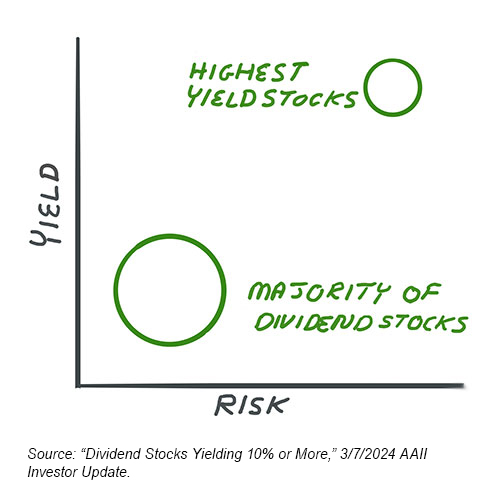 The year’s most-read Investor Update focused on dividend stocks yielding 10% or more. I found 91 such stocks when I screened for them during the first week of March. Many of these high yielders were classified as real estate investment trusts (REITs) or energy companies—both master limited partnerships (MLPs) and other publicly traded trusts. While the yields were juicy, more than one-third of those companies had lowered their dividends within the previous 12 months.
Near the bottom of this summer’s pullback, I shared three signals for when to buy stocks during market volatility. Those three signals were the CBOE Volatility Index (VIX) rising at least one standard deviation above its historical average, the S&P 500 index falling by a magnitude of 7% (7%, 14%, 21%, etc.) from its record high and a rebound by the S&P 500 back above its 200-day moving average. Even though only the first two of those signals had been tripped, the S&P 500 went on to travel a bumpy road up to new record highs.
BlackRock Inc.  (BLK) chairman Larry Fink characterized retirement as “a much harder proposition than it was 30 years ago” in his annual letter to investors. I followed up Fink’s March letter by listing five of those retirement challenges and suggesting solutions for them. Longer life-spans, spending savings in retirement and fear about what the future could look like were among the threats Fink believes people now face. Postponing claiming Social Security, keeping your starting withdrawal rate below 5% and allocating a small percentage of your portfolio to nonvolatile assets like a money market fund can help with all three.
I started out 2024 by writing about where the market indicators stood as of January 4. In that commentary, I told AAII members that “there are two trends going in our favor: 1) The S&P 500 has historically risen during the fourth year of a president’s first term; and 2) years with big gains are typically followed by years with more gains.” Both trends played out, with the S&P 500 ending the year with a 25% gain. I will write an updated version of that commentary for 2025 in a week or two.
Following my mother-in-law’s October funeral, I shared lessons and insights my wife and I learned from caring for her. The key takeaways included assisting her with (and eventually managing) her personal finances, the importance of having an updated will, the significant value of a prepaid funeral and the critical need to know the location of all key documents—including account inventories, insurance policies, retirement community contracts and trust documents. Several AAII members improved on the list with their own valuable insights in the comments section.

-
AAII’s Model Portfolio Review Week
Join us next week for year-end reviews of our model portfolios. From January 6 through 10, we’re holding live webinars to give you a deeper understanding of our strategies and results. See the schedule and register for any or all webinars. -
3 Ways to Redo Your Social Security Claim
Certain circumstances may allow you to improve your retirement prospects by changing a prior Social Security claiming decision. -
When It's Time to Transfer Financial Decision-Making
Failing to plan for a transfer of financial responsibilities can undo years of careful plans. Actionable steps to protect you and your heirs. -
Increasing the Aftertax Returns on Your Portfolio
The two primary rules for reducing investing-related taxes are transacting less and holding less tax-friendly investments in tax-preferred accounts. Read about them in the December 2024 AAII Journal.
AAII Sentiment Survey
Optimism among individual investors about the short-term outlook for stocks decreased in the latest AAII Sentiment Survey. Meanwhile, neutral sentiment increased and pessimism was unchanged.
Bullish sentiment, expectations that stock prices will rise over the next six months, decreased 2.4 percentage points to 35.4%. Optimism is below its historical average of 37.5% for the first time in five weeks and was last lower on April 25, 2024 (32.1%).
Neutral sentiment, expectations that stock prices will stay essentially unchanged over the next six months, increased 2.3 percentage points to 30.4%. Neutral sentiment is below its historical average of 31.5% for the 25th time in 26 weeks.
Bearish sentiment, expectations that stock prices will fall over the next six months, is unchanged at 34.2%. Pessimism is above its historical average of 31.0% for the sixth time in seven weeks.
The bull-bear spread (bullish minus bearish sentiment) decreased 2.4 percentage points to 1.3%. The bull-bear spread is below its historical average of 6.5% for the third time in six weeks.
This week’s special question asked AAII members their opinion on the Federal Reserve’s decision to cut interest rates by 0.25 percentage points.
Here’s how they responded:
- It was the right move: 43.5%
- They should have left rates unchanged: 41.9%
- They should have cut rates by a larger amount: 3.8%
- They should have cut rates by a smaller amount: 0.9%
- Not sure/no opinion: 9.7%
Bullish: 35.4%, down 2.4 points
Neutral: 30.4%, up 2.3 points
Bearish: 34.2%, up 0.0 points
Bullish: 37.5%
Neutral: 31.5%
Bearish: 31.0%
See more Sentiment Survey results.

AAII Asset Allocation Survey
Individual investors’ allocations to stocks increased while cash and bond allocations decreased in the December Asset Allocation Survey.
Stock and stock fund allocations increased 1.1 percentage points to 69.8%. Stock and stock fund allocations are above their historical average of 61.5% for the 55th consecutive month.
Bond and bond fund allocations decreased 0.7 percentage points to 14.6%. Bond and bond fund allocations are below their historical average of 16.0% for the 11th consecutive month.
Cash allocations decreased 0.4 percentage points to 15.6%. Cash allocations are below their historical average of 22.5% for the 25th consecutive month.
- Stocks and Stock Funds: 69.8%, up 1.1 percentage points
- Bonds and Bond Funds: 14.6%, down 0.7 percentage points
- Cash: 15.6%, down 0.5 percentage points
- Stocks: 31.2%, down 0.3 percentage points
- Stocks Funds: 38.6%, up 1.4 percentage points
- Bonds: 4.3%, down 0.5 percentage points
- Bond Funds: 10.4%, down 0.2 percentage points
- Stocks/Stock Funds: 62.0%
- Bonds/Bond Funds: 16.0%
- Cash: 22.0%
Take the Asset Allocation Survey.
December 19, 2024 December Charts of Interest: A Small-Cap Resurgence?
December 12, 2024 S&P 500 Stocks With the Potential to Outperform in 2025
December 5, 2024 Five Smart Strategies to Reduce Your 2024 Capital Gains Taxes
November 28, 2024 Thanksgiving Conversations: Planning for the Future

Discussion
Barry J from TX posted almost 2 years ago:
“What captured AAII members’ attention?” is always the question of the week. #1 Each week I try to reconstruct answers to this question from the data the Investor Updates and Weekly COIs provide. The standard indicators are the range of opinions on 1) the question of the week, and changes and levels of 2) AAII sentiment and 3) member PF allocations. These 3 sources provide trend data that members can view on site, but no one ever discusses the data. Even the press only focuses on the short-term data. #2 The “most read Investor Updates” added 5 new indicators” 1) High Interest DIVYs, 2) 3 volatility indicators (VIX StDev changes, SPX ST changes, SPX 200D SMA changes; 3) solutions to 5 RT challenges; 4) SPX trends in election cycles; and 5) ways to prepare and assist older relatives. Thus, Charles has provided both longer term and short-term perspectives. Very clever curation. #3 Data on the percentages would have added a desert course for this feast. Of course, the fact that the choice of topics and data are highly curated moderates the ability to construct anything close to a snap shot but a crude mosaic and tempus fugit. I can predict more about Charles’ interests than AAII members. #4 The choices of the archived articles Charles selects provides some pointers into Charles’ purposes and intents. So I conclude: #5 Charles is AAII’s Moses. We can only hope, that like Moses, after we wander in the AAII Negev a few more years, Charles leads us to a “promised land” that has more oil than the one Moses settled for. Maybe 2025 is our salvation. Maybe not. #6 Do you know why Moses was a great leader? He had a great staff. (I love that one.) #7 THUS … I have concluded the obvious, my dear Watson. Professing to be a “long term investor” means creating a portfolio that is more like cooking with a crockpot – 1) throw in a bunch of things that are good for you like fresh vegetables, 2) add some fresh meat like hot stocks, 3) season it to taste with your preferred level of volatility and … 4) set it and 5) forget it, AND … the best part – 6) know you have enough nourishment (aka wealth) to live well, long, and prosper. #8 Unfortunately, I always come away with a distorted picture into the AAII Member Psyche. Assuming that the “II” in AAII indicates that “AAIIers” are individuals who construct opinions independently, their opinions are always the best answer we can get, but more AAII member comments would be useful to expand our Rorschach. #9 My forecast for 2025? 1) Keep your eyes on volatility gauges in the article. 2) Remember our journeys for that promised land and a crockpot feast continues. #10 As an indicator of the “Wisdom of AAII” consider the loci of their most recent estimates of how 2025 will play out. 1) 43.5% of AAIIers opined that Fed decision to cut FFR 0.25% (which reset the “effective interest rates” @ 4.5% only 1% above the current CPI inflation rate @3.5%. This should tamp down recent stampedes toward higher UST10 yields, the best alternative safe fixed income investment. AAIIers acted on this monetary policy move by reducing their FI investments in their PFs by 0.7% to 14.7% for first time in 5 weeks (12/1/24) and holding steady @3.2% higher which than historical allocations @31%. This tracks as a 60%-40% PF tilted 10% to the higher risk side of the yield curve. This could be a reaction to the "Santa Claus Bust." And bullish sentiment in the AII Sentiment Survey was up @35.4% but below its HA @ 37.5% for the 1st time in 5 weeks. #11 The WOAAII curve says: As a crowd, we are repositioning to weather this one out until we see some results from the 119th Congress (a deficit ceiling resolution, FY26 fiscal spending limits, continued tax cuts, changed treaties) and see what kind of new macroeconomic fiscal opportunities/problems DT2’s “Day One" promises bring (deportations? reduced labor pool? high costs of labor? inflation? tariffs?). I am following crude oil inventories and prices as key market futures indicators. Charles, seize your staff and lead us on. Oil Ho! Happy New Year.
John L from NJ posted almost 2 years ago:
Yes! Let's build generational wealth starting in 2025. Start with giving up the unrealistic dream of beating the market. Check out SPIVA to see how few professionals beat the market over long periods (6% - 20 years). Take a long drink and admit you have no idea how to pick a financial advisor, mutual fund manager, or newsletter that will beat the market over the next 20 years. So how do you achieve market or near market returns? One way is low cost stock market index funds. Maybe AAII advice. Maybe not. Last check showed the shadow stock portfolio beating the broad market over it's lifetime due to outstanding early results but not recently as in the last 15 years. The rest of the AAII newsletters could be winners but who knows as their historic results haven't been published to my knowledge. But even if their return history was known; we can't know how they will do in the future. In my opinion AAII is only good for the entertainment value. Generational wealth? That pretty much excludes bonds and low interest saving accounts. So 100% low cost equity index funds for a lifetime. Any other approach is like buying lottery tickets - it only works for the lucky.
Mark S from OH posted over 1 year ago:
John, your post made me curious - I went back and looked at the shadow stock portfolio, starting with the year 2000, and compared performance with investing $10,000 in VFINX (Vanguard S&P 500) in the initial year and letting it ride. The first three years were incredibly successful for the shadow stock portfolio. For 2003, you would still be ahead, but the difference was much smaller. Any year after 2003, VFINX has performed better than the shadow stock portfolio.
You need to log in as a registered AAII user before commenting.
Create an account