

February Charts of Interest: Tariffs, Uncertainty, Eggs and More
by Charles Rotblut | February 20, 2025
Tariffs remain a hot topic for corporate executives. I show you just how much in this month’s charts of interest. Among the other charts I highlight are those focusing on how uncertainty affects stock prices, the shrinking number of “pure growth” stocks and rising egg prices. I hope you find this month’s charts of interest to be all it is cracked up to be.
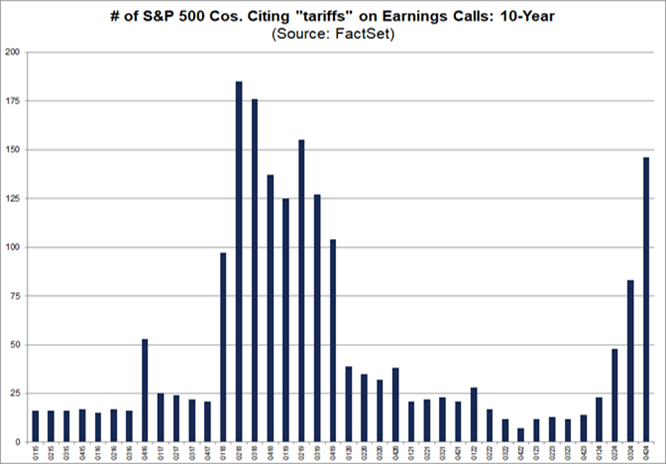
Unsurprisingly, Companies Are Discussing Tariffs a Lot More
The term “tariff” or “tariffs” was cited by half of the S&P 500 index companies that reported earnings between December 15, 2024, and February 6, 2025. At 146 companies, “this marks the highest number of S&P 500 companies citing ‘tariff’ or ‘tariffs’ on quarterly earnings calls since [second-quarter] 2019 (155),” observed FactSet’s John Butters. “If the current pace continues through the remainder of the earnings season, the fourth quarter [of 2024] will record the highest number of S&P 500 companies citing ‘tariff’ or ‘tariffs’ on earnings calls for a quarter over the past 10 years. The current record is 185 companies, which occurred in [second-quarter] 2018.”
(The dates at bottom of the chart are very difficult to read. They range from the first quarter of 2015 on the left to the fourth quarter of 2024 on the right.)
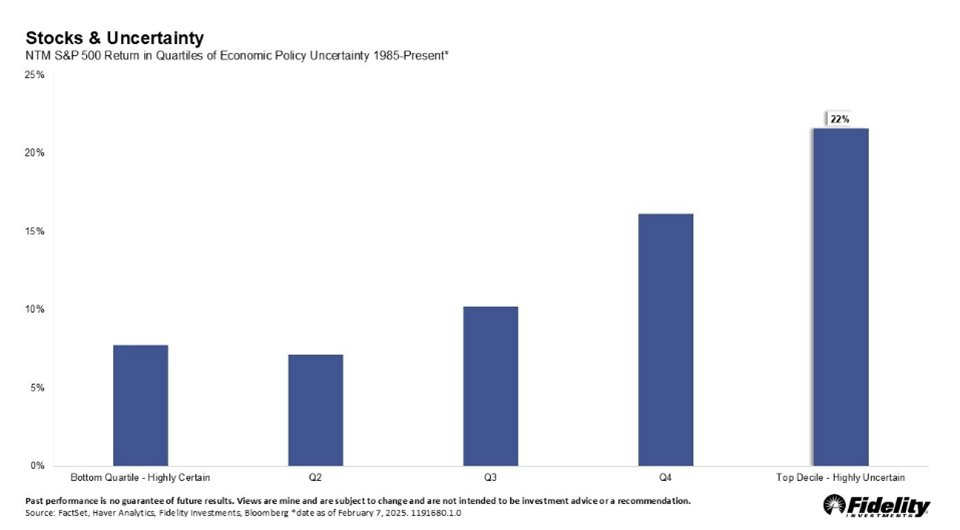
Uncertainty Is Good for the Market
The stock market is often described as climbing a wall of worry. The chart below supports this. Fidelity’s director of quantitative market strategy Denise Chisholm writes, “While uncertainty might seem like a signal to de-risk, that approach looks problematic historically. More often than not, uncertainty has tended to be a tailwind for market returns. For investors, the choice is ironically clear—statistically speaking, it’s been better to embrace the unknown.”
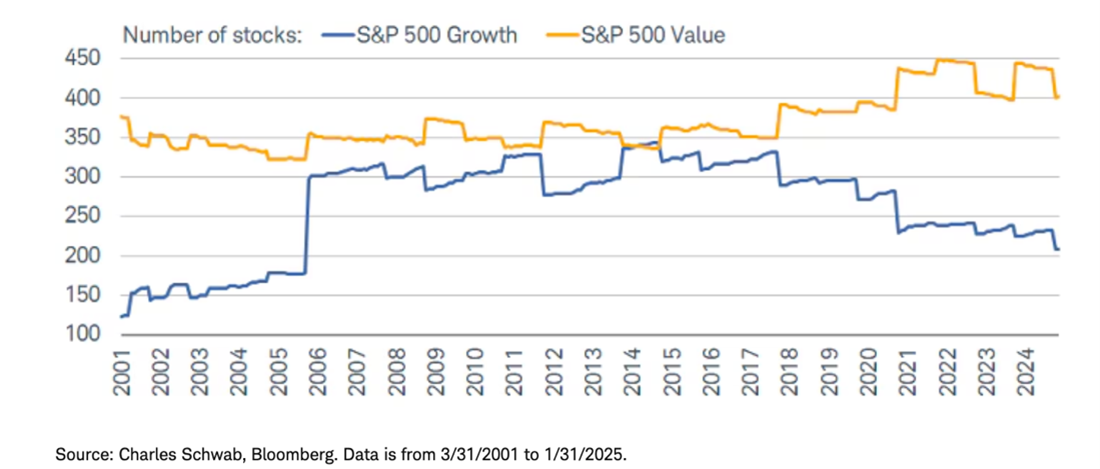
More Value, Less Growth
The number of stocks in the S&P 500 Pure Growth index has fallen over the past several years. Meanwhile, the S&P 500 Pure Value index has seen more stocks added to it, according to Charles Schwab’s Liz Ann Sonders and Kevin Gordon.
The two indexes aren’t required to have a set number of stocks. The S&P 500 Pure Growth selects stocks based on sales growth, the ratio of earnings change to price and price momentum metrics. The S&P 500 Pure Value, meanwhile, uses a value score based on ratios of book value, earnings and sales to price.
How one defines growth and value matters. As Sonders and Gordon note, “There are times (like today) when huge differences in indexes and factors can lead to dramatically different performance dynamics.” This is why AAII encourages investors to look past an exchange-traded fund (ETF) or mutual fund’s name and see what its methodology actually is.
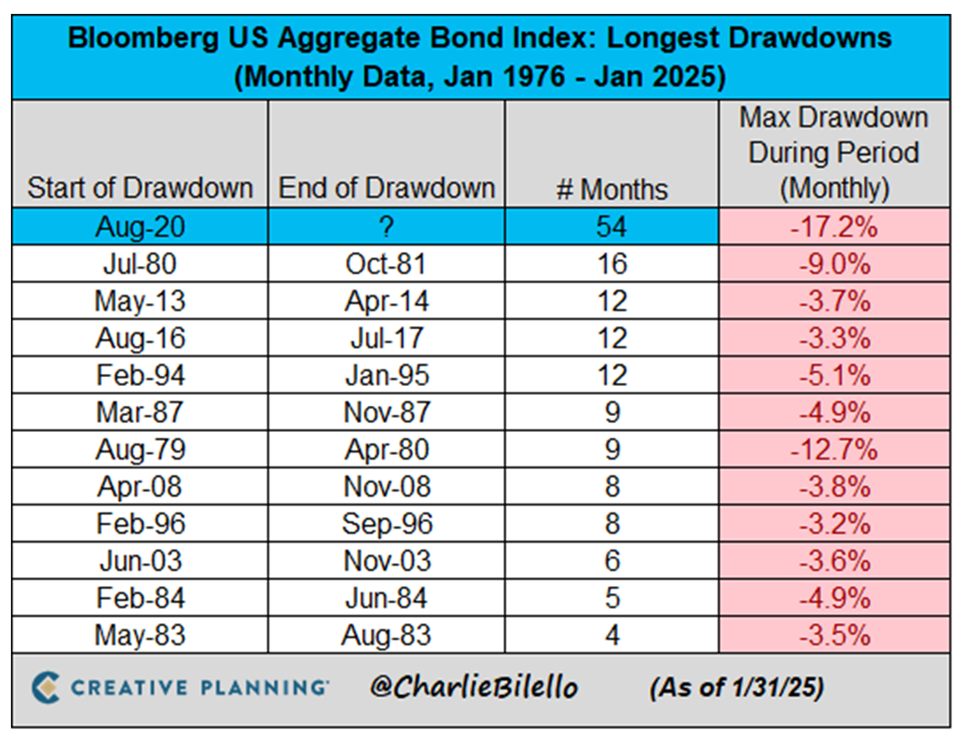
Bonds Are in an Extended Slump
The Bloomberg U.S. Aggregate Bond index remains in its longest downturn ever at 54 months, according to Charlie Bilello. The index measures the investment-grade, U.S. dollar-denominated, fixed-rate taxable bond market.
The cause for the slump is simple: Bond yields bottomed during the pandemic and then rose sharply as inflation surged. Since then, inflation hasn’t fully pulled back and neither have bond yields.
Expense Ratios Really Do Matter
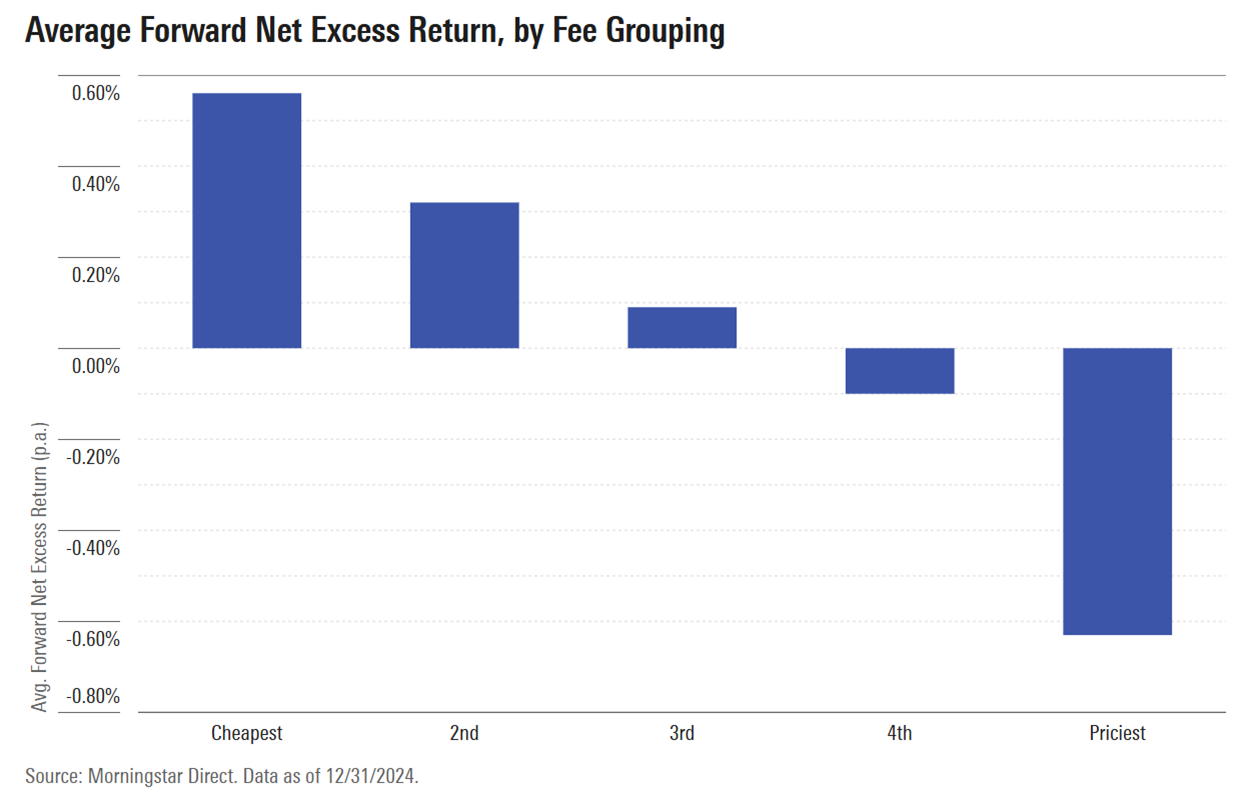
Expense ratios are the most reliable predictor of whether a mutual fund will outperform or underperform. Morningstar’s Jeffrey Ptak, CFA, found “an almost perfect stair-step pattern” between expense fees and future five-year returns. The funds with the cheapest expenses ratios had the highest returns (cheapest 10%), while the fund with the priciest expense ratios (most expensive 10%) had the worst returns.
You can see a fund’s expense ratio and how it compares to its peers in AAII’s Fund Evaluator. Simply enter a fund’s name or ticker symbol into the search bar on AAII.com and then scroll down to the “Performance and Fees” section.
I’m Just the Messenger …
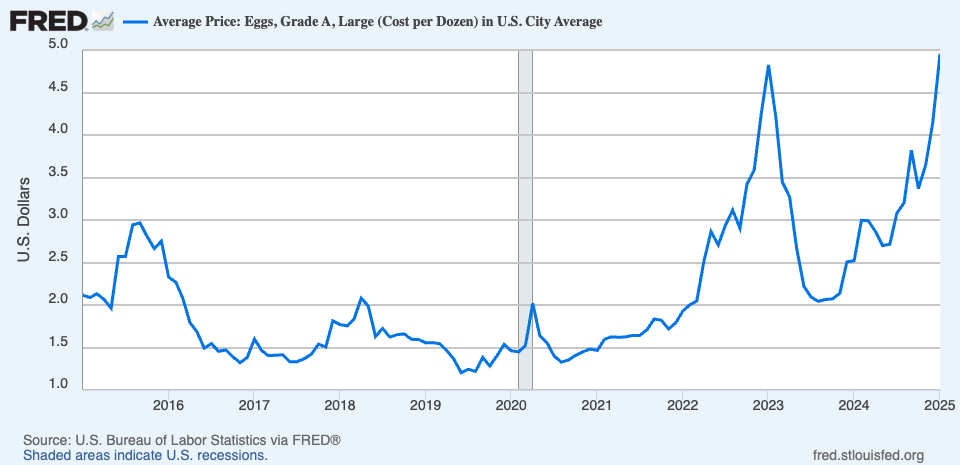
Here’s a chart from the St. Louis Federal Reserve’s FRED database highlighting the surge in egg prices. The avian flu has sent egg prices to a record high.
Not surprisingly, Waffle House recently implemented a $0.50 per egg surcharge on customer orders.

-
Striking the Right Balance Between Growth and Value Stocks
A look at historical performance sheds light on whether favoring growth or value stocks makes a difference. -
Understanding Mutual Fund Fees and Expenses
While it is natural to focus on the performance track record when selecting a fund, expenses and fees can have a dramatic impact on your realized rate of return. -
Choosing the Right Mutual Fund or ETF for You
Along with the fund and ETF guides, the February 2025 AAII Journal includes suggestions and tools to help you identify the perfect fund for your portfolio.
AAII Sentiment Survey
Pessimism among individual investors about the short-term outlook for stocks decreased in the latest AAII Sentiment Survey. Meanwhile, both optimism and neutral sentiment increased.
Bullish sentiment, expectations that stock prices will rise over the next six months, increased 0.8 percentage points to 29.2%. Bullish sentiment is below its historical average of 37.5% for the sixth time in eight weeks.
Neutral sentiment, expectations that stock prices will stay essentially unchanged over the next six months, increased 6.0 percentage points to 30.3%. Neutral sentiment is below its historical average of 31.5% for the 31st time in 33 weeks.
Bearish sentiment, expectations that stock prices will fall over the next six months, decreased 6.8 percentage points to 40.5%. Bearish sentiment is above its historical average of 31.0% for the 12th time in 14 weeks.
The bull-bear spread (bullish minus bearish sentiment) increased 7.6 percentage points to –11.3%. The bull-bear spread is below its historical average of 6.5% for the seventh time in nine weeks.
This week’s special question asked AAII members which factor is most influencing their six-month outlook for stocks.
Here is how they responded:
- The economy and/or inflation: 46.0%
- Valuations: 13.3%
- Corporate earnings: 11.6%
- Monetary policy/interest rates: 11.3%
- Other: 17.9%
Bullish: 29.2%, up 0.8 points
Neutral: 30.3%, up 6.0 points
Bearish: 40.5%, down 6.8 points
Bullish: 37.5%
Neutral: 31.5%
Bearish: 31.0%
See more Sentiment Survey results.

February 13, 2025 Five Simple Steps to Make Sense of Earnings Reports
February 6, 2025 How Tariffs Could Affect U.S. Individual Investors
January 30, 2025 What Investors Should Know From Monday's AI Sell-Off
January 23, 2025 January Charts of Interest: Presidential Stock Market Scorecard

Discussion
Barry J from TX posted over 1 year ago:
#1 As Foghorn Leghorn would say to Henry, “Son, they laid some grade AAAs this week.” #2 Tariffs are a hot topic on EPS calls because DT2 hoisted a tariff petard (and a 51st state, DOGE, buy Greenland, Ukraine minerals, buy crypto, and buy Trump bitcoins, etc, etc, etc ) and suddenly ... all future economic outcomes grew in uncertainty, and all those bright shiny objects distracted analysts from their jobs -- analyzing the hard data that matters with stock performance. I see the topic of tariffs (wasn’t that a steamy book in the 1970s?) the same way I see chicken prices: someone lays ‘em; someone eats ‘em, and producers raise prices. Yuk or yolk? #3 An uncertain tailwind is not a good thing at altitude; it affects your airspeed and fuel consumption and throws off your estimated time of arrival which means you are trading one type of uncertainty (speed) for another (arrival time). #4 My understanding of the historical definitions of the relationship between value and growth stocks is value stocks are the ones in lower 30% of the index by P/E and growth stocks are the upper 30% by P/E. Value stocks are underpriced (hence the term value) and growth stocks prices are “growing” in price (which is how they got into the top 30%). ## I follow Liz Saunders and think she’s a very credible strategic analyst, but I don’t see how the numbers change if the percentage cut offs are fixed. Me thinks someone somewhere is diddling with the definitions to make a distinction without a difference. Yet another reason to beware of "geeks" bearing gifts. #5 I am not sure about Charlie Bilello’s observation. I am not uncertain that bonds tanked for several DECADES, like the 1930s and 1960s. #6 Do fund ERs matter? You bet ‘um Lone Ranger. Jack Bogle said this first 30 years ago. It has been the distinctive difference driving differing trajectories of fund types ever since. The mutual fund business model is inherently inferior to the ETF business model. It has bad DNA and no RNA. The distinction between these two types of funds is WHO keeps most of the profits. #7 Charles, why do you rarely (as in never) comment on the AAII Sentiment Survey shifts and trends? Why do we see so few comments on the survey shifts/trends? The survey is referenced in the press, but it is always used like a drunk uses a lamppost, for support, not illumination.
robert from SC posted over 1 year ago:
Barry J from TX, I always learn a lot from your comments. You have a wonderful sense of humor. Thank you for your regular posts.
You need to log in as a registered AAII user before commenting.
Create an account