

Mutual Funds to Gain ETF Tax Advantages and Intraday Trading
by Charles Rotblut | October 02, 2025
Featured Tickers: DFSV
DFSVX
VBR
VSIAX
DFSV
DFSVX
VBR
VSIAX
The line separating exchange-traded funds (ETFs) and mutual funds could become much more blurred in the coming months. The U.S. Securities and Exchange Commission (SEC) issued a notice on Tuesday stating its intent to grant Dimensional Fund Advisors (DFA) the ability to offer ETF share classes for its existing mutual funds. This could create advantages for individual investors.
Currently, the ETFs and mutual funds offered by nearly all firms are separate entities. For instance, there is no intermingling of DFA US Small Cap Value Portfolio Institutional Class fund  (DFSVX) assets and DFA US Small Cap Value ETF (DFSV) assets. They are two completely different investment vehicles. Purchases and redemptions made in the small-cap value mutual fund have no impact on the ETF with the same name.
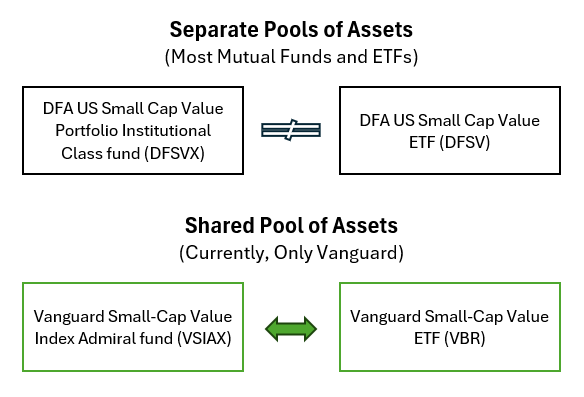
Vanguard is the exception. Vanguard Small-Cap Value Index Admiral fund (VSIAX) and Vanguard Small-Cap Value ETF (VBR) are merely different share classes of the same fund. They share the same pool of assets. Inflows and outflows from the mutual fund share class affect the ETF share class, and vice versa.
A patent allowed Vanguard to be the sole fund family to do this for more than 20 years. This patent expired in 2023. Since then, applications from other investment firms to offer ETF classes for existing mutual funds have poured in. Morningstar says that over 75 firms have filed applications; Reuters puts the number at “about 80.”
DFA’s application says that shareholders will be able to exchange their mutual fund share classes for ETF share classes once the dual share classes are available. This will allow investors to get the tax benefits of ETFs without incurring capital gains taxes or any potential transaction fees.
Mutual fund share class holders should, in theory, gain some tax efficiency from the dual share class structure too. It would allow some portfolio changes to be conducted through the ETF share classes.
ETFs do in-kind transactions. An in-kind transaction frequently avoids being a taxable event because securities are swapped for other assets of equal value. Mutual funds, conversely, sell the assets that the managers want to remove from the portfolio. This can lead to capital gains, which are taxable.
Individual investors could also realize some cost savings when buying or selling fund shares. Currently, brokers limit the number of mutual funds that can be bought or sold on a transaction-free basis. All ETFs are bought and sold on a commission-free basis at most brokers.
However, there are potential downsides. The extent to which the dollar value of the assets associated with the mutual fund share is larger than that associated with the ETF class, the tax efficiency of the ETF could be adversely affected. For example, if many mutual fund shareholders redeem at once, the fund might need to sell securities for cash rather than execute tax-efficient in-kind transfers, potentially triggering capital gains for all shareholders, including ETF holders.
ETF shares could also trade at prices separate from their underlying net asset value (NAV). The ETF’s share price may be higher or lower than the underlying value of the assets attributed to each share. We already see this occurring with lesser-traded ETFs.
Capacity is another issue. When a manager believes their fund has reached its dollar limit for what it can attractively invest, they can close the fund. Closing off a fund to new inflows prevents investors from buying new shares in the mutual fund. ETFs cannot do the same. A flood of assets into a top-performing ETF could lead to too much money chasing too few assets.
Despite these risks, I think allowing more investment firms to offer dual mutual fund and ETF share classes is a win for us individual investors. It will give us a more tax-friendly investment structure, the flexibility to make portfolio changes during market hours (via the ETF share class) and lower costs. The change should also put more pressure on mutual fund companies to stop charging front-end loads.
What it does not do is resolve the problem of underperforming active fund managers, the higher fees charged by many funds or the risks of individual investors buying and selling too frequently.

-
Online Exclusive: Mutual Funds vs. ETFs: What Makes Them Different?
These two categories of professionally managed funds differ in important ways that should be taken into consideration before settling on an investment. -
Mutual Funds Converting to ETFs for Tax Efficiency and Convenience
Conversions of mutual funds into exchange-traded funds (ETFs) have been a growing trend. -
This Isn't Your Grandpa's Retirement
The newly released October 2025 AAII Journal explores how AAII Retirement Investing guides retirees and those saving for retirement through the constantly evolving challenges and opportunities.
AAII Sentiment Survey
Optimism among individual investors about the short-term outlook for stocks increased in the latest AAII Sentiment Survey. Meanwhile, neutral sentiment decreased and pessimism was unchanged.
Bullish sentiment, expectations that stock prices will rise over the next six months, increased 1.2 percentage points to 42.9%. Bullish sentiment is above its historical average of 37.5% for the third time in nine weeks.
Neutral sentiment, expectations that stock prices will stay essentially unchanged over the next six months, decreased 1.1 percentage points to 17.9%. Neutral sentiment is unusually low and is below its historical average of 31.5% for the 63rd time in 65 weeks.
Bearish sentiment, expectations that stock prices will fall over the next six months, was unchanged at 39.2%. Bearish sentiment is above its historical average of 31.0% for the 44th time in 46 weeks.
The bull-bear spread (bullish minus bearish sentiment) increased 1.2 percentage points to 3.8%. The bull-bear spread is below its historical average of 6.5% for the 33rd time in 35 weeks.
This week’s special question asked AAII members if they hold gold or other precious metals in their portfolio, either directly or through an exchange-traded fund (ETF).
Here is how they responded:
- No, I do not: 55.6%
- Yes, I own gold or other precious metals: 18.7%
- Yes, I own both precious metals and mining companies: 15.9%
- I just own mining companies that focus on precious metals: 7.9%
- I am considering adding gold to my portfolio: 1.9%
Bullish: 42.9%, up 1.2 points
Neutral: 17.9%, down 1.1 points
Bearish: 39.2%, down 0.0 points
Bullish: 37.5%
Neutral: 31.5%
Bearish: 31.0%
See more Sentiment Survey results.

AAII Asset Allocation Survey
Individual investors’ allocations to stocks increased while bond allocations increased and cash allocations decreased in the September AAII Asset Allocation Survey.
Stock and stock fund allocations increased 1.0 percentage points to 68.3%. Stock and stock fund allocations are above their historical average of 61.5% for the 64th consecutive month.
Bond and bond fund allocations increased 0.1 percentage points to 16.3%. Bond and bond fund allocations are above their historical average of 16.0% for the fourth time in six months.
Cash allocations decreased 1.1 percentage points to 15.4%. Cash allocations are below their historical average of 22.5% for the 34th consecutive month.
- Stocks and Stock Funds: 68.3%, up 1.0 percentage points
- Bonds and Bond Funds: 16.3%, up 0.0 percentage points
- Cash: 15.4%, down 1.1 percentage points
- Stocks: 28.4%, down 0.6 percentage points
- Stocks Funds: 39.9%, up 1.6 percentage points
- Bonds: 5.0%, down 0.5 percentage points
- Bond Funds: 11.2%, up 0.6 percentage points
- Stocks/Stock Funds: 62.0%
- Bonds/Bond Funds: 16.0%
- Cash: 22.0%
Take the Asset Allocation Survey.
September 25, 2025 Options for Your Cash as More Fed Rate Cuts Are Likely
September 18, 2025 September Charts of Interest: Rate Cuts, Plus a 3,821% Investment Return
September 11, 2025 Muni Bond Funds' Additional Advantage
September 4, 2025 Beware of the Popularity Trap for ETFs

Discussion
Charlie M. from NY posted about 1 year ago:
So, once the ETF and mutual fund are 'merged', the ETF and the mutual fund are essentially identical. Will I be able to convert from one to the other as a like-for-like exchange and avoid paying capital gains tax on any gains I have? If so, is it reasonable to think my broker will report this "properly" come tax time? And, conversely, claim any losses without going through the 30-day wash sale rules?
Charles Rotblut from Illinois posted about 1 year ago:
Hi Charlie,
Dimensional says it will allow mutual fund shareholders to convert to the ETF share class on a tax-free basis. I would think other mutual fund providers would follow in the same footsteps, but I cannot guarantee that will be the case.
Brokers should be able to handle the tax tracking, but keep your own records. Dimensional, for its part, has backend work that needs to be done before launching the ETF share class. I would expect the wash sale rule to apply to the converted shares, especially since the ETF shares will be substantially the same investment.
-Charles
Barry from TX posted about 1 year ago:
Charles, #1 thank you for the Ben Franklin +/- analysis of this major II opportunity. #2 I wonder if DFA will decide to match the much lower VGD ERs after this change to gain market share. #3 VGD has a new, aggressive, but untested, CEO who seeks to bump market share, too. This rivalry might just be the competitive rivalry we need to get ERs down. #4 Lower DFA ERs could change the "cost of ownership" math in Paul Merriman's recent article on using factors to diversify his famous DFA-based 4-6 Fund portfolios. See "A Magic Allocation Recipe: Mixing Factor Investing Into a 60/40 Portfolio," the article to the right of this one.
Charles M Rotblut from Illinois posted about 1 year ago:
Barry,
I haven't seen anything regarding the expense ratios on the forthcoming DFA ETF share class. The firm's current ETFs have expense ratios mostly ranging between 0.14%-0.30%. Their cheapest mutual funds charge between 0.08% and 0.20%, so we'll see.
-Charles
D from MD posted about 1 year ago:
When & why is a passive ETF more tax efficient than a passive Mutual Fund with the exact same assets? Is this going to start a "get on the bandwagon" effort by funds to create ETF classes for existing Mutual Funds? How would this really be beneficial to the existing Mutual Fund owners? -- the ones who own Mutual Funds because they do NOT have the daily volatility of ETFs ?
Charles M Rotblut from Illinois posted about 1 year ago:
D,
The answer will depend on the mutual fund and its ETF counterpart. If there are no brokerage transaction fees, then the decision to hold the mutual fund share class or the ETF share class of a Vanguard fund comes down to personal preference. The differences are not meaningful.
For actively managed funds, the ETF share classes could be more tax efficient because of the in-kind transactions. This would particularly be the case when the ETF share class only accounts for a small percentage of the fund's overall assets.
-Charles
You need to log in as a registered AAII user before commenting.
Create an account