

Muni Bond Funds' Additional Advantage
by Charles Rotblut | September 11, 2025
Municipal (muni) bond funds have an additional advantage over similar taxable bond funds beyond their tax-advantaged yields. Muni bond funds have also realized higher returns, according to a study published recently in The Wall Street Journal.
The tax advantage comes from the types of bonds held. Muni bond coupon (interest) payments are not taxed at the federal level. Depending on the issuer and where you reside, they may also be exempt from state and local taxes (SALT). These advantages flow through to investors who own muni bond exchange-traded funds (ETFs) and mutual funds.
The tax-equivalent yield matters more than the quoted yield for a muni bond or bond fund for this reason. The tax-equivalent yield is the yield you realize after taxes are considered. Put another way, it shows you how much interest income you get to keep on an aftertax basis.
Once you adjust the yield, muni bond ETFs and mutual funds look more attractive relative to similar taxable bond funds. Consider intermediate-term bond ETFs. The average yield for the muni national intermediate ETF category is 3.5%. This equates to a tax-equivalent yield of 5.6% for an investor in the 37% tax bracket [0.035 ÷ (1 – 0.37)]. In contrast, the average yield for the intermediate core bond ETF category is lower at 4.3%.
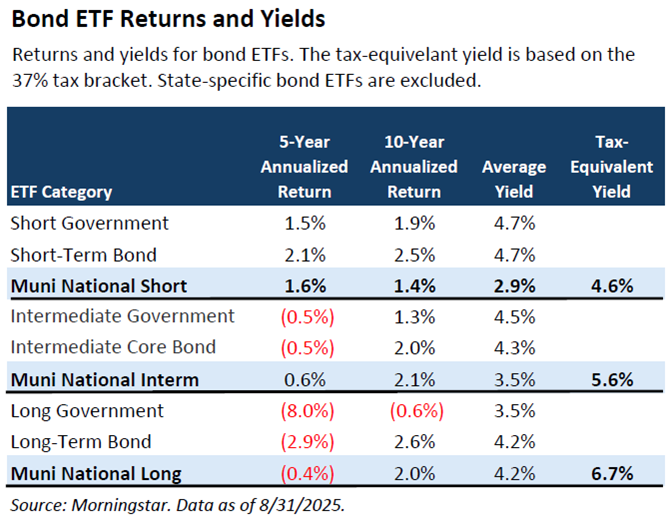
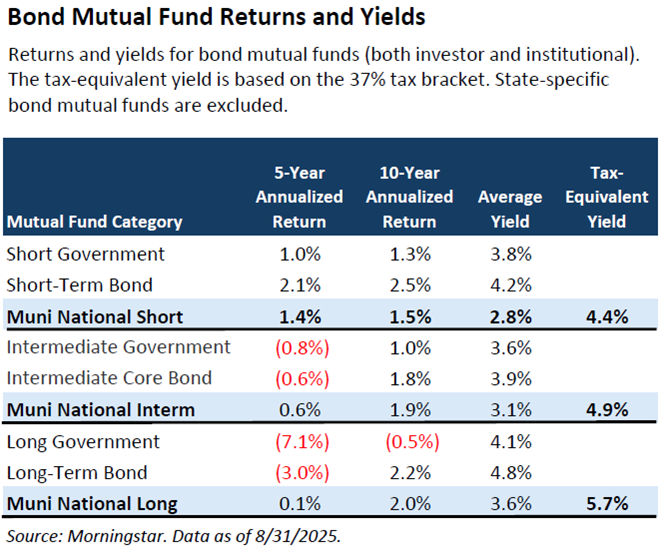
(Tax-equivalent yields are also used for comparing a muni bond against a similar taxable bond.)
George Mason University professor Derek Horstmeyer believes that most investors are better off going with muni bond funds when returns are also factored into the decision-making process. Horstmeyer and his research assistants compared the universe of domestic muni mutual funds against similar taxable bond funds. (State-specific funds were excluded.) Horstmeyer and his assistants considered fees, credit ratings and average maturity, among other factors, to better compare the two types of funds against each other.
Overall, the return for the average muni bond has been 3.32% on annualized basis over the past 15 years, according to Horstmeyer. Comparable taxable bond funds realized just a 1.54% aftertax annualized return. (The returns shown in the tables above are for the broad categories, whereas Horstmeyer’s analysis matched similar types of funds.)
The returns are based on the 37% tax rate. What’s notable, given the comparatively smaller tax savings, is that the tax-exempt muni bonds outperformed even at the 10% marginal tax rate.
There was one exception: short-term bond funds. “If you are below the 32% marginal tax-rate level, then it is usually better to invest in a taxable bond fund,” wrote Horstmeyer.
None of this analysis considers Medicare premiums or tax-preferred accounts. Muni bond interest realized in taxable accounts is added back into modified adjusted income when calculating the Medicare income-related monthly adjustment amount (IRMAA).
Bond interest earned in individual retirement accounts (IRAs), Roth IRAs, 401(k) plans and similar types of accounts is not taxed. The tax-equivalent yield therefore does not apply in such cases.

-
Calculating the Tax-Equivalent Yield of Muni Bonds
The quoted yield on a municipal bond may be understated relative to that of a similar corporate bond once taxes are factored in. A simple formula lets you determine which yield is more attractive. -
Diversify Tax-Exempt Interest Income With Muni National Bond Funds
If you are in a higher tax bracket and your portfolio generates significant income from fixed-income investments not held in tax-deferred accounts, you might consider municipal bond funds. -
What the One Big Beautiful Bill Act Means for Your Taxes
The OBBBA created new tax-saving opportunities. The September 2025 AAII Journal gives steps you might consider taking.
AAII Sentiment Survey
Pessimism among individual investors about the short-term outlook for stocks increased in the latest AAII Sentiment Survey. Meanwhile, optimism and neutral sentiment decreased.
Bullish sentiment, expectations that stock prices will rise over the next six months, decreased 4.7 percentage points to 28.0%. Bullish sentiment is below its historical average of 37.5% for the seventh time in 11 weeks.
Neutral sentiment, expectations that stock prices will stay essentially unchanged over the next six months, decreased 1.5 percentage points to 22.5%. Neutral sentiment is below its historical average of 31.5% for the 60th time in 62 weeks.
Bearish sentiment, expectations that stock prices will fall over the next six months, increased 6.1 percentage points to 49.5%. Bearish sentiment is unusually high and is above its historical average of 31.0% for the 41st time in 43 weeks.
The bull-bear spread (bullish minus bearish sentiment) decreased 16.6 percentage points to –21.5%. The bull-bear spread is unusually low and is below its historical average of 6.5% for the 30th time in 32 weeks.
This week’s special question asked AAII members what type of stocks they are favoring right now.
Here is how they responded:
- Dividend stocks: 24.3%
- Value stocks: 12.9%
- Growth stocks: 10.3%
- Small-cap stocks: 4.0%
- A mix of the above/other: 48.5%
Bullish: 28.0%, down 4.7 points
Neutral: 22.5%, down 1.5 points
Bearish: 49.5%, up 6.1 points
Bullish: 37.5%
Neutral: 31.5%
Bearish: 31.0%
See more Sentiment Survey results.

September 4, 2025 Beware of the Popularity Trap for ETFs
August 28, 2025 History Cautions That Keurig Dr Pepper Spin-Off Returns Could Fizzle
August 21, 2025 August Charts of Interest: Valuations at Dot-Com Bubble Levels
August 14, 2025 Why Private Investments Don't Belong in 401(k) Accounts

Discussion
vic smyth from illinois posted about 1 year ago:
Wow, the stock market is at all-time highs while AAII Sentiment has almost twice as many (1.77:1) bears as bulls? Would be interesting for someone to do some research to see what happened during other times in history when sentiment was this bearish at all-time highs. I would guess that the market kept churning higher for a while.
Barry from TX posted about 1 year ago:
Vic, the research you are asking for is exactly what the new AII Sentiment offering provides. I asked the same question earlier this year when I noticed that AAIIers reported portfolio allocations did not change proportionately as their reported market expectations to the two AAII surveys. Wayne has assembled 10 or so indicators into an AAII Sentiment Dashboard and Wayne tracks the historic probabilities for similar changes near term which is approximately the same time period as the AAII surveys. I have learned a lot about how investor sentiment relates to market movements. Lesson #1: You cannot predict what markets will do when (i. e., “time the market”), but you can evaluate how the historic probabilities relate to near-term market conditions and “anticipate” the probabilities of potential impacts on your holdings in a highly volatile environment where asset yields and return probabilities matter. I think there is still a trial offer.
Cheryl from CA posted about 1 year ago:
In the article on Muni Bonds funds additional advantage, i have a question on the statement that reads: "Bond interest earned in individual retirement accounts (IRAs), Roth IRAs, 401(k) plans and similar types of accounts is not taxed." Would it be more accurate to say that "bond interest earned in tax deferred accounts like IRA's and 401K's is not taxed in the year earned"? (I understood you typically do pay ordinary income tax when you withdraw the earnings.)
Charles Rotblut from Illinois posted about 1 year ago:
Hi Cheryl,
Interest and capital gains realized in tax-deferred accounts is not taxed. Only distributions are. (The one exception is unrelated business taxable income, UBTI, which does not affect most IRA owners.)
-Charles
You need to log in as a registered AAII user before commenting.
Create an account