

Recent Dividend Aristocrats Additions Reveal Leeway in the Rules
by Charles Rotblut | February 09, 2023
Featured Tickers: CHRW
NDSN
SJM
CHRW
NDSN
SJM
Special note: The U.S. Securities and Exchange Commission (SEC) is seeking feedback about the inclusion of mandatory arbitration clauses in investment advisory agreements. We will be meeting with the agency next week to discuss these clauses. If you have opinions about the inclusion of mandatory arbitration clauses that you would like us to pass on to the SEC, please share your thoughts in the comments box located at the end of this week’s Investor Update.
Last week, S&P Dow Jones Indices added three new stocks to its Dividend Aristocrats index, which tracks stocks with lengthy records of increasing their dividends. The new additions are: C.H. Robinson Worldwide Inc.  (CHRW), J.M. Smucker Co. (SJM) and Nordson Corp. (NDSN).
Even if you don’t favor dividend growers, this change is worth noting. It provides a good example of why the methodology of the index tracked by a passively managed mutual fund or exchange-traded fund (ETF) may not always be what you think it is. In the case of the S&P 500 Dividend Aristocrats Index, there is some leeway in one of the key requirements the index is known for. 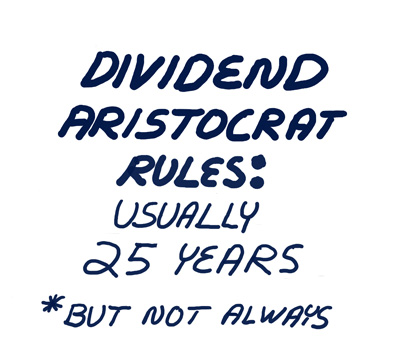
On its website, S&P Dow Jones Indices says, “The S&P 500 Dividend Aristocrats is designed to measure the performance of S&P 500 constituents that have followed a policy of increasing dividends every year for at least 25 consecutive years.” Yet, new addition J.M. Smucker has only raised its dividend for 21 consecutive years. We know this because the stock is held in the AAII Dividend Investing portfolio.
So, why did S&P Dow Jones Indices add J.M. Smucker to the index?
The methodologies for the S&P Dow Jones Indices and indexes from other providers are available online. Dividend Investing editor Derek Hageman found the following eligibility requirements for the Dividend Aristocrats:
- Must be a member of the S&P 500 index,
- Has increased total dividend per share amount every year for at least 25 consecutive years,
- Has a minimum float-adjusted market capitalization (FMC) of at least $3 billion as of the rebalancing reference date and
- Has an average daily value traded (ADVT) of at least $5 million for the three months prior to the rebalancing reference date.
In addition to these requirements, he also found “stock diversification criteria and sector diversification criteria.”
“According to the S&P Dow Jones Indices methodology,” noted Hageman, “‘at each annual reconstitution, the minimum number of constituent stocks is 40 … if the number of constituent stocks is fewer than 40, then S&P 500 constituent stocks with a history of increased dividends of more than 20 consecutive years, also satisfying the criteria on market capitalization and liquidity above, are added in decreasing order of dividend yield until the stock diversification criteria is satisfied.’”
Furthermore, “‘As part of the annual reconstitution, if the sector diversification criteria is not satisfied following the selection of constituent stocks as detailed above, the following additional steps are taken: The S&P 500 constituent stocks with a history of increased dividends of more than 20 consecutive years, also satisfying the primary criteria on market capitalization and liquidity above, are added in decreasing order of dividend yield until the sector diversification criteria is satisfied.’”
In other words, the rule is 25 years, but if there are not enough passing stocks and/or there is not adequate sector diversification, leeway is allowed. This is not something investors would know unless they took the effort to look at the Dividend Aristocrats’ methodology.
Other indexes use different rules. You won’t know what those rules are unless you do an online search for “[index name] methodology.”
The leeway allowed by S&P Dow Jones Indices in its Dividend Aristocrats index is not a bad thing since it helps maintain diversification among companies and across sectors. Plus, 21 consecutive years of increasing dividends is still a very tough requirement to meet. We’ve seen companies raise their dividend by a penny per share just to keep their streak of consecutive dividend increases going and maintain their “aristocrat” status.
The lesson for those of you who own passively managed mutual funds and ETFs is to take a little bit of time to look at the rules of the indexes those funds follow. Those rules may or may not be what you’d expect based on the index’s name or a brief description of the index.
(A quick side note before ending today’s commentary: Some of you might have noticed the use of both “indices” and “indexes.” S&P Dow Jones Indices is the formal name of the company. The AP Stylebook—whose guidelines we and many other outlets follow—uses “indexes.” Merriam-Webster lists both “indices” and “indexes” as the plural of “index.”)

-
Viewing the Sector Exposure of Dividend Stocks Through the Aristocrats
One factor that dividend investors often overlook is asset allocation, or the type of firms being invested in. -
Dividend Aristocrats With Longest Streak of Dividend Increases
The Dividend Aristocrats strategy has demonstrated a history of weathering market turbulence over time by capturing most of the gains of rising markets and fewer of the losses in falling markets. -
Pros and Cons of Two Dividend Investing Strategies
Which are the better dividend-paying stocks—stocks with a lower initial yield but with a high dividend growth rate, or stocks with a low dividend growth rate but with a higher initial yield? -
The Individual Investor’s Guide to the Top Mutual Funds 2023
Out of the more than 50 mutual fund categories covered in this year’s guide, just three realized positive returns last year. -
Millionaires Worry $1 Million Is Not Enough for Retirement
Thirty-five percent of high-net-worth investors think it will take a miracle to achieve a secure retirement, a survey found.
Members are looking for your input. Can you help with this question from the Value Investing Community?
“In the article ‘Warren Buffett and the Evolution of Value Investing,’ Robert Hagstrom discusses how the value factor has progressed through three stages: classic value investing; valuing a business, not a stock; and the value of network economics. He also shares his thoughts on Buffett’s allocation and overall strategy. What were your initial thoughts when reading this article about Hagstrom’s personal observations about value investing as a whole, as well as Buffett’s strategy?”
Tap the button and then choose the Join the Community button on the right to answer this question in the AAII Community
Answer This Question in the AAII Community »
AAII Sentiment Survey
Optimism among individual investors about the short-term direction of the stock market jumped to its highest level in more than a year according to the latest AAII Sentiment Survey. Neutral sentiment also rose, while pessimism fell.
Bullish sentiment, expectations that stock prices will rise over the next six months, rose 7.6 percentage points to 37.5%. This is the highest level of optimism registered by the survey since December 30, 2021 (37.7%). It is also the first time in 58 weeks that bullish sentiment is at or above its historical average of 37.5%.
Neutral sentiment, expectations that stock prices will stay essentially unchanged over the next six months, rose 2.0 percentage points to 37.5%. Neutral sentiment is above its historical average of 31.5% for the sixth consecutive week. At six weeks, this is the longest streak of above-average neutral sentiment since a seven-week stretch in December 2021 and January 2022.
Bearish sentiment, expectations that stock prices will fall over the next six months, fell 9.6 percentage points to 25.0%. This is the lowest level of pessimism registered by the survey since November 11, 2021 (24.0%). Bearish sentiment is below its historical average of 31.0% for just the fourth time out of the past 64 weeks.
The bull-bear spread (bullish minus bearish sentiment) is 12.5%. This is the first positive reading in 45 weeks and the first above-average reading in 58 weeks.
This year’s rebound in stock prices along with less aggressive monetary policy are likely contributing to the improved level of optimism. Nonetheless, concerns about the economy, inflation and corporate earnings remain.
Bullish: 37.5%, up 7.6 points
Neutral: 37.5%, up 2.0 points
Bearish: 25.0%, down 9.6 points
Bullish: 37.5%
Neutral: 31.5%
Bearish: 31.0%
See more Sentiment Survey results.

February 2, 2023 We Want Your Feedback on an AAII Journal Article Idea
January 26, 2023 Two Ways to Select a Stock From a Screen
January 19, 2023 Closed-End Muni Bond Funds Are Cutting Their Payouts
January 12, 2023 Optimism Among Individual Investors Was Historically Low Last Year

Discussion
Frank Mix from GA posted over 3 years ago:
Mandatory Arbitration Clauses are designed to greatly favor the corporation over the individual. The arbitrator is typically paid by the corporation and too many decisions against the corporation may cost the arbitrator future business. For this reason I prefer mandatory clauses be illegal. Using an arbitrator is fine if both parties agree. Thanks.
Nancy V from CA posted over 3 years ago:
Mandatory arbitration clauses should be outlawed in our opinion. The arbitration sessions are usually held at the location chosen by the corporation, and the arbitrator is selected by the corporation. Mediation (in which the mediator's opinion is optional) should be tried first, and the right to sue should be an option. Too often, people don't read the boilerplate contract language, and don't realize their legal rights are being forfeited. Also, companies are usually not willing to strike this language. Another more concerning item that we are seeing in contracts is an Indemnification Clause. We are currently in the process of negotiating new client documents with a new broker/dealer (through our existing advisor), and are appalled to find language that holds them harmless from even negligence and willful misconduct. While we could opt to not move to this broker/dealer if they won't modify the wording, we are concerned that more companies may adopt something similar. We urge AAII to advocate for the protection of clients' right to sue in both situations. Thank you.
Ira E from Florida posted over 3 years ago:
I am unalterably opposed to mandatory arbitration clauses. They seek to deny individuals their rights under the law in a way that is non-negotiable. While arbitration may make sense in many instances, it should be undertaken only with the voluntary informed consent of both parties and not forced on one party by the other as the price of a financial advisory agreement.
Tim from NY posted over 3 years ago:
Please work hard to outlaw mandatory arbitration clauses and any other legal concept in any retail consumer transaction that puts the individual at a disadvantage when pitted against any large corporation they transact with. The individual should have special protections under the law designed to incentivize corporations providing consumers a good or service to self regulate in favor of consumer protection.
Craig Howard from Colorado posted over 3 years ago:
Many of the earlier comments reflect an incomplete or mis-understanding regarding how arbitration is handled in the financial services industry. With very limited exceptions, FINRA (see finra.org) regulates all trading in equities, corporate bonds, securities futures, and options. All US financial services companies (i.e., investment banks & broker-dealers, but NOT commercial banks) and their agents are required to register with and follow FINRA rules and regulations. When a customer files a claim against a broker-dealer for example, FINRA assigns an arbitrator or arbitration team to conduct a hearing and make findings. I am a FINRA Arbitrator. I don't know about how arbitration is handled in other business areas, but, I can attest to FINRA's singular focus on maintaining the integrity of the arbitration process for all claims filed against financial services companies. My personal experience has been that FINRA arbitrations are handled in a very tightly controlled, fair, professional manner. The training and selection of arbitrators by FINRA are rigorous. And, the documentation required of arbitrators is substantial. I'd note that being a FINRA Arbitrator is not a profession/vocation from which I believe one can earn a living. My experience has been that cases are few and far between. And, the fees earned are nominal given the time required to prepare for and attend an arbitration hearing. This is fine with me, as I'm a retired US Army officer with other interests that keep me busy. I do have 45 years of personal investing experience with a number of brokerages, but I have never worked for any financial services company, nor has any immediate family member. Having said all of the above, I believe customers should have a choice between agreeing to have disputes settled by arbitration or filing a lawsuit. But, given the huge differences in the costs associated with litigation versus arbitration, the financial services company should also have the right to charge higher fees to those customers who want to retain the right to pursue litigation.
Bill Dornbush from Tennessee posted over 3 years ago:
I am opposed to mandatory arbitration clauses. It could be that arbitration serves a purpose but I feel I should have the choice to use it or not. Even though arbitrators say they do their best to be neutral, we must recognize that they also want to be paid and since the company usually pays, the arbitration would tend to favor the company. I would never want to use an arbitrator recommended and paid by the company against which I have a complaint.
Barry from TX posted over 3 years ago:
Thank you Derek for your continuing vigilance over the AAII Dividend offering. There are several key lessons in Charles’ “Message from Garcia”-like posting. (1) Diversification trumps time. (2) We “dumb money” folks are not that dumb. 100 % of comments see through this Trojan Horse ploy. Any arbitration clause will favor the institution against the investor. They will choose the arbitrator. They will pay the arbitrator. They will show up with a lot more evidence. Arbitration is very similar to “Let’s Make a Deal.” The host – the fund owner – knows where the payoffs are and will steer the session, so the investor always gets the goat, not the prize. Count on this outcome since THEIR lawyers will write the arbitration agreement that you MUST accept to play the game by their rules.
Claude Y Paquin from Georgia posted over 3 years ago:
In the course of my career as a lawyer, I was invited to participate in securities arbitrations conducted by a panel of three arbitrators. One of the three had to be from the “industry.” Not all disputes involve customers: some disputes are between brokers, or between a broker and an employee. Hearings were scheduled in hotel meeting rooms booked for a half day. The presentations involved voluminous documents which the arbitrators could not take the time to examine carefully. So much time was used up by the lawyers presenting their case that very little time was left for any review and meaningful discussion among the arbitrators, who were all strangers to each other and understandably not eager for late-afternoon overtime. It was a rush-rush world of jumping to conclusions and getting the job over with, and that’s not how justice ought to work. A better solution, it seems to me, would be for the SEC to appoint Administrative Law Judges, like the IRS does for tax court judges or Social Security for benefit claimants, who would be adequately trained (and supervised), properly compensated, and would take the time to review all the evidence and prepare a written opinion in support of a decision that could be appealable. There should be no mandatory arbitration clauses in investment advisory agreements unless the arbitration system is demonstrably fair, properly supervised, and with a possibility of appeal beyond a reasonable financial threshold. (Hey, it’s hardly an “agreement” if it’s mandatory!)
Al Morgan from Indiana posted over 3 years ago:
Arb Clauses do have some advantages to both sides. However, I agree as Yogi once said, In theory there is no difference, in practice there is. And its generally in the favor of the companies. But I would think a possible compromise would be, do arbrituation for $ amounts less than $10k..$5k..something like that. Or chosen arbritration judges must be proven neutral (ie. must be limited to a 40% to 60% in favor of company on record). Arbritration judges must come from an association of judges (again neutral) but randomly chosen (from a field of no less than 3 cognizant in disputed case). Arbritration must allow for redo/rearbritrate for new evidence, by appeal, proven (either statistically or directly) judge bias, by new council). The redo/rearbritrate must be done to a different (but independent) org than what was used for orig arbritrate. If many (several?) arbritrations are/have arisen due to same issue/problem/incident/company (as tracked by independent arbritration org) then it will automatically be allowed to go to US suit...doesn't have to, but allowed. If plaintiff wants he can pay for arbritration...if plaintiff wants he can put together many cases(from other plaintiffs) as one case if to a reasonable degree of same nature - as judged by independent association. Companies must freely/electronic/internet/widely publish their arbritration cases statistics and specifics as to $, what was disputed, specific service or fund or stock, resolution (in favor of company, in favor of plaintiff, compromise) every year.
Alan Jones from Ohio posted over 3 years ago:
I feel mandatory arbitration should be outlawed as a "requirement". Most, if not all firms are requiring mandatory arbitration as a requirement to do business with them. The fact that most or all firms have this requirement, limits or eliminates the choices we have as individual investors. We no longer can go to another firm, since most/all have this close. "Competition" is eliminated from a dispute resolution standpoint. If we would like to settle a dispute in a court of law, we cannot. To me, this is an industry monopoly, and should be illegal. Arbitration should be an option if both parties agree. We should not give up the constitutional right to a fair trial in order to do business with an industry. Again, it's an industry that restricts this because most/all require it.
Bruce Nickerson from California posted over 3 years ago:
Mandatory arbitration allows financial firms to charge investors less because of less litigation expense. Some claims are valid and others not so much so an arbitrary 50% in favor of either group may not be valid. If investors want the right to sue then they can use more expensive firms that do not arbitrate.
David Greenbaum from New Jersey posted over 3 years ago:
I won't give up my legal rights to do business with anyone. Mandatory arbitration clauses are bad because once a company can limit their exposure to malfeasance, they will eventually see it as profitable. Let's not forget that the raison d'être for any company is making money.
You need to log in as a registered AAII user before commenting.
Create an account