

Single-Stock ETFs Underperform the Stocks They Track
by Charles Rotblut | November 06, 2025
Featured Tickers: COIN
CONL
TSLA
TSLL
COIN
CONL
TSLA
TSLL
Leveraged single-stock exchange-traded funds (ETFs) have enriched their issuers, but not investors.
First launched in the U.S. approximately three years ago, single-stock ETFs are designed to track the performance of a single stock. They offer the possibility to realize double or even triple the return of a stock on a single day.
Among the oldest of these ETFs is the Direxion Daily TSLA Bull 2X Shares ETF  (TSLL). It seeks to realize two times (200%) the return of Tesla Inc. (TSLA) shares on a daily basis, before fees and expenses. Holding it for longer than one day can lead to disappointing results.
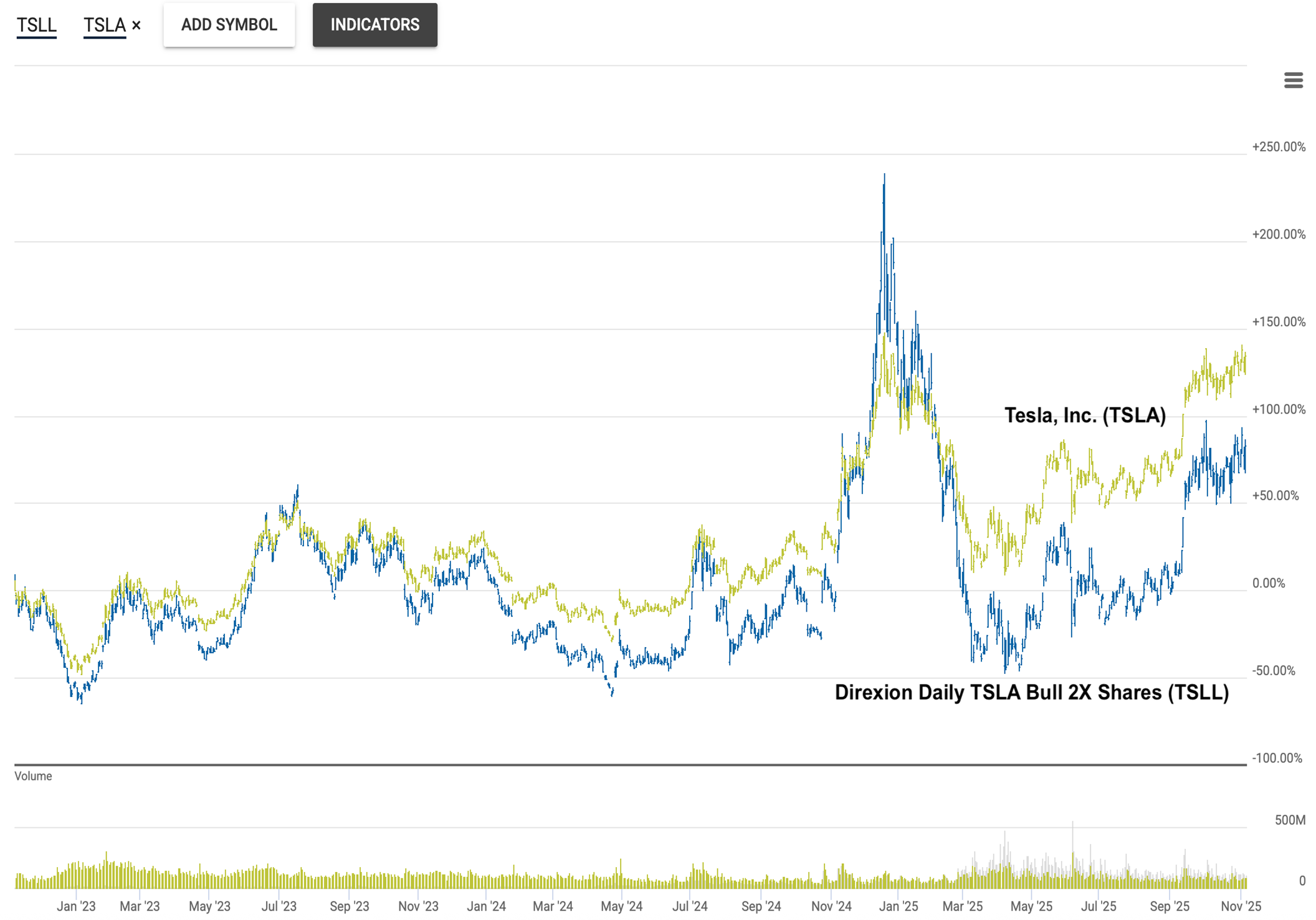
Look at the chart below. Over the past three years, shares of Tesla have gained 135%. Shares of Direxion Daily TSLA Bull 2X Shares have realized a 64% return over the same period. Yes, you read that right—the ETF has realized just half Tesla’s return.
Three-Year Performance of TSLL and TSLA
Source: AAII.com, with data from QuoteMedia as of 11/5/2025.
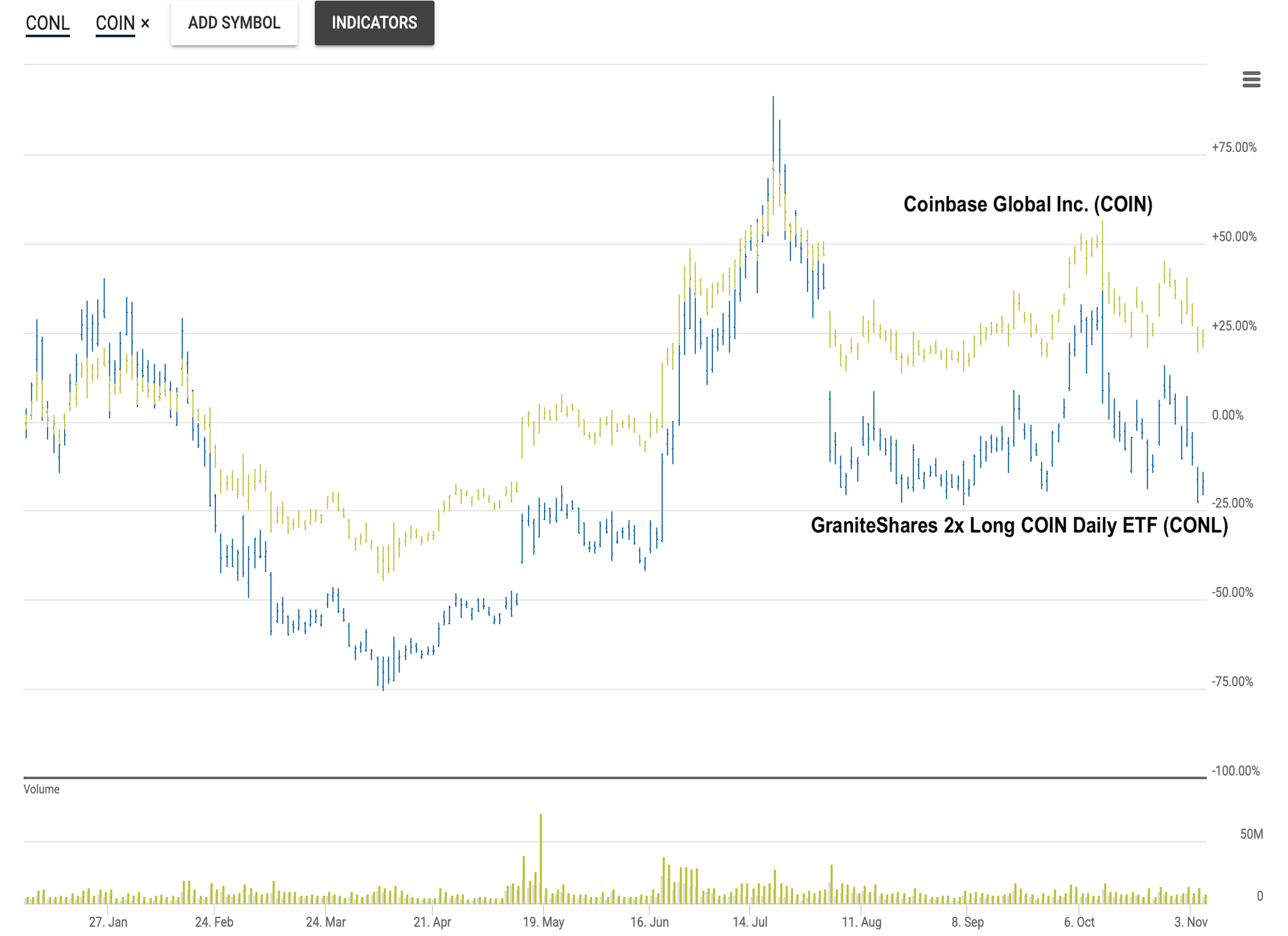
Even over shorter periods, the returns can be far different from what an investor expects. The chart below depicts the year-to-date performance of the GraniteShares 2x Long COIN Daily ETF (CONL). It is designed to realize two times the daily percentage change of Coinbase Global Inc.’s (COIN) common stock, before fees and expenses.
Year to date through the close on Wednesday, November 5, 2025, GraniteShares 2x Long COIN Daily has fallen 11%. This drop in price has occurred even though shares of Coinbase Global are up 29% this year. Ouch!
Year-to-Date Peformance of CONL and COIN
Source: AAII.com, with data from QuoteMedia as of 11/5/2025.
The differences in returns directly stem from how leveraged single-stock funds are designed. They provide a multiple of the stock’s return (e.g., 2x) for a single day, not several days, months or years. Holding one of these funds for longer than one day results in compounded returns that will not match the performance of the stock being tracked.
Matthew Crouse, CFA, Ph.D., explained the concept in a 2020 AAII Journal article: “Consider an investment that increases 10% one day and decreases 10% the next. One dollar invested would be worth $1.10 after day one and $0.99 ($1.10 × 0.90) after day two. The arithmetic average return is 0%, and yet the investor has lost 1%.
“[Leveraged investment products] amplify this effect, which has been called volatility drag or volatility decay. Using our same 10% and –10% daily returns, a 3x-leveraged ETF would have a gain of 30% on day one and a loss of 30% on day two. One dollar invested would be worth $1.30 after day one and $0.91 ($1.30 × 0.70) after day two. The arithmetic average return is 0%, and yet the investor has lost 9%!”
These returns clearly make the case for owning the stock and not the single-stock ETF. Yet despite the disappointing performance for these and other leveraged single-stock ETFs, there is currently $40 billion of investor dollars placed in leveraged single-stock ETFs, according to VettaFi data cited by The Wall Street Journal.
We at AAII commonly tell individual investors to read the fact sheets and prospectuses before buying an ETF or mutual fund. We also strongly believe that no one should buy an investment they don’t fully understand. Leveraged single-stock ETFs fall into this category.
Even if you do understand the risks of a single-stock ETF and only intend to hold it for one day, realize that you are speculating and not investing. It is impossible to predict how a given stock or even the overall market will perform on a given day. The use of leverage only amplifies the price change and the magnitude of your potential loss.

-
Leveraged ETFs: Don’t Get Wiped Out by the Tail
Think carefully before buying a leveraged investment product that might seem highly attractive based on historical performance. Two key negatives are volatility drag and tail risk. -
Online Exclusive: What to Know About Single-Stock ETFs
Single-stock ETFs carry unique risks and are only meant for sophisticated investors who are active traders. -
Identifying Quality Dividend Stocks When Yields Are Low
The newly posted November 2025 issue of the AAII Journal explores how success in today's dividend investing landscape requires abandoning the outdated practice of simply chasing the highest yields.
AAII Sentiment Survey
Neutral sentiment among individual investors about the short-term outlook for stocks increased in the latest AAII Sentiment Survey. Meanwhile, optimism and pessimism decreased.
Bullish sentiment, expectations that stock prices will rise over the next six months, decreased 6.1 percentage points to 38.0%. Bullish sentiment is above its historical average of 37.5% for the sixth time in eight weeks.
Neutral sentiment, expectations that stock prices will stay essentially unchanged over the next six months, increased 6.7 percentage points to 25.8%. Neutral sentiment is below its historical average of 31.5% for the 68th time in 70 weeks.
Bearish sentiment, expectations that stock prices will fall over the next six months, decreased 0.6 percentage points to 36.3%. Bearish sentiment is above its historical average of 31.0% for the 49th time in 51 weeks.
The bull-bear spread (bullish minus bearish sentiment) decreased 5.5 percentage points to 1.7%. The bull-bear spread is below its historical average of 6.5% for the 36th time in 40 weeks.
This week’s special question asked AAII members what they think about the Federal Reserve’s decision to cut rates by 0.25 percentage points.
Here is how they responded:
- It was the right move: 54.2%
- They should have left rates unchanged: 29.6%
- They should have cut rates by more percentage points: 9.5%
- They should have raised rates: 1.6%
- Not sure/no opinion: 5.1%
Bullish: 38.0%, down 6.1 points
Neutral: 25.8%, up 6.7 points
Bearish: 36.3%, down 0.6 points
Bullish: 37.5%
Neutral: 31.5%
Bearish: 31.0%
See more Sentiment Survey results.

October 30, 2025 Shut Up, Brain: Why Investing Is a Marathon, Not a Sprint
October 23, 2025 October Charts of Interest: Happy Birthday, Bull Market!
October 16, 2025 Gold Soars, but the Reason Isn't Clear
October 9, 2025 More Time Spent on Your Portfolio Can Worsen Returns

Discussion
Barry from TX posted 11 months ago:
Charles, #1 The lessons from this article will be included in our Thanksgiving Prayers this year. We will thank God that we are blessed to be “Dumb Money” folks, who are too stupid to be tricked by the math to invest in leveraged funds. #2 The effects of the difference in the BASE RATES on the up/down percentage moves are just "tricky" enough to mesmerize the too-cool-for-school “leveraged beta” crowd like a fat Tabby with a toy mouse on a string or a slinky on a stairway. I am so happy to be so stupid. #3 Paying attention in 7th grade paid off. #4 Maybe we should change our name to the “American Association of Dumb Investors." ”#5. Remember, Churchill was right, “Americans can always be trusted to do the right thing … once all other possibilities have been exhausted.” He ought to know. Preparing and waiting for destiny to come to you is a strategy that worked for him. It could work for us Dumb Money folks, too. #6 Thank you, Charles, for the timely reminder. AAII staff will be in our prayers, too. Regards. Happy Thanksgiving.
Barry from TX posted 11 months ago:
FYI The AAII article "What to Know About Single-Stock ETFs" by Matthew Bajkowski in November 2022 alerted us that single-stock ETFs carry unique risks and are only meant for sophisticated investors who are active traders.
You need to log in as a registered AAII user before commenting.
Create an account