

More Time Spent on Your Portfolio Can Worsen Returns
by Charles Rotblut | October 09, 2025
Having more time to manage your portfolio doesn’t lead to better results. In fact, it may lead to worse outcomes.
Yes, setting aside more time gives you more opportunities to research companies, analyze financial statements and carefully weigh investment options. However, none of this is the same as having a disciplined, evidence-based process that you routinely follow.
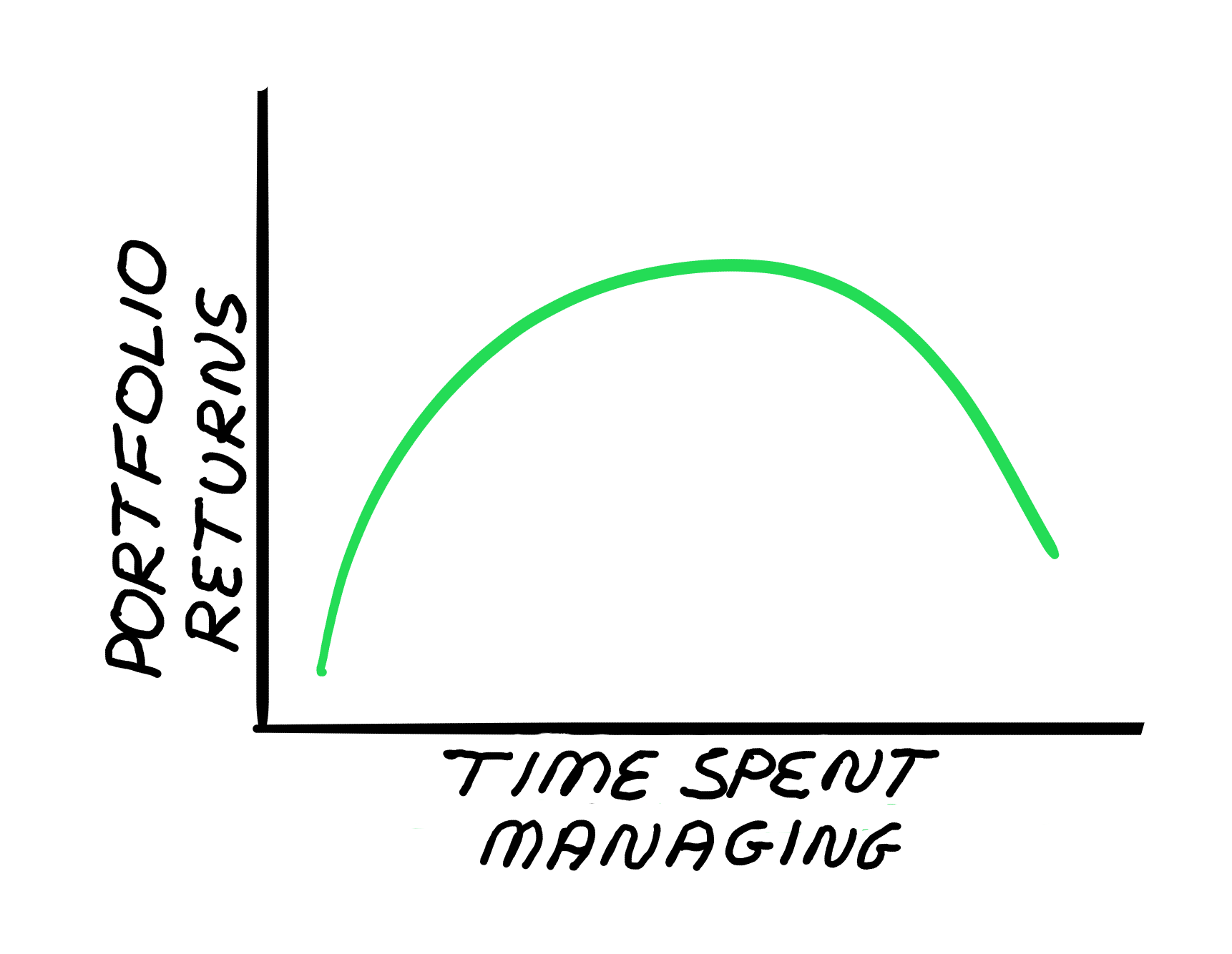 A study conducted by researchers from Umeå University in Sweden demonstrated this. They tracked 59,105 individual investors for five years—two years before retirement and three years after retirement. Detailed portfolio data from the Swedish Tax Agency was used to analyze how those investors performed.
Returns worsened after retirement, when those investors had more time to analyze investments. Risk-adjusted alpha fell 0.6 percentage points after retirement. For combined stock and mutual fund portfolios, alpha fell 0.5 percentage points. (Alpha is the additional return attributed to an investor’s decisions.)
These decreases in alpha may not seem significant until you realize that the investors tracked, as a group, were already underperforming. Prior to retirement, their average portfolios were underperforming by 3% to 4% annually. The extra time spent managing their portfolios made matters worse. The Swedish study illustrates the law of diminishing returns in action: Beyond a certain point, additional time spent on portfolio management becomes counterproductive.
One cause of the worsened performance was increased trading activity. Annual trading frequency was up 7.7% after retirement, adding about one-quarter of a trade per year. The number of stocks held in portfolios also increased, from an average of 5.5 stocks before retirement to 6.3 stocks after retirement. There was also greater variation in behavior after retirement, as some retirees became substantially more active traders.
Increasing the time spent researching stocks makes intuitive sense. Time constraints during working years create a barrier to processing investment information. Remove that barrier by retiring, and investors have more time and energy to devote to their portfolios.
While this might seem like an advantage, it’s disadvantageous if it causes a person to stray from a disciplined process. It is even more dangerous if one doesn’t have a good, repeatable process before increasing the amount of time spent analyzing investments.
So how much time should disciplined investors spend managing their portfolios?
The range of time a disciplined investor needs to spend on their portfolio starts at just a few minutes per year. A passive investor holding exchange-traded funds (ETFs) or mutual funds that track well-known indexes will only need to periodically check their statements, ensure their portfolio allocation is close to their target and take any needed withdrawals [e.g., required minimum distributions (RMDs)].
Investors holding individual stocks should monitor quarterly earnings reports. A weekly or monthly check of your portfolio will allow you to catch any important news or events. Pay attention to any changes that might cause a stock to meet a predefined sell rule, such as a high valuation.
If you prefer to check your portfolio daily, consider doing so after the U.S. markets have closed so you have a cooling off period before acting on any emotions.
Only those engaging in trading or other active strategies need look at their portfolio more frequently. Even then, you should follow a disciplined process governing what you will look at and what decisions you will make.

-
A One-Page Plan for Maximizing Long-Term Wealth
The PRISM Wealth-Building Process can be used to set up and carry out a disciplined plan for accumulating wealth. -
Active Versus Passive: Which Do You Choose?
Active management provides more control, but passive management reduces expenses. -
Understanding the Performance Measurement Enigma
The October 2025 AAII Journal explains why the most common method to calculate fund performance does not reflect how most people invest.
AAII Sentiment Survey
Optimism among individual investors about the short-term outlook for stocks increased in the latest AAII Sentiment Survey. Meanwhile, neutral sentiment increased and pessimism decreased.
Bullish sentiment, expectations that stock prices will rise over the next six months, increased 3.0 percentage points to 45.9%. Bullish sentiment is above its historical average of 37.5% for the fourth consecutive week. Optimism was last higher on December 5, 2024 (48.3%).
Neutral sentiment, expectations that stock prices will stay essentially unchanged over the next six months, increased 0.6 percentage points to 18.5%. Neutral sentiment is unusually low and is below its historical average of 31.5% for the 64th time in 66 weeks. This is the first time neutral sentiment has been below 20% for four consecutive weeks since 2007.
Bearish sentiment, expectations that stock prices will fall over the next six months, decreased 3.5 percentage points to 35.6%. Bearish sentiment is above its historical average of 31.0% for the 45th time in 47 weeks.
The bull-bear spread (bullish minus bearish sentiment) increased 6.5 percentage points to 10.2%. The bull-bear spread is above its historical average of 6.5% for the first time in 10 weeks.
This week’s special question asked AAII members which market-capitalization style of stocks they expect to outperform over the next six months.
Here is how they responded:
- Small-cap stocks: 33.5%
- Large-cap stocks: 29.2%
- Mid-cap stocks: 17.3%
- Not sure/no opinion: 20.0%
Bullish: 45.9%, up 3.0 points
Neutral: 18.5%, up 0.6 points
Bearish: 35.6%, down 3.5 points
Bullish: 37.5%
Neutral: 31.5%
Bearish: 31.0%
See more Sentiment Survey results.

October 2, 2025 Mutual Funds to Gain ETF Tax Advantages and Intraday Trading
September 25, 2025 Options for Your Cash as More Fed Rate Cuts Are Likely
September 18, 2025 September Charts of Interest: Rate Cuts, Plus a 3,821% Investment Return
September 11, 2025 Muni Bond Funds' Additional Advantage

Discussion
Al Harkrader from MN posted about 1 year ago:
How much of that can be attributed to investors becoming more cautious after retirement? I personally started funneling returns to "safer" vehicles. Does risk-adjusted alpha cover that?
Tyree from AR posted about 1 year ago:
I need my money back
Rob from NC posted about 1 year ago:
Garbage "research." "Risk-adjusted alpha" is meaningless jargon. Evidently, Swedes as a group are chronic underperformers, because [p]rior to retirement, their average portfolios were underperforming by 3% to 4% annually"! REALLY!? So this study involved people who already don't know how to invest!?
EdgeOfFree from CA posted about 1 year ago:
The basic premise has been reported on for many years - more time = more trading = worse returns. The “Risk-adjusted alpha” also is mis-leading. The decision to take on “more risk” is one of THE most important decisions you can make. If you have the time to monitor the market and you outperform the index (SPY) by 2x on longer than a 1-yr time-frame because you added the right stock and options, i.e., added risk, then why should I subtract the amount attributable to that decision? Yes, extra risk can cut both ways, but I would not measure “risk-adjusted” - just measure my returns. If I outperformed a 60/40 portfolio because I’m at 130% stock … how is that bad? I agree with calling out the risk for those who may try and time the market with short-term trading - it rarely, if ever, works. Managing the amount of “Risk” one can handle is a major skill and opportunity that should not be ignored IMO.
Barry from TX posted about 1 year ago:
Charles, does this “prove” Proverbs 16:27-29, “idle hands are the devil’s workshop?” Does the “frowny face” graphic portray the face of every wife of every retiree husband saying “Amen” in unison?
Charles M Rotblut from Illinois posted about 1 year ago:
Al - The authors found that the retirees held more stocks in their portfolios after retirement.
Rob - Underlying the alpha calculated was an increase in trading activity. Some of the retirees more actively traded their portfolios, which led to the decrease in alpha.
Barry - You could interpret the chart as wives who were perturbed about their husbands not understanding "together forever but not for lunch". :)
Charles
You need to log in as a registered AAII user before commenting.
Create an account