

Can AI Help Manage Your Portfolio?
by Charles Rotblut | August 13, 2026
About 40% of consumers “have sought help from [artificial intelligence (AI)] to manage their personal finances,” according to a recent JD Power survey. More than one in four respondents (27%) found AI to be “somewhat or significantly helpful.”
The top three ways consumers have used AI are to compare prices (24%), to find coupons or discounts (22%) and to get suggestions for increasing income or saving money (21%). I can vouch for using AI to compare prices. I recently used ChatGPT to help me get a better price on a Garmin running watch. The result was $25 in savings.
The JD Power survey follows a Lloyds Banking Group survey that found that 56% of adults in the U.K. used AI in the last 12 months to assist them with managing money. More than half of those individuals sought information on “budgeting, savings planning or general financial education.” Additionally, over one-third of those AI users (37%) reported that they “engage with AI for investment research and recommendations.”
Is AI reliable enough to use for managing your portfolio? The answer is “it depends.” What information you ask it for and how you write queries (aka prompts) matters greatly. So does your ability to confirm whether the answer it provides is correct.
Demographics and Prompts Influence AI’s Suggestions
A study conducted earlier this year by researchers at the Massachusetts Institute of Technology (MIT) and Stanford University asked a demographically representative sample of adults to write free-text prompts to a large language model (LLM) financial adviser. Each person was asked to describe their finances, then ask the AI chatbot how much to spend and how to invest between stocks and safer options.
These prompts were then organized into 12 buckets defined by employment status, age and income. Prompts from each bucket were randomly selected and used to create simulated life paths. The researchers simulated 1,000 individuals. Each person started at age 22 with no wealth, retired at age 65 and died at age 90. ChatGPT version GPT-5.2 was used.
The chatbot recommended saving more during one’s working life and drawing down savings in retirement. This is consistent with well-established financial practices. The AI-generated allocations called for an average 65% weighting in stocks that decreases with age. The one exception was for young adults with little wealth; the AI chatbot suggested that they build an emergency fund first.
About 30% of suggested savings rates were multiples of 10%, and 34% of suggested dollar amounts were multiples of $5,000, demonstrating a bias toward simple, round numbers. The 4% rule was proposed as the basis for withdrawal strategies in 85% of the chatbot’s recommendations. This rule calls for withdrawing 4% of your portfolio balance at retirement, then increasing that dollar amount each year for inflation. The study’s authors noted that academic prompts led to more flexibility in determining how much to withdraw.
The prompts used mattered. Modeled wealth at age 60 was lower for women, study participants who had low levels of financial literacy and those who had not previously used AI for financial advice. According to the study’s authors, the AI chatbot suggested lower stock allocations for female investors and those with lower financial literacy. The chatbot’s simulations also resulted in lower savings for participants without the relevant AI experience. All outcomes assume that investors will follow the AI’s advice and act accordingly—a big assumption.
Where AI Can Help Investors
AI chatbots are good at summarizing long documents into bullet points. This can be useful if you want to analyze a company’s regulatory filings, investor presentations or other lengthy documents.
I’ve found AI to work well with spreadsheets. It can quickly convert a formatted PDF table into an Excel file. You can use it to create spreadsheet models to do your own analysis or forecasting. However, you will have to go through the spreadsheet to ensure that all calculations are done properly, especially if data is being pulled in from different cells. The more information and feedback you give the chatbot, the better the outcome.
You can also use AI to search for information, whether on a specific investment, economic data or financial research. In doing so, be sure to instruct the chatbot to only look at reliable sources and then do your own research to confirm that its output is correct.
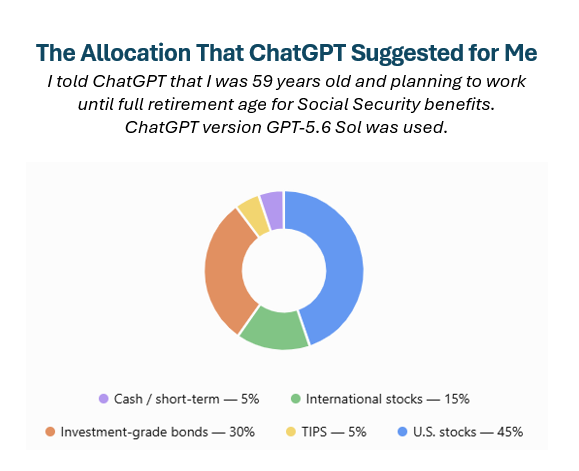
As far as your allocation is concerned, AI can suggest a portfolio mix, but view its suggestions as a starting point instead of personalized advice. The allocation that ChatGPT gave me this morning is more conservative than what I use for my retirement savings. AI chatbots have shown themselves to be reward-seeking and therefore can be prone to giving you answers they think you want to hear instead of answers you don’t want to hear.

-
Using Large Language Models for Stock Valuation Analysis
Given structured inputs, LLMs can reproduce the logical framework for valuation and generate multiple scenarios. -
Power Up Your Portfolio With AI: A Practical Guide for Individual Investors
AI tools like ChatGPT and Claude can be used to organize your portfolio, run “what-if” scenarios and test rebalancing strategies. -
Tax-Advantaged Income From Muni Closed-End Funds and ETFs
The August 2026 AAII Journal explores how closed-end municipal bond funds or muni bond ETFs may make sense for those in high tax brackets in search of income.
AAII Sentiment Survey
Neutral sentiment among individual investors about the short-term outlook for stocks increased in the latest AAII Sentiment Survey. Meanwhile, optimism and pessimism decreased.
Bullish sentiment, expectations that stock prices will rise over the next six months, decreased 2.3 percentage points to 34.7%. Bullish sentiment is below its historical average of 37.5% for the fourth consecutive week.
Neutral sentiment, expectations that stock prices will stay essentially unchanged over the next six months, increased 2.4 percentage points to 27.4%. Neutral sentiment is below its historical average of 31.0% for the 23rd consecutive week.
Bearish sentiment, expectations that stock prices will fall over the next six months, decreased 0.1 percentage points to 37.9%. Bearish sentiment is above its historical average of 31.5% for the 27th consecutive week.
The bull-bear spread (bullish minus bearish sentiment) decreased 2.3 percentage points to –3.2%. The bull-bear spread is below its historical average of 6.5% for the fourth consecutive week.
This week’s special question asked AAII members whether they think other investors are too bullish or too bearish right now.
Here is how they responded:
- They are too bullish: 47.6%
- Their sentiment toward the market is about right: 22.7%
- They are too bearish: 19.5%
- Not sure/no opinion: 10.3%
Bullish: 34.7%, down 2.3 points
Neutral: 27.4%, up 2.4 points
Bearish: 37.9%, down 0.1 points
Bullish: 37.5%
Neutral: 31.0%
Bearish: 31.5%
See more Sentiment Survey results.

August 6, 2026 Widening Operating Margins Are Boosting Earnings, for Now
July 30, 2026 Many of This Year's New ETFs Are Speculative or Complex
July 23, 2026 July Charts of Interest: The Widespread Influence of AI Spending
July 16, 2026 How to Build an Earnings Season Watchlist

Discussion
Rob from NC posted about 1 month ago:
It looks like AI is relying on college professors for its investing "intelligence." The allocation ChatGPT proposed is insane. Thus, I have no fear that it will replace me as the family investment manager anytime soon.
Dietmar from Austria posted about 1 month ago:
AI can be useful for extracting data from financial reports to fill in your personal check list if buying or selling a stock. But it is essential to recheck and calculate some of the data yourself.
Barry from TX posted about 1 month ago:
Charles, #1 Thanks for morphing into the unautomated AAII version of “Charles the Chat Bot” 1.0 [CtCB1.0] and reporting on the surveys and your experiences using AI in investment management. I learned more from you than the academics’ research. Imagine that. (It has happened several times in my life.) #2 Dr Bob nailed it as usual: ‘It looks like AI is relying on college professors for its investing "intelligence."#3 BIG QUESTION I HAVE: Why didn’t you reference the [many] AAII articles on AI that provided tutorials, prompts, and scripts as learning tools? I found them to be very helpful tutorials and a big time saver. #4 I detected several biases that these researchers introduced. (1) The unspecified “demographic models” they used to “fit” their data most likely reflect their personal and demographic biases (and we know how that skews data). (2) The surveys did not define their assumptions about portfolio allocations and portfolio construction, i. e, they did not use a COMPLETE systematic step-wise approach like AAI PRISM does. Thus, we have no “model” or any historical data to compare the validity of their assumptions and outcomes. #5 My experience with chatbots is similar to yours. I use them to automate tedious tasks my operating system does not do, but I DO NOT TRUST THE INFO THEY PROVIDE. I see too many biased, tilted, and/or incomplete responses to trust them. #6 Since around 2023 or so, Morningstar has published a series of articles to inform Financial Advisors on how to use AI, and SCHW and other brokers have proprietary programs to educate their “captive network” of FAs on AI. #7 In ALL of the (many) FA surveys I have read, the FAs MAIN GOAL for using AI is to automate the CLIENT CONTACT PROCESS end-to-end so they can focus on “growing the business.” Interfacing directly with clients is THE MAIN service FAs provide. FAs want to use AI to manage the exact jobs that you pay an FA a FEE to do – PERSONALIZED advice and hand-holding to slake emotions. #8 This two-pronged trend – (a) relying on AI bots to do the jobs brokers do and (b) FAs were supposedly “certified” to do – is disturbing for the work efforts and ethics of the FA profession. #9 Add the growing deployment of ROBO advisors and very soon client contact will vanish, but the fees will not. Dr. Bob and the AAIIers vs the “Robo FAs.” Sounds more exciting than Godzilla vs Mothra. So, desu ka, ne?
Sam from MI posted about 1 month ago:
@Barry, I agree with you about how brokers are using chatbots to automate the front end of the client relationship. It reminds me of air travel; on one hand, we want concierge service and comfortable seats but, on the other hand, we make our buy decision by price. Happily, there seems to be a consumer revolt against subpar automated service these days. This morning, a car dealership used an automated sales process on me and, when I asked for the price, it auto-responded with, "We use market-based pricing," which made me laugh. Well, chatbot, so do I, and your price isn't competitive and I'm disgusted as well.
Barry from TX posted about 1 month ago:
@Sam, good post. Today's "robo chatbots" are trying to reprogram our thoughts to conform to today's "large language model" training databases... just like the "creatures from outer space" (oddly enough, the abbreviation here is "CFOs") in the 1956 horror movie "Invasion of the Body Snatchers," where creatures from outer space reprogram our brain ... if you ever go to sleep. Stay awake. The CFOs are coming for us. Regards
Barry from TX posted about 1 month ago:
THE EVENT I am waiting for is a real-money contest between (1) a group of at least 30 FAs and (2) at least 3 chatbots competing over one year. Each contestant must manage 3 portfolios: (1) for a 25-year-old, (2) for a 45-year-old, and (3) for a 65-year-old, where each starts with the national average level current investment levels each age group currently owns. Oh, by the way, I want AAII to enter as the dark-horse 50-to-1 entry. Could be great advertising ... or not. Then we can compare the effectiveness of human and chatbot technologies.
Rich from NV posted about 1 month ago:
I find the surveys lacking critical background data to be relevant. A few significant numbers that would lend credence to the surveys are: number of participants, number of retirees participating, net worth of participants (or worth of portfolio) and age of participants. I am a long-time member of AAII. I have seldom participated in the surveys and I rarely more than glance at them. In my search of the AAII website, I found only two articles shedding any light on the demographics of the surveys’ universe, one from 2004 and one from 2013. A more frequent update on AAII members’ demographics would be very much welcomed by me; I would especially be interested in the membership by country.
You need to log in as a registered AAII user before commenting.
Create an account