

Answering AAII Member Questions About Tokenized Stocks
by Charles Rotblut | August 27, 2026
Several members asked questions and posted comments in response to this month’s AAII Journal article “A New Form of Share Ownership: Issuer-Sponsored Tokens.” For those of you who have not read the article yet, stock transfer agent Computershare announced earlier this year that it will support U.S.-listed companies that choose to issue tokenized versions of their stocks.
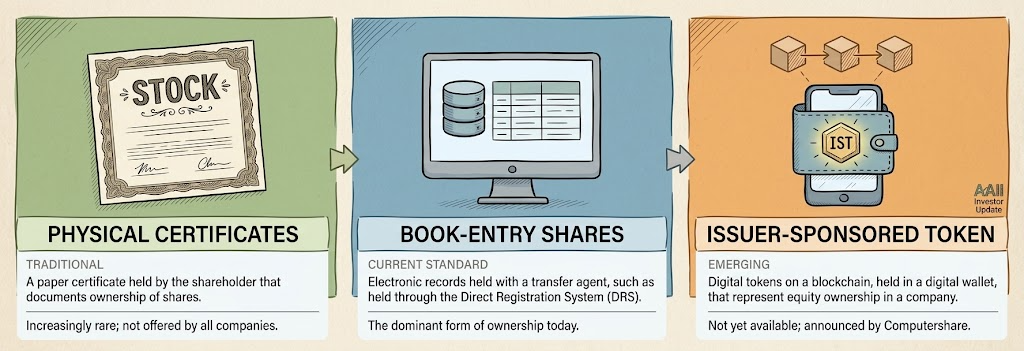
Issuer-sponsored tokens (ISTs) will be a third form of stock ownership. The other two options are physical stock certificates, when offered, and book-entry shares, such as shares held through the Direct Registration System (DRS).
The move toward tokenized shares involves many of the largest companies in the financial industry. More than 30 financial firms participated in a trial recently in which financial securities such as stocks and bonds were converted into digital tokens. Those companies included BlackRock, CME Group, Goldman Sachs, Invesco, J.P. Morgan, S&P Dow Jones Indices, Vanguard and others.
Here are the paraphrased questions from AAII members and my answers.
Why Would Someone Want an IST?
One reason is settlement. Tokenized shares will trade on a blockchain, providing instantaneous settlement. Another reason is the ability to hold stocks in a digital wallet. Though digital wallets are not widely used right now, this could change if stablecoins gain more traction. Both your stablecoins and your securities could conceivably be held in a single wallet, providing some simplicity.
Why Would I Forgo SIPC Coverage?
Forgoing coverage from the Securities Investor Protection Corp. (SIPC) is a trade-off that an investor must be comfortable making if they are interested in ISTs. Under current law, SIPC coverage does not extend to digital wallets held by individuals. Even brokers that offer cryptocurrency trading, such as Fidelity and Robinhood, hold those coins outside of the SIPC-member broker-dealer accounts where traditional securities—such as stocks, bonds and exchange-traded funds (ETFs)—are held.
How Will Tax Reporting Work for Tokenized Stocks?
Current tax rules require reporting of all digital asset transactions “whether or not they result in a taxable gain or loss.” Short- and long-term capital gains rules apply. Brokers that facilitate digital asset transactions are required to issue a Form 1099-DA. That said, regulations will need to catch up with evolving technologies.
How Is the Transfer Agent Notified of a Wallet-to-Wallet Transfer?
Transfers of ISTs from one digital wallet to another will be recorded on the blockchain. The transfer agent (e.g., Computershare) will then reflect the ownership record change on the company’s master securityholder file. Note that each issuer determines the specific blockchain(s) its IST can trade on and the type(s) of digital wallet(s) it can be held in. In addition, ISTs may only be transferred to individuals or entities that have been “allowlisted,” meaning that their identities have been verified, they have passed sanctions screening and are connected to their digital wallets.
Conclusion
I want to stress that officially tokenized stocks and bonds are still in their early stages. I use the word “officially” because some tokenized vehicles currently exist that track the price of an underlying asset. However, these tokenized vehicles don’t provide actual ownership of the underlying assets. Contrastingly, ISTs will represent actual equity ownership in the company.
It is uncertain when ISTs will start becoming available. The companies Computershare has spoken with were described to us as being in an “educational phase.” Once ISTs start launching, watching and waiting will be a prudent strategy.

-
An Individual Investor’s Intro to Stablecoins
Initially used for cryptocurrency trading, stablecoins are becoming an alternative for payment systems that could eventually supplant credit cards. -
Bitcoin and Beyond: Your Options for Investing in Crypto
The world of cryptocurrency continues to evolve as it garners mainstream acceptance from governments, traditional financial institutions and investors. -
Trump Accounts: Key Rules to Know Before You Contribute
The August 2026 AAII Journal outlines the positives and caveats to consider with the new Trump Accounts.
AAII Sentiment Survey
Pessimism among individual investors about the short-term outlook for stocks increased in the latest AAII Sentiment Survey. Meanwhile, optimism and neutral sentiment decreased.
Bullish sentiment, expectations that stock prices will rise over the next six months, fell 2.5 percentage points to 32.9%. Bullish sentiment is below its historical average of 37.5% for the sixth consecutive week.
Neutral sentiment, expectations that stock prices will stay essentially unchanged over the next six months, decreased 2.0 percentage points to 22.6%. Neutral sentiment is unusually low and is below its historical average of 31.0% for the 25th consecutive week.
Bearish sentiment, expectations that stock prices will fall over the next six months, rose 4.5 percentage points to 44.4%. Bearish sentiment is unusually high and is above its historical average of 31.5% for the 29th consecutive week. Bearish sentiment was last higher on June 11, 2026.
The bull-bear spread (bullish minus bearish sentiment) decreased 7.1 percentage points to –11.5%. The bull-bear spread is below its historical average of 6.5% for the sixth consecutive week.
This week’s special question asked AAII members how they would describe the earnings guidance given by companies during second-quarter 2026 earnings season.
Here is how they responded:
- Better than I expected: 49.0%
- Approximately what I expected: 27.6%
- Worse than I expected: 6.2%
- Not sure/no opinion: 17.2%
Bullish: 32.9%, down 2.5 points
Neutral: 22.6%, down 2.0 points
Bearish: 44.4%, up 4.5 points
Bullish: 37.5%
Neutral: 31.0%
Bearish: 31.5%
See more Sentiment Survey results.

August 20, 2026 August Charts of Interest: 30-Year Bonds Make Headlines
August 13, 2026 Can AI Help Manage Your Portfolio?
August 6, 2026 Widening Operating Margins Are Boosting Earnings, for Now
July 30, 2026 Many of This Year's New ETFs Are Speculative or Complex

Discussion
John L from NJ posted about 1 month ago:
Charles please answer the question: Why would an investor forgo SPIC protection? Token execution speed can't be much faster than Fidelity Brokerages current online trading platform. And there seems to be no benefit to having a digital wallet and the additional concern of block chain security or perhaps more accurately wallet "insecurity". What is the tokenized stock advantage that would convince the average investor to give up SPIC protection?
Charles Rotblut from IL posted about 1 month ago:
Hi John,
The only apparent advantages once ISTs launch are instantaneous settlement and the simplicity of having everything in a digital wallet. If neither matter to you, then there isn't a reason to own an IST. My hunch is that we will see infrastructure grow around digital wallets, stablecoins and ISTs with big financial institutions involved. Whether the rules regarding SIPC protection evolve to cover digital assets in some manner remains to be seen.
Charles
Charles M Rotblut from Illinois posted about 1 month ago:
To be clear, settlement is when cash or a stablecoin must be transferred to the seller. Right now, settlement for stocks is T+1, meaning one day after the trade. Though brokers allow us to buy another stock or ETF immediately after selling in a cash (meaning a non-margin) account, the cash from the sale of a security do not have to be transferred to the seller's account until one business day later. With ISTs, settlement occurs immediately.
Monk Monk Jr. from Texas posted about 1 month ago:
This is an example of a solution looking for a problem, but it will create more serious problems. Here is the list of problems that this may create: - If the specific implementation of blockchain does not support PQE, then it will be subject of Harvest Now and Decrypt later sort of attacks. - Digital wallets use PKE, which requires that you remember the keys or else you lose access to your money for good. The keys are not something that a normal human can remember, so it must be stored on a computer. If that computer fails for some reason, and you cannot retrieve the keys, the money is lost. - Upon death, dealing with tokens will be a nightmare for the heirs. There is just no mechanisms in place to solve this and the technology is not going to help. - The only valid reason that is stated is instantaneous settlement. But the proposal did not explain how the market makers will work in this environment, and how buyers and sellers are going to be protected given the possibility of low volumes and hence wide spreads between bid and ask. - This will enable state actors who have computing resources to attack the financial markets far more easily than the existing systems. It is not inconceivable that the anonymity that blockchain provides will enable well healed actors to manipulate the prices of stocks and bonds without getting caught. These are some of the things that came on top of my mind (I am an engineer by training and I teach blockchain, smart contracts and cryptocurrencies at college level). I suggest that people be very careful before they jump into this stuff.
Barry from TX posted about 1 month ago:
“Monk Monk Jr. from Texas,” #1 Thank you for sharing your knowledge and taking the time and community leadership to provide this detailed list of five threats to IST ownership that every investor should consider before using ISTs. #2 The threat of losing access to a digital wallet of tokens greatly offsets the list of other “advantages.” #3 As you pointed out, the only entity benefiting here is Computershare. They are trying to make a market for their services. #4 I would love to see the contract you have to sign. Expect “Best efforts,” “Hold harmless,” and “Indemnification” clauses to be buried in a very long contract that you sign. #5 Like the lyrics in Randy Newman’s theme song from the series “Monk” say… "It's a jungle out there. ... Disorder and confusion everywhere. No one seems to care. Well, I do. … People think I'm crazy, 'cause I worry all the time. If you paid attention, you'd be worried too. You better pay attention too. … Call it paranoia. Even paranoids have enemies. ... I'm not the one who's crazy … I could be wrong, but I don't think so. 'Cause it's a jungle out there.” Regards
You need to log in as a registered AAII user before commenting.
Create an account