

A Five-Part Framework for Analyzing a Hot IPO Stock
by Charles Rotblut | June 27, 2019
This year’s hottest initial public offering (IPO) has nothing to do with ride-sharing or the tech sector. Rather, it’s a food company. Shares of Beyond Meat Inc. (BYND) are currently trading more than six times above their offering price of $25 per share. This dramatic rise has occurred in a period of less than eight weeks.
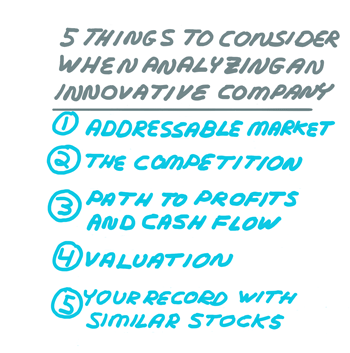 I’m focusing on Beyond Meat because it provides an example of some of the things to consider when looking at a new, innovative company. Though many of the specifics discussed here will be about Beyond Meat, each of the five questions can easily be asked about other companies as a base for analysis.
What is the addressable market?—Estimating the realistic number of customers helps to determine the size the company could grow to. It’s difficult to know what the number actually will be, but there are often clues. The reported revenue numbers for existing companies operating in the same space provide a gauge. For biotech and pharmaceutical companies, you may be able to find data on the prevalence of certain diseases with a bit of research. You can also take a step back and consider what you know.
In the case of Beyond Meat, Tyson Foods Inc. (TSN) reported 2018 beef sales of $15.5 billion. While it is not the only company selling beef, Tyson Foods serves as a useful measure because Beyond Meat’s primary product is designed to look like beef.
What Tyson Foods’ revenues don’t tell you is how many people will be regular Beyond Meat consumers. Many people enjoy their steak and hamburgers and may not find the taste or texture of Beyond Meat to be as satisfactory. Beyond Meat also costs more, putting it out of range to be included in the regular budgets of many households. Its higher level of sodium—five times the amount of beef according to Consumer Reports—may be a turn off for those who are watching their sodium intake.
What’s the current and potential competition?—Even if one takes a rosy view of the addressable market, competition may limit a single company’s ability to reach its potential. Current competitors may adapt and/or prove to be stronger than believers in the new, innovative company expect. Barriers to entry may also be lower than anticipated, leading to competition.
Real beef is obvious competition for Beyond Meat. Impossible Foods Inc., which makes the Impossible Burger, is another one. There are other competitors coming. Two weeks ago, Tyson Foods announced its own plant-based and blended (plant and beef) food products. Perdue Farms also introduced its own blended meat products (plant and chicken). Earlier this week, Whole Foods agreed to be the first U.S. retailer to carry products from U.K.-based Meatless Farm Co.
What is the path to profitability and positive cash flow?—It is not unusual for a new company experiencing strong growth to report losses and spend more cash than it brings in from business operations. Hiring staff, building up corporate infrastructure and marketing the products all cost a lot of money. At some point, a company should be able to achieve enough efficiencies and scale to both be profitable and realize positive cash flow from operations.
Beyond Meat is nowhere near this. The company’s loss widened during the first quarter. Its cash outflows from operations—the change in cash from business operating activities—were $13.3 million. Though Beyond Meat guided for adjusted EBITDA (earnings before interest, taxes, depreciation and amortization) to be breakeven by the end of the year, the figure should be taken with a grain of salt. Adjusted EBITDA is a concocted figure that management wants you to look at; it is not a measure of actual cash flow.
Margin and cash flow analysis can help you determine if the company is headed in the right direction. Over time, overhead costs (general and administrative) should decrease relative to revenues. The asset turnover ratio (average assets divided by sales) should begin to improve. Cash from operations should become positive. It’s also helpful to track management’s guidance. Analysts’ earnings estimates should be moving toward future profitability. If the company keeps falling short or the goal posts keep moving further out, it’s not a good sign.
What does the valuation imply?—Though proponents of new companies like to argue that traditional valuation measures should be ignored, they do provide a gauge of how much optimism is being priced in. Beyond Meat is a good example of this. Its current market capitalization of $9.8 billion implies a price-to-sales ratio of 46.7 relative to projected full-year 2019 sales of $210 million. Flipping the equation around, investors are pricing in more than a fortyfold increase in sales from the projected year-end level.
Determining the addressable market can help you assess the reasonableness of the figure. Growing to in excess of $9 billion in sales requires taking significant market share away from current competitors here in the U.S. and/or elsewhere in the world. Alternatively, one would have to assume that optimism about Beyond Meat’s growth prospects stays high enough to warrant a significantly high valuation for the stock in the future.
What’s your record with past similar investments?—Finally, it’s worth asking yourself about how well you’ve done with similar investments in the past. Have you correctly picked winners or losers among new, innovative companies? If the answer is yes, ask how much of your previous success was due to luck instead of skill? So-called lottery stocks can provide big gains, but they also tend to be costly investments more often than not.

-
Valuing Young Growth Companies – New York University professor Aswath Damodaran shared his six-step method for valuing growth companies with limited histories.
-
The Traits Successful Business Visionaries Share – Young companies can be assigned high valuations based on the vision their CEOs have. This article explains what the five primary types of vision are and how to monitor CEOs’ progress toward them.
Individual investors’ expectations about the short-term direction of the stock market are nearly unchanged from a week ago. The latest AAII Sentiment Survey only shows fractional changes in optimism and pessimism.
Bullish sentiment, expectations that stock prices will rise over the next six months, edged up 0.1 percentage points to 29.6%. This is the 19th time this year that optimism is below its historical average of 38.5%.
Neutral sentiment, expectations that stock prices will stay essentially unchanged over the next six months, is unchanged at 38.4%. Neutral sentiment is above its historical average of 31.0% for the 21st time in 22 weeks.
Bearish sentiment, expectations that stock prices will fall over the next six months, declined by just 0.1 percentage points to 32.1%. Pessimism is above its historical average of 30.5% for the seventh consecutive week.
All three indicators are currently within their typical ranges.
Many individual investors have been monitoring trade negotiations, particularly between the U.S. and China. The rebound in stock prices may have relieved some concerns about a steeper decline in stock prices occurring, though others still anticipate a larger drop than occurred this spring. Also having an influence are monetary policy, Washington politics (including President Trump), geopolitics, valuations, corporate earnings and the pace of economic growth.
This week’s special question asked AAII members if the Federal Open Market Committee (FOMC) should cut rates at its July meeting. Opinions were split. Slightly more than half of all respondents (53%) say no, the Fed should not lower rates. Conversely, nearly 40% of respondents say, yes, rates should be cut. Those in the “no” camp cite sustained economic growth, the current lack of inflation, the need to save cutting rates for the next recession and not reacting to political pressure. Those in the “yes” camp cite the need to offset the trade war, fending off deflationary threats and keeping the economic expansion from weakening.
Here’s a sampling of the responses:
- “No. Hold that ace until it’s needed.”
- “Yes, the economy is slowing with tariffs being part of the slowdown.”
- “No. The Fed should only cut rates if the economy is slowing, not because the president wants it.”
- “Yes, the world needs to fight deflation.”
- “No, not until there are real signs of an economic slowdown.”

Bullish: 29.6%, up 0.1 points
Neutral: 38.4%, down 0.0 points
Bearish: 32.1%, down 0.1 points
Bullish: 38.5%
Neutral: 31.0%
Bearish: 30.5%
June 20, 2019 Rate Cuts Closer to a Reality; What to Do About It
June 13, 2019 How to Take Advantage of the Gross Profitability Premium
June 6, 2019 The New SEC Rules Don’t Go Far Enough
May 30, 2019 Cherry-Picking Data to Make Active Managers Look Good

Discussion
No comments have been added yet. Add your thoughts to the discussion!
You need to log in as a registered AAII user before commenting.
Create an account