

A Five-Step Process for Building and Maintaining Wealth
by Charles Rotblut | May 21, 2020
We at AAII have been thinking about the steps investors should take if they want to build and maintain wealth. Our discussions have been part of a broader project to help you build a personalized investing plan. While the project is too new to have an official name, we’ve started referring to it by its code name, “The AAII Way.”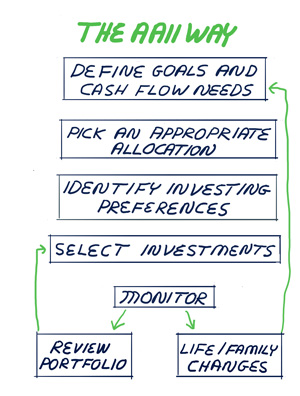
At the heart of the process are the five key steps shown in the chart to the right. They are dependent, meaning one step must be done before moving onto the next, and a change at the top or bottom can lead to a comprehensive review. Picking an allocation strategy without knowing what you’re investing for can leave you holding a portfolio unsuited to achieve your goals. Similarly, it doesn’t make sense to select specific investments without first identifying what your investing preferences are.
Complete each step and you will have an investing plan to guide you through varying market conditions and significant changes over the course of your life. We’ll be going into more detail about each one in the weeks and months ahead, but to start off with, here is brief overview of each step.
Define Goals and Cash Flow Needs: Why are you investing? When will you need the cash? How much will you need to withdraw? Answering these three questions will guide all of your other wealth-management decisions. The answers determine your investing timeline and your tolerance for risk. The first question identifies your goals. The second question defines the length of time you plan to invest. The third question defines the amount of cash you will need to pull out of your portfolio.
Pick an Appropriate Allocation: Whereas defining goals and cash flow needs clarifies why you are investing, asset allocation is the framework for how you are going to achieve them. The asset classes you choose to invest in—and the proportionate amount of savings allocated to them—will significantly determine whether your goals are reached, and your needs are fulfilled. Asset allocation also governs all of your other investing decisions. It enables you to narrow your focus, identify when to make portfolio adjustments and to create a portfolio that’s tailored to your financial and psychological tolerances for risk.
Identify Investing Preferences: How involved do you want to be in the process of managing your portfolio? How much complexity are you willing to tolerate? Is minimizing costs and taxes key or are you willing to incur some higher (but not excessive) costs to pursue a more active strategy and/or have a professional make the investment decisions/provide guidance? Give those questions serious thought as the answers will vary by person. Some individual investors enjoy rolling up their sleeves and analyzing individual securities. Some find comfort in working with a financial planner or adviser. Others sleep well at night knowing their entire portfolio is invested in traditional index funds. It’s possible to be a blend of all three. Your personality, interest, time and comfort level determine what makes sense for you.
Select Investments: Your asset allocation strategy and investing preferences guide the decisions made here. Asset allocation determines whether you should be looking at equity, fixed-income or cash investment vehicles. (Since most of you reading this already have a portfolio, the decision about what to look at depends on the changes you will need to make to your portfolio to bring it in line with your investing plan.) Your investing preferences will determine the types of investments you are seeking out, whether they are individual funds, mutual funds, exchange-traded funds (ETFs) or a combination of all three. You may even instruct your adviser or planner to assist you if your preferences call for working with one.
Monitor: The final step is reviewing your portfolio and your investing plan for changes. The portfolio review involves monitoring your investments to ensure they are not violating your sell rules. (If one or more investment violates a sell rule, go back to the previous step and find a replacement.) Periodically check your allocation to ensure it hasn’t gone too far astray form your targets. If retired, ensure your required minimum distributions (RMDs) have been taken (RMDs are suspended for 2020) and that your portfolio is still on track to provide income for the remainder of your life. Finally, take note of any life or family changes. Retirement, marriage, the birth of a new child or grandchild or a significant change in health warrant revisiting your goals and cash flow needs to see if they are still valid. If a change needs to be made, go back to the first step and revise your investing plan accordingly.
Does this process work for you? Is there something you would suggest we change? Tell us in the comments section below.
In the weeks to come, we are going to expand on The AAII Way. There are many decisions underlying the framework shown here, and we’ll be unveiling simple worksheets to help you make them. Along the way, we’ll continue to ask for feedback to ensure that what we’re creating is something you and your fellow AAII members find useful.

-
Creating and Following a Real Financial Plan – One of the keys for making better financial decisions is to understand why money is important to you, says Carl Richards.
-
Actions to Take During the Five Years Prior to Retirement – Ahead of reaching a known large life goal such as retirement, you should begin to think about how your investment profile may change and adjust accordingly.
Optimism among individual investors about the six-month outlook for stocks rebounded but remains below 30% in the latest AAII Sentiment Survey. Pessimism pulled back, while neutral sentiment is nearly unchanged.
Bullish sentiment, expectations that stock prices will rise over the next six months, rose 5.7 percentage points to 29.0%. Bullish sentiment is below its historical average of 38.0% for the 11th consecutive week and the 16th week this year.
Neutral sentiment, expectations that stock prices will stay essentially unchanged over the next six months, declined by a slight 0.1 percentage points to 26.0%. Neutral sentiment remains below its historical average of 31.5% for the 14th consecutive week and the 18th time in 19 weeks.
Bearish sentiment, expectations that stock prices will fall over the next six months, declined 5.6 percentage points to 45.0%. Pessimism is above its historical average of 30.5% for the 13th consecutive week.
Pessimism is at an unusually high level for the 11th consecutive week. Optimism is back within its typical historical range.
The continued high level of pessimism reflects the coronavirus pandemic and concerns about the economy. However, some AAII members have been encouraged by the rebound in the stock market from its March lows. Many—but not all—have also told us that they have used the downturn to look for buying opportunities among stocks (see this month’s AAII Journal for more). Other factors influencing AAII members’ sentiment include the upcoming November U.S. presidential election, corporate earnings and valuations.
In this week’s special question, we asked AAII members for their opinion of the current valuation of stocks. An overwhelming majority of respondents state that current market valuations are inflated to some degree. Specifically, 51% of respondents say that they believe stocks are at least slightly overvalued and 20% of respondents believe that stocks are very overvalued. A majority of both groups believe that current valuations reflect recent efforts by the Federal Reserve to boost liquidity, rather than actual company performance and/or earnings. This compares to 16% of respondents who say that current stock prices make sense given that a number of states and countries have begun to reopen. Additionally, 13% of respondents state that they believe the market is undervaluing stocks. Rationale includes that many companies have been able to mitigate headwinds in the current economic environment and that the market has not taken these efforts into account.
Here is a sampling of the responses:
- “I don’t believe current prices reflect the future of the market. Stock prices are being supported by actions of the Fed instead of realistic estimates of economic activity.”
- “Most are fairly priced or overpriced. However, there are some stocks like Altria Group Inc. (MO) that have price-earnings ratios of 15, which are below the S&P 500 index’s price-earnings ratio of 20 and look cheaply priced.”
- “Stocks are considerably overvalued because earnings estimates have not been revised downward enough to reflect the severity of the current recession. Unemployment is incredibly high and will be slower to recover than expected. In addition, there are going to be many more business failures and loan defaults. I expect the S&P 500 to fall to at least 1,800, and possibly to 1,300 in the next year.”
- “I feel mid-cap and large-cap stocks are at a plateau at this time, while small-cap value has plenty of room to run up with. There are many uncertainties regarding what is happening at this time for almost all levels.”

Bullish: 29.0%, up 5.7 points
Neutral: 26.0%, down 0.1 points
Bearish: 45.0%, down 5.6 points
Bullish: 38.5%
Neutral: 31.0%
Bearish: 30.5%
May 14, 2020 We’re Going to Help You Create an Investing Plan
May 7, 2020 Small-Cap Stocks Are Really Cheap, Relatively Speaking
April 30, 2020 I Rebalanced My Portfolio After Sinning a Little
April 23, 2020 Volatility Has Been Extraordinarily High, But Is Declining

Discussion
Klaus from NH posted over 6 years ago:
This concept is a great idea that frankly is overdue for AAII. It pairs nicely with the Level-3 approach. Keep up the good work and let us lifetime members know when the book is ready - I will buy a copy for myself and my three sons as they are in the beginnings of their careers and there is a dearth of pragmatic common-sense materials for the DIY.
Dave from New Jersey posted over 6 years ago:
Thank you for naming my investment approach. I was introduced to asset allocation when I signed up for my company's 401K with Vanguard and selected the Wellington Fund as my sole investment. Seeing they use 60/40 allocation and have been in existence since 1929 convinced me 60/40 might not be perfect, but at least it is not wrong. I have stuck with that allocation for 33 years and do not plan to change even after I retire.
Brian from Washington posted over 6 years ago:
Here's a suggestion for a name for the five steps to building and maintaining wealth. "Five foundations to financial security"
Jim from Utah posted over 6 years ago:
Great idea. Anxious to see the finished product, and am more than willing to help you kick the tires on the process as it evolves. I think that both this approach and the A+ Investor can benefit from the AAII Staff occasionally publishing an instructional critique (dignified and appropriately anonymous of course) of those willing to submit their work for review. A+ started publishing subscribers' stock analyses, but the constructive feedback from AAII would be most instructive. I'm happy to be a guinea pig.
Charles Rotblut from IL posted over 6 years ago:
Thanks all. The comments are appreciated.
You need to log in as a registered AAII user before commenting.
Create an account