

I Rebalanced My Portfolio After Sinning a Little
by Charles Rotblut | April 30, 2020
For several years, I’ve written and talked about my 403(b) workplace retirement account. Long-time readers of this newsletter know that I check it to see if rebalancing is needed twice a year, at the end of April and the end of October. This week was one of those weeks. I’m going to discuss my decision to rebalance along with other actions I’ve taken during the coronavirus pandemic volatility.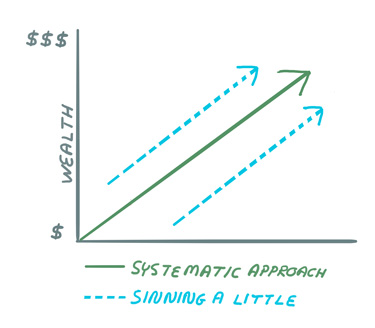
My 403(b) account is allocated to five mutual funds: Vanguard 500 Index fund (VFIAX), Vanguard Small-Cap Value Index fund (VSIAX), Vanguard FTSE All-World ex-US Small-Cap Index fund (VFSAX), Vanguard Real Estate Index fund (VGSLX) and the Vanguard Intermediate-Term Investment-Grade fund (VFIDX). The allocation is heavily weighted to equities because of the still lengthy time horizon I have before withdrawals will be taken and because of my need for portfolio growth. The bond allocation is a psychological ballast against volatility and provides a bucket I can draw from when stocks are down. (To be fair, Treasury bonds have less credit risk than corporate bonds and would provide a better ballast—though at the cost of less long-term total return.)
The target allocation is 20% to each fund. Contributions are evenly and automatically invested in each fund. A five-percentage-point band in either direction in terms of the actual portfolio weighting for each fund is used to allow for fluctuations in value. When any single fund’s allocation weight is above 25% or below 15% at the end of April or the end of October, the portfolio is rebalanced. The two dates reflect the end of the best six months for stocks (November through April) and the end of the worst six months for stocks (May through October).
The use of the allocation bands and the two calendar dates are why I rebalanced on Monday. Well, part of the reason …
I made two allocation adjustments this year. The first was on March 16, when I shifted some portfolio dollars out of the bond fund and into the S&P 500 index fund. My rationale was that the S&P 500 was down about 30% from its high on that day. The majority of the bear markets since World War II have experienced drops of less than 30%. Even if the March bear market had turned out to be worse, I figured—based on history—we were closer to the bottom than to the top. If I turned out to be early and we experienced a drop in excess of 40%, I was prepared to do it again. (The 1973–74, 2000–02 and 2007–2009 bear markets were the only ones in the post-WWII era to have dropped by more than 40%.)
The decision to act was based on what Cliff Asness, the head of investment firm AQR Capital Management, describes as “sinning a little.” The phrase refers to straying away from a systematic investment approach in a limited fashion. It’s akin to eating a dessert while on a diet. Celebrating a special event with a good dessert won’t throw off your weight loss plans. Eating cake and ice cream every day will.
March’s decision led to my actions this week. The S&P 500 fund’s allocation was above the 25% mark—thanks in part to the market’s rebound—as we approached the end of April, so I rebalanced the entire portfolio. I shifted money out of the S&P 500 fund and less out of the bond fund and increased the portfolio weightings of the other three funds. After rebalancing, the portfolio was evenly weighted at 20% per fund.
There are a few key points I want to make. Any time one strays from their systematic investment approach, there is a risk of doing more harm even though the intent is to boost returns. This is why there are dual blue bars in the doodle above. Sinning a little can boost returns but it can also hurt returns. Sinning a lot can cause a lot of harm and should be avoided.
My timing turned out to be lucky as the market bottomed a week after I made the move. The decision to act was thought out in advance and based on data—not emotions—with a preset plan to return to my systematic approach. I bumped the S&P 500 fund’s allocation only up to 25%—the upper end of the weighting range—so, I sinned a little. I avoided making a big bet given the uncertainty of the pandemic. (If I owned a working crystal ball, I would have been a more aggressive sinner. I don’t own one and acted accordingly.)
I also used the downturn to do a Roth IRA conversion and harvest some tax losses. The Roth IRA conversion had already been planned for this year; the market downturn allowed me to get a bigger bang for my tax buck. The tax loss harvesting involved selling shares out of a broad market fund (held in a traditional brokerage account) and moving the proceeds into a highly correlated but different fund. Doing so didn’t have a measurable impact on my allocation but will make my tax bill a little smaller this year. In both cases, it was a matter of being cognizant of opportunities the market was giving me to take actions in accordance with my long-term plan. (There are no free lunches on Wall Street, but sometimes you can find the opportunity to snag a snack.)

-
Best Practices for Portfolio Rebalancing – My process of periodic rebalancing is based on this study by Vanguard.
-
Stock Market Retreats and Recoveries – The data I use to gauge the severity of market declines is shown in this article by Sam Stovall.
The percentage of individual investors describing their short-term outlook for stocks as neutral climbed for the sixth consecutive week. The latest AAII Sentiment Survey also shows a rebound in optimism and a pullback in pessimism.
Bullish sentiment, expectations that stock prices will rise over the next six months, rose 5.7 percentage points to 30.6%. Nonetheless, optimism remains below its historical average of 38.0% for the eighth consecutive week and the 13th week this year.
Neutral sentiment, expectations that stock prices will stay essentially unchanged over the next six months, edged up 0.2 percentage points to 25.4%. Though a small change, it marks the sixth consecutive weekly increase and puts neutral sentiment at its highest level in two months. However, neutral sentiment remains below its historical average of 31.5% for the 11th consecutive week and the 15th time in 16 weeks.
Bearish sentiment, expectations that stock prices will fall over the next six months, fell 6.0 percentage points to 44.0%. Pessimism is above its historical average of 30.5% for the 10th consecutive week.
Bearish sentiment continues to be at an unusually high level for the eighth consecutive week. The breakpoint between typical and unusually high (more than one standard deviation above average) readings is 39.9%. Both bullish and neutral sentiment are within their typical historical ranges.
The continued high level of pessimism reflects the ongoing bear market and the coronavirus pandemic. Some AAII members have been encouraged by the rebound in the stock market from its March lows, however. Many—but not all—have also told us that they have used the downturn to look for buying opportunities among stocks. Other factors influencing AAII members’ sentiment include the November elections, corporate earnings, economic growth and valuations.
In this week’s special question, we asked AAII members how oil prices are affecting their outlook. More than two out of five (43%) of respondents say they are feeling more bearish given the recent oil market volatility. Rationale within this group includes a belief that the price of a barrel of oil has a profound impact on the global economy and that negative crude futures indicate a long road to recovery for both the energy sector and overall economy. This group compares to 35% of respondents who state that they are now more bullish in the long term. Many within this group believe that the market has bottomed out and that, in the short term, lower crude prices will benefit the travel and farming industries. Finally, 22% of respondents state that oil prices are not affecting their economic outlook.
Here is a sampling of the responses:
- “Oil price decline is a somewhat bearish signal for me. But the sector has good future value—with companies that have solid balance sheets.”
- “Here in oil-rich Oklahoma, the state economy will ‘tank’ until the price of WTI crude increases. Personally, does not impact my investment decisions. I do not own any exploration and production stocks.”
- “I figure oil prices will remain low for quite a while. Small producers will go out of business. However, after things settle down, it really doesn’t change my outlook for the big picture.”
- “I see oil prices as a positive! Low oil prices help the costs of companies struggling from the pandemic.”

Bullish: 30.6%, up 5.7 points
Neutral: 25.4%, up 0.2 points
Bearish: 44.0%, down 6.0 points
Bullish: 38.5%
Neutral: 31.0%
Bearish: 30.5%
April 23, 2020 Volatility Has Been Extraordinarily High, But Is Declining
April 16, 2020 What to Do With the Stimulus Check
April 9, 2020 The CARES Act and Tax Rule Changes
April 2, 2020 Measuring Companies’ Financial Strength Amid Spike in Borrowing

Discussion
c bird from Washington posted over 6 years ago:
I am curious have you actually done an evaluation of how much better (or worse ) you are because of continual re balancing of equities. Yes I read Paul Samuelson's "The mathematics of Speculative Price" in April 1973, SIAM Review. But I am still skeptical. 1975, visiting Asst Prof, Math Dept IU, Indiana U contributes, 2000 to TIAA-CREF. I split it 50/50 and ignore it till 2016. by 2016 I'm ~3/4 CREF and 1/4 TIAA. If I had re-balanced every year or every decade I'd have about 1/3 less than I do know. similar story at my next position though VALIC seriously underperformed, TIAA-CREF but that's UGA for you Moral CROE is not always a good idea
Dave G. from WA posted over 6 years ago:
C. Bird Your result is easy to explain. By not rebalancing your 50/50 split you let your "winners" run (equities) and did not sell them and add to the "losers" bonds. Because of your large bond position, it was quite noticeable. It does not mean it was the right thing to do. If your risk tolerance is 50/50 then the reason you rebalance is to manage that risk and not let it get too far from where it should be. It is not to make more or less return as that result is "unknowable" in advance. Whether Charles made money by "sinning" or lost money by sinning is out of his control and actually is not really the point. The point is only to maintain your asset allocation. It's fun sometimes to try and make more money, it's just safer to stay to your written plan and not "play" with your future retirement just because you think you know where the market is going.
John Lambert from NJ posted over 6 years ago:
Sinning a little? When stocks are down 30% it is time for long term investors to load up on stocks and sin a lot. Drop the bond fund and go all in with Stocks. No guts no glory!
Dan Smith from VA posted over 6 years ago:
I too did what C. Bird did. Our Observatory was in TIAA/CREF, and when I started in 1984 the allocation defaulted to 50/50. I then worked with management to also allow Fidelity as an option, mainly so I could more easily follow the results and compare it with alternatives. However, I left $2500 in each of TIAA and CREF before switching to Fidelity. Now it is about 3 to 1. As you say, TIAA would have reduced volatility in those 35 years, but it was for retirement and I didn't care about volatility. I generally like James Cloonan's Level3 strategy. But I have delayed Social Security till 70, so it will cover all of our "Basic Needs". Which leaves the investments as more optional money for any given year, which adds flexibility to the withdrawal plan.
Michael Daillak from CA posted over 6 years ago:
This article's "five-percentage-point band" is effectively allowing for a 25% range, up or down, before recognizing a re-balancing signal. I use a 15% range, but I'm okay with up to a 20% range. More important is the allocation between an investment usually not correlated with equities (i.e. stocks/ETFs), usually that investment is fixed income (i.e. bonds) - but, unfortunately, that hasn't been the case since 2010. The author's allocation is 20% bonds, 80% equities. At almost age 80, I use 50% "Cash" instead of bonds to "sleep very well" no matter what "Mr. Market" does (and also have it available for 24/7 end-of-life care) - and of course when equities go down significantly, I have "Cash" to invest. I do watch each individual company's percentage in my equities portfolio and if one exceeds 30% of the total value of my equities portfolio (most of which pay dividends, and have a history of increasing their dividends at a five year average annual rate of at least 7%, as well as a stock-split every 10 or 15 years), THEN I "RE-BALANCE" ONCE EVERY 12 MONTHS BY SELLING "one-fifth" OF THAT POSITION UNTIL IT IS LESS THAN 15% OF MY TOTAL EQUITIES PORTFOLIO. THEN I STOP ALL "RE-BALANCING" UNTIL A POSITION AGAIN EXCEEDS 30% OF THE TOTAL EQUITIES PORTFOLIO!! I only buy bonds in extreme market situations, when I can buy a diversified portfolio of individual issues (no ETF or Mutual Fund) of investment grade short-term corporate maturities (2 to 6 years) at a price averaging 75 cents, per $1 at maturity. Because of the Federal Reserve's manipulation of interest rates over the last 10 years, no such opportunity came to my attention in this current crisis, but was very much available in November of 2008 (I was able to close all those positions in February 2010 at an average of $1.05 per $1 at maturity). Which brings me to my final point that, given the recent AAII article "The Risks of Investing in Bonds", I'm very glad that a number of times during the past 10 years I have allocated some of my "Cash" to the ETF GLTR, which is essentially very similar to being diversified by investing in Gold, an investment not correlated to the stock market. Of course I would have been even happier, if my "Cash" had been able to produce some type of return for the last 10 years - instead of being penalized by a Federal Reserve that was so terrified at letting "Mr. Market" return to "competitively" establishing interest rates. Now look at the mess they've got themselves, and us, and the U.S., into!
You need to log in as a registered AAII user before commenting.
Create an account