

Dollar-Cost Averaging Works Well for Retirement Contributions
by Charles Rotblut | August 22, 2019
Sometimes it’s just not worth trying to get fancy. Such is the case with retirement contributions. If you’re making regular contributions to your retirement plan savings every pay period or every month, invest the money as soon as it hits your retirement savings account (aka dollar-cost averaging). Don’t worry whether the market is up or down; put the money to work. Doing so has good odds of being the most profitable step you can take.
As a thought experiment, I crunched the numbers on adjusting the timing and size of contributions based on the calendar or market performance. In all cases, the simplest strategy of investing the contributions each and every month stood out as being highly effective. Even when returns were higher from a timing strategy, the difference in wealth was not great enough to offset the risk of making a mistake by trying to fancy things up.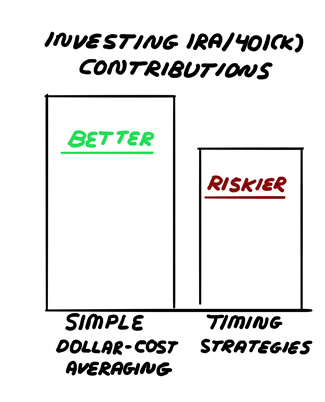
Before I get into describing the analysis and the findings, I want to address one big thing: as your retirement portfolio grows in size, the impact your contributions will have on your overall savings decreases. For a person with small savings, contributions have a large percentage impact. At larger portfolio sizes, monthly contributions have a small percentage impact. Thus, at larger portfolio sizes, any additional return realized by perfectly timing when contributions are invested will be more than offset by the swings in the overall balance of your retirement portfolio. Nevertheless, you should continue to contribute as much as is reasonably possible since doing so increases the size of your retirement nest egg.
My baseline for this analysis involved monthly contributions made to a portfolio solely holding the SPDR S&P 500 ETF Trust (SPY). This exchange-traded fund (ETF) tracks the performance of the S&P 500 index. I specifically chose this ETF because it’s a good proxy for the performance of the stock market and more than 25 years of monthly data was easily obtainable through Yahoo Finance. I assumed a starting maximum contribution to an individual retirement account (IRA) of $3,000 in 1994 and increased the amount every year relative to the rate of annual inflation. The maximum contribution amounts are not exact for any single year, but the ending limit of $5,063 in 2018 was close enough to the Internal Revenue Service’s cap on IRA contributions for purposes of this analysis. Adjusting the annual (and thereby monthly) contribution amounts to match the maximum amount an investor could have actually put into an IRA each year—exclusive of any catch-up contributions—would not have impacted the findings.
The calendar strategy involved postponing investing monthly contributions at the end of July and at the end of August. This would have avoided investing new dollars at the start of what have historically been the two worst calendar months of the year (August and September). At the end of September, a dollar amount equal to the contributions scheduled to be made at the end of July, August and September were invested. Doing this resulted in virtually no difference in ending wealth relative to simply investing the same amount each and every month. It also showed no consistent advantage in terms of the number of years the timing strategy outperformed.
The timing strategy involved accelerating the timing of contributions to take advantage of market dips. I based it on the data from Sam Stovall that suggests buying stocks when the market falls at 7% intervals can be an effective strategy. Whenever the SPDR S&P 500 ETF fell by 7% or more from its last end-of-month all-time high, monthly contributions were doubled. Then if the ETF fell by 14%, contributions were tripled. If the ETF fell by 21%, contributions were quadrupled.
I’ll use 2008 as an example to explain how this worked. In January 2008, the SPDR S&P 500 ETF was down approximately 11% from the end of October 2007, so the monthly contribution was doubled. The timing formula was then reset to contribute the equivalent of three months’ worth of contributions if the ETF declined by 14% from its high. This rule wasn’t triggered in February, so no contribution was made. In March, the ETF was down 14.7%, so three months of contributions were made. The timing threshold was then reset to an amount equal to four months of contributions being made if the SPDR S&P 500 ETF fell by 21% or more from its high up to the maximum allowable amount for the year. If this threshold wasn’t met, contributions resumed at their regular interval after the accelerated months were skipped. So, no contributions were made in April or May of 2008 and regularly monthly contributions were made in June, July and August of 2008. The SPDR S&P 500 ETF was down 25% from its high in September 2008, triggering the acceleration of four months’ worth of contributions. Because of the annual cap on contributions, only half of this amount could be added and invested. No other contributions were made for the remainder of the year. The 21% threshold for accelerating four months of contributions remained in effect until the market fully rebounded from its financial crisis drop.
If this sounds complicated, it’s because there were shifting rules to follow during market downturns. While the strategy worked during some years, it didn’t consistently lead to better returns. A big reason may have been that a person saving for retirement is limited in how much they can put into a retirement account. The ability to get really aggressive with buying during downturns is limited by the contribution limits. At the same time, the assumption that a person would not accelerate the timing of all of their contributions for the year made a difference.
A final test showed this to be true. Simply investing the maximum annual amount allowable near the beginning of a calendar year (e.g., the end of January 2018 for the 2018 tax year) beat timing strategies and even monthly dollar-cost averaging. For many people saving for retirement, this may be too big of a one-time expenditure. Making regular contributions coinciding with when a paycheck is received is often more feasible and easier to adhere to. For the many who fall into this category, there is a strong case to be made for immediately investing those contributions regardless of what the market is doing.

-
Which IRA Should You Contribute to and When? – A T. Rowe Price study found that making IRA contributions at the beginning of a tax year resulted in greater wealth than waiting until April of the following year.
-
Inherited IRA Rules for Spouses, Heirs and Trusts – The rules regarding required distributions from an IRA vary depending on who inherits it.
Optimism about the short-term direction of the stock market among individual investors remains at an unusually low level despite rebounding for a second consecutive week. The latest AAII Sentiment Survey also shows slightly higher neutral sentiment and lower bearish sentiment.
Bullish sentiment, expectations that stock prices will rise over the next six months, rose 3.5 percentage points to 26.6%. Nonetheless, optimism is below its historical average of 38.0% for the 26th time this year.
Neutral sentiment, expectations that stock prices will stay essentially unchanged over the next six months, rose 1.7 percentage points to 33.6%. The increase keeps neutral sentiment back above its historical average of 31.5% for the 13th time in 14 weeks.
Bearish sentiment, expectations that stock prices will fall over the next six months, fell 5.1 percentage points to 39.7%. Pessimism is above its historical average of 30.5% for the 12th time in 15 weeks.
As noted above, bullish sentiment continues to be at an unusually low level (more than one standard deviation below average). Historically, the S&P 500 index has experienced above-average and above-median returns during the six- and 12-month periods following unusually low levels of optimism. Bearish sentiment is back within its typical range, though barely so.
Many individual investors have been monitoring trade negotiations, particularly between the U.S. and China. Additionally, many AAII members expect a recession to start within the next 12 to 24 months. Also having an influence on sentiment are Washington politics, geopolitics, valuations, corporate earnings, monetary policy and interest rates.
This week’s special question asked AAII members how they perceive the performance of the stocks they own or follow relative to the year-to-date returns of the S&P 500 and the Nasdaq composite. The results were mixed. Almost 28% of respondents say they are underperforming the two indexes, though some say they weren’t trailing by very much. Slightly more than 23% say the performance of their equity holdings is close to the performance of the two indexes. Approximately 20% of respondents say their portfolios are outperforming the two indexes.
Here is a sampling of the responses:
- “My allocation floated along stable, but a few points behind the S&P 500 and/or Nasdaq.”
- “Overall, the equities in my portfolio have done as well as, or a little better than, the S&P 500.”
- “Less volatile, somewhat lower returns, but I’m not just invested in large caps and am also taking a more defensive approach.”
- “The stocks I own have increased in value but not as much as the S&P 500.”
- “No perception about it. They are performing above market averages ... thankfully.”

Bullish: 26.6%, up 3.5 points
Neutral: 33.6%, up 1.7 points
Bearish: 39.7%, down 5.1 points
Bullish: 38.5%
Neutral: 31.0%
Bearish: 30.5%
August 15, 2019 To Be Different Than an Index Fund, Diversify by Strategy
August 8, 2019 Two Shorter-Term Strategies for Sector ETFs
August 1, 2019 Magnitude Versus Frequency of Outperformance, Plus the Fed’s Rate Cut
July 25, 2019 Spotting Dividend Warning Signs

Discussion
John Lambert from NJ posted over 7 years ago:
Could this also apply to withdraw strategies? Simple monthly withdraws rather than bucket approaches.
Chris from NC posted over 7 years ago:
I do not understand the Calendar strategy. Why would someone delay making contributions during July and August, historically the two worst months for stock market performance. Isn't the objective to buy low, sell high? Buying when the market is down is the only way dollar cost averaging works.
Donald Myers from AZ posted over 7 years ago:
I am well beyond the time when I could contribute to an IRA or a 401k. For most people that time would be when they are still employed and their contributions would take place on their paycheck schedule so I think one of the basic premises of the article is wrong, namely that one could "time" the contributions. All of my IRA contributions were in fact rollovers from my 403b/401a (former employer retirement plan) There were limitations on when and how much I could rollover, I use a different plan for "contributions", namely I re-invest all dividends and interest but I can't control the timing or the amounts. I use monthly RMD distributions (proportional selling to cover those).
Jules Vogel from CA posted over 3 years ago:
I didn't see a response to John Lambert's question. I think I read somewhere that when selling you use a set number of shares rather than dollars. Is this right? Thanks . . .
You need to log in as a registered AAII user before commenting.
Create an account