

To Be Different Than an Index Fund, Diversify by Strategy
by Charles Rotblut | August 15, 2019
Diversification is commonly thought about at the portfolio level. Mix stocks with bonds and cash. Add in other assets, such as real estate and gold, if you would like to further spread out your allocations.
This is the broad scope. Within individual asset classes, diversification is also possible. Holding several different stocks (at least 10) limits the risk of any single stock tanking your portfolio. You can also diversify by size, holding both larger and smaller companies.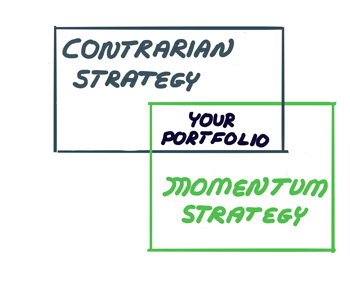
All of this is the traditional way of thinking about diversification. A newer way of thinking about diversification centers around factors. Factors are characteristics associated with higher returns. Size is one factor. Value is another. Momentum and profitability are factors too. Combining the right mix of factors can boost returns.
There is another way to achieve diversification. It doesn’t go by any fancy monikers. Some of you may already be doing it, either purposely or unintentionally. It’s done using a mix of strategies. Combining different active strategies into a single portfolio can lead to higher returns when done correctly. The key is to make sure you end up with a portfolio that is actually diversified instead of merely a higher-cost version of the S&P 500 index.
I’ll give you an example using two famous investing gurus. William O’Neil’s CAN SLIM stock screening approach seeks out growth stocks with strong price momentum. He wants stocks exhibiting positive momentum in terms of both price performance and earnings. These are so-called winners. David Dreman is the opposite. He prefers stocks that trade at low valuations. If they’ve recently stumbled, say because of an earnings miss, then they may present a potential buying opportunity for Dreman adherents who tend to be contrarians.
The two strategies differ in other ways too. The Dreman screening methodology requires that a dividend be paid. Dreman also prefers more stable companies, so the screen seeks out large- and mid-cap companies. O’Neil’s research suggests that small-cap stocks can be better investments because of their potential for higher upside volatility. However, his approach is market-cap neutral since it seeks out momentum stocks of any size.
Because O’Neil’s and Dreman’s strategies are in contrast to each other, the odds of them overlapping in terms of the stocks identified are low. Buying stocks in equal dollar amounts from each strategy creates a diversified portfolio since you will end up with stocks from different industries with varying market capitalizations. Such a portfolio also has the potential not to overlap with the S&P 500 since there will be industries and sectors completely left out—those with companies not qualifying for purchase under either strategy.
I chose O’Neil and Dreman because of their contrasting styles. There are certainly many other combinations of active strategies you could put together.
If you are a mutual fund investor, for instance, you could combine funds following differing strategies. In doing so, you should read the objectives and look at the portfolio holdings carefully to ensure that there isn’t overlap.
Investors holding individual stocks should pay attention to the types of stocks that their individual strategies identify to also ensure overlap is minimal. In doing so, be careful about not creating what is essentially a higher-priced index fund. By combining too many strategies or by trying to check every single style box, you’ll end up with a portfolio that has similar characteristics to a broad market fund. Worse yet, your portfolio will be more complex, harder to manage and be more costly to maintain than an index fund for approximately the same level of returns. Succeeding at active investing, meaning doing better than a traditional index fund over the long term, requires being different than the market.
There isn’t a set number of strategies where overlap becomes a problem, though the number of strategies you incorporate into a single portfolio should be low. For AAII’s Stock Superstars Report, we combine four strategies: profitability and momentum, value, positive earnings estimate revisions and reasonably priced growth. Each strategy in the portfolio finds different stocks. The portfolio itself is sector and market-cap neutral, meaning it looks across the broad universe of stocks to find the most attractive names. The result is a portfolio that is both different than the market and has a long-term record of outperforming the market, which is what you want from an active strategy.
For those of you who are interested in learning more about how to be a diversified investor at the asset class level using a multi-strategy approach, my colleague Wayne Thorp has published a special report highlighting five stocks that are Diversification Winners. It’s part of a special $1 AAII promotion we are running this week.

-
David Dreman’s Contrarian Approach to Stock Selection – This 2015 AAII Journal article goes into greater detail about how Dreman took advantage of investor irrationality by targeting discounted, fundamentally sound stocks.
-
To Beat the Market, Invest Differently Than the Market – James O’Shaughnessy explains why it is necessary for active investors to have portfolios that look different than the market.
Optimism among individual investors for stocks to advance over the next six months remains at an unusually low level despite rebounding this week. The latest AAII Sentiment Survey also shows pessimism staying at an unusually high level.
Bullish sentiment, expectations that stock prices will rise over the next six months, rebounded by 1.5 percentage points to 23.2%. Optimism remains below its historical average of 38.5% for the 25th time this year.
Neutral sentiment, expectations that stock prices will stay essentially unchanged over the next six months, rose 1.8 percentage points to 32.0%. The increase puts neutral sentiment back above its historical average of 31.0% for the 12th time in 13 weeks.
Bearish sentiment, expectations that stock prices will fall over the next six months, declined 3.3 percentage points to 44.8%. Pessimism is above its historical average of 30.5% for the 11th time in 14 weeks.
As noted above, bullish sentiment remains at an unusually low level and bearish sentiment remains at an unusually high level for the second consecutive week. Historically, the S&P 500 index has experienced above-average and above-median returns during the six- and 12-month periods following unusually low readings.
The survey period runs from Thursday through Wednesday. Reminders to take the survey are sent out every Monday.
Many individual investors have been monitoring trade negotiations, particularly between the U.S. and China. Though the implementation of new tariffs on Chinese goods has been postponed, the market’s ongoing volatility is having an effect. Additionally, a separate survey we recently conducted among AAII members found that 48% expect a recession to start within the next 12 to 24 months.
Also having an influence on sentiment are Washington politics, geopolitics, valuations, corporate earnings, monetary policy and interest rates.
This week’s special question asked AAII members what changes they have made, if any, in response to the threat of new tariffs. More than 50% of respondents say that they have made no changes yet, though many describe themselves as being more cautious as the trade war continues. Additionally, 18% of respondents say that they are avoiding Chinese stocks and/or reducing equity exposure, while 19% say that they are allocating more to bonds and/or exchange-traded funds (ETFs). Finally, 10% of respondents say that they have increased their cash holdings significantly and are waiting to make any portfolio adjustments if necessary.
Here is a sampling of the responses:
- “I have reduced exposure to some very old winners. The bull is getting long in the tooth.”
- “I am long in cash because I believe the market will be down in coming months and I want to have cash to get back in at more attractive prices.”
- “Migrated money from equities to municipal bonds. The next few months will be very volatile, and I wanted more stability in my portfolio.”
- “No changes. I think that the market will be choppy as it reacts to news rather than data. That said, bull markets only last so long and eventually this one has to end.”
- “I won’t be buying any chip-related stocks for a while. Also, I’m staying away from businesses with lots of China exposure.”

Bullish: 23.2%, up 1.5 points
Neutral: 32.0%, up 1.8 points
Bearish: 44.8%, down 3.3 points
Bullish: 38.5%
Neutral: 31.0%
Bearish: 30.5%
August 8, 2019 Two Shorter-Term Strategies for Sector ETFs
August 1, 2019 Magnitude Versus Frequency of Outperformance, Plus the Fed’s Rate Cut
July 25, 2019 Spotting Dividend Warning Signs
July 18, 2019 How the VMQ Stocks Momentum Indicator Was Changed

Discussion
David Humphrey from AZ posted over 7 years ago:
the $1 link goes to another link that goes to checkout with nothing filled in. No good.
You need to log in as a registered AAII user before commenting.
Create an account