

Investment Expenses Are a Drag; Tips for Reducing Them
by Charles Rotblut | August 06, 2020
How you would like to give up $90,000 of wealth to investment expenses? It’s a rhetorical question; we all know the answer is “no way!” Yet, there are many investors incurring this cost—and much more.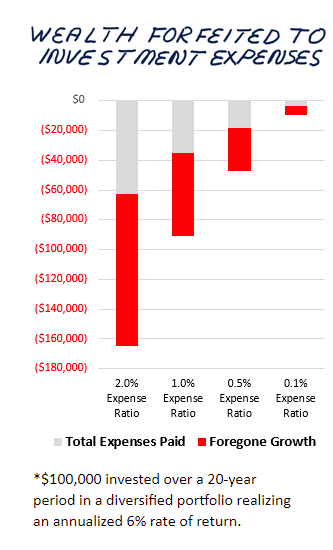
The number is based on what an investor who started with a $100,000 portfolio would forfeit in wealth over a period of 20 years. This investor is assumed to have paid 1% in expense fees and invested in a diversified portfolio realizing an annualized return of 6%. These assumptions are akin to an investor who allocated 60% of their portfolio to stocks, 40% of their portfolio to bonds and bought and held mutual funds charging what is currently an average expense ratio. The number reflects both the expenses paid and the growth in portfolio size lost to those expenses.
Put another way, not only is forfeiting $90,000 in wealth very possible, it may be a conservative estimate considering what investors have historically paid for commissions, transaction fees and fund expense ratios.
The impact of both higher and lower expense ratios can be seen in the chart to the right. Notice how much growth in wealth is foregone because of costs. Every dollar paid in expenses is a dollar not left in the portfolio to realize future compound returns. Expenses paid today result in less wealth to grow tomorrow.
Not all investment expense ratios are bad. You may be comfortable paying a modest expense ratio to own a mutual fund or an exchange-traded fund (ETF) to get exposure to certain asset classes (e.g., foreign stocks, bonds, etc.) rather than hand-selecting the securities yourself. You may receive good information and insights by subscribing to certain services and publications. A software program or service that helps you find good investment ideas or helps you stay organized will be worth many times its cost.
The key is to limit investment-related costs to only those things you get value from. Value, in this case, can be useful information, investment ideas you might not otherwise come across on your own and/or resources that help you become a more effective manager of your own assets. Like other parts of your budget, it makes sense to periodically review them. Our newest worksheet for The AAII Way will help you do this.
In terms of reducing your investment expenses, here are reasonable ways you could go about doing do so:
Favor Mutual Funds and ETFs With Below-Average Expense Ratios—There is rarely a reason to own a fund whose expense ratio is above that of its category average. You can see what the averages are in our Mutual Fund and ETF guides.
Review Your 401(k) Fees—If your employer provides a retirement plan—such as a 401(k), 403(b), 457, etc.—look over the costs. You may not be able to do much about the fees charged beyond having a conversation with your human resources department, but you may find opportunities for cost savings. Options may include switching to funds with lower expense ratios, holding fewer funds or switching to all electronic communication if you haven’t already done so. If the plan and its investment options are very expensive, it may make sense to only contribute up to the maximum to get the employer match if you can contribute the remainder to a Roth IRA and/or your spouse’s IRA and Roth IRA.
Review 529 and HSA Fees—If you are contributing to a 529 college savings plan and/or a health savings account (HSA), review the plan fees. If they seem high, they may well be. In such cases, see if there are lower-cost alternatives available.
Switch Brokers—All of the major discount brokers have waived commissions on online trades of stocks and ETFs. There isn’t a reason to pay commissions. If your broker is charging a transaction fee to buy certain mutual funds, consider whether it makes sense to transact directly with the mutual fund firm or use a comparable fund included in your broker’s no-transaction-fee list.
If Using an Adviser, Consider Whether a Lower-Cost, Fee-Only Planner Can Provide the Same Services—Those who are seeking guidance on allocation and long-term planning may find that a fee-only financial planner serves their needs well. A higher-cost adviser is warranted when one’s financial situation is complex and/or special wealth services are required.
Take Advantage of Asset Location—With a few exceptions, the IRS is pretty hands-off about which assets you hold in your retirement accounts and which you hold in your taxable accounts. Investments paying interest or distributions that are taxed at ordinary income rates [e.g., real estate investment trusts (REITs), corporate bonds, etc.] should be held in tax-preferred accounts such as traditional IRAs and Roth IRAs.
Be Wary of Higher-Cost Investment Offerings—Private investments, variable annuities and other similar products generally come with higher costs. These costs may not be fully apparent at first glance, so you will need to ask. They can include commissions, ongoing expense ratios and fees for pulling out (e.g., surrender fees).
Try out The AAII Way worksheets we’ve created so far and give us your feedback in the comments section for each. We want them to be useful to you.
1. Identifying and Prioritizing Your Financial Goals Worksheet
2. Our Revised Risk Tolerance Worksheet
3. A Worksheet for Determining How Your Portfolio Is Managed
4. Financial Account Inventory Worksheet
5. Investment Expense Tracking Worksheet — New!

-
The Impact of Expense Ratios on Retirement Income – Simply lowering investment expenses on a $1 million portfolio by 0.01% boosts annual portfolio income by more than $200 per year, says AAII contributing editor Craig Israelsen.
-
An In-Depth Look at the Tax Consequences of Asset Location – Find out how you can boost your aftertax return by prudently choosing whether to hold it in a taxable or tax-preferred account.
Optimism among individual investors about the short-term direction of the stock market rebounded but remains unusually low. The latest AAII Sentiment Survey also shows lower levels of neutral and bearish sentiment.
Bullish sentiment, expectations that stock prices will rise over the next six months, rebounded 3.1 percentage points to 23.3%. The drop keeps bullish sentiment below its historical average of 38.0% for the 22nd consecutive week and the 27th week this year.
Neutral sentiment, expectations that stock prices will stay essentially unchanged over the next six months, declined 2.2 percentage points to 29.1%. This is the 28th time out of 30 weeks that neutral sentiment is below its historical average of 31.5%.
Bearish sentiment, expectations that stock prices will fall over the next six months, declined 0.9 percentage points to 47.6%. Pessimism is above its historical average of 30.5% for the 24th consecutive week and the 26th time this year.
Bullish sentiment remains at an unusually low level for the seventh time in eight weeks. Bearish sentiment remains at an unusually high level for the 20th time out of 22 weeks. Historically, both have generally been followed by above-average and above-median returns for the S&P 500 index, though the link is stronger for unusually low optimism than it is for unusually high pessimism.
In this week’s special question, we asked AAII members what their opinion is of the current monetary actions being taken by the Federal Reserve. Two out of five respondents (40%) say that the current monetary actions being taken by the Fed are appropriate and necessary to stabilize the economy.
This compares to 30% of respondents who express their concerns about the rising level of the national debt. Many respondents under this category say that the excessive printing of money is devaluing the dollar and could cause hyperinflation. An additional 17% of respondents say that the Fed has been successful in stabilizing the economy in the short term, but they are concerned about the longer-term consequences that will likely occur.
Here is a sampling of the responses:
- “Helpful to the economy as were the short-term fiscal actions but we need some complementary longer-term fiscal actions like infrastructure investment and state and local government support to dig ourselves out of the unemployment hole the coronavirus pandemic continues to dig for us.”
- “Artificially propping up the stock market and severely devaluing the U.S. dollar.”
- “I’m really nervous about what the Fed is doing. So far, it has helped the economy and the stock market. One has to wonder if there are consequences down the road. Modern monetary theory (MMT) proponents will say it doesn’t matter because we can monetize our debt. I say it doesn’t matter until it does.”
- “If the Fed is going to print money, I feel it could be deployed better. For instance, less money to the stock market and more money for infrastructure, education, health care and other things that will make our economy healthier.”
- “The Fed is trying to keep the economy from plummeting into a depression. It’s hopeful that fiscal measures will help out.”

Bullish: 23.3%, up 3.1 points
Neutral: 29.1%, down 2.2 points
Bearish: 47.6%, down 0.9 points
Bullish: 38.5%
Neutral: 31.0%
Bearish: 30.5%
AAII Asset Allocation Survey
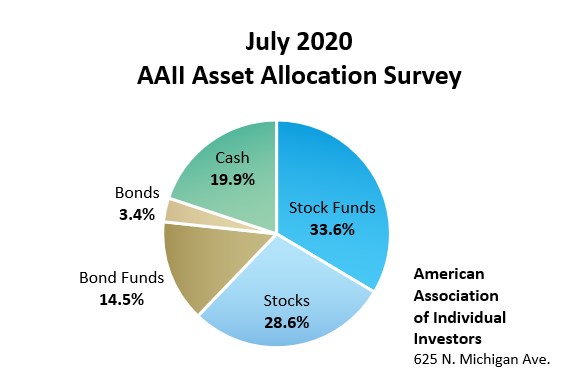
Individual investors’ exposure to fixed-income assets declined to its lowest level in 15 months according to the latest AAII Asset Allocation Survey. Exposure to equities declined as well, while cash allocations rose.
Stock and stock fund allocations were down 1.0 percentage points to 62.2%. The historical average is 61.0%.
Bond and bond fund allocations declined 0.4 percentage points to 17.9%. This was the lowest allocation to fixed-income assets since April 2019 (17.1%). Even with the decrease, bond and bond fund allocations are above their historical average of 16.0% for the 17th consecutive month and the 18th time in 19 months.
Cash allocations rebounded 1.5 percentage points to 19.9%. The historical average is 23.0%.
The decline in fixed-income allocations occurred as bond yields fell throughout July. At the same time, optimism in our weekly sentiment survey ended last month at one of the 40 lowest levels recorded in the survey’s 33-year history.
July AAII Asset Allocation Survey results:
- Stocks and stock funds: 62.2%, down 1.0 percentage points
- Bonds and bond funds: 17.9%, down 0.4 percentage points
- Cash: 19.9%, up 1.5 percentage points
July AAII Asset Allocation Survey details:
- Stocks: 28.6%, up 0.7 percentage points
- Stock Funds: 33.6%, down 1.8 percentage points
- Bonds: 3.4%, up 0.4 percentage points
- Bond Funds: 14.5%, down 0.7 percentage points
Historical Averages:
- Stocks/Stock Funds: 61.0%
- Bonds/Bond Funds: 16.0%
- Cash: 23.0%
The numbers are rounded and may not add up to 100%.
The AAII Asset Allocation Survey has been conducted monthly since November 1987 and asks AAII members what percentage of their portfolios are allocated to stocks, stock funds, bonds, bond funds and cash. The survey and its results are available online at: www.aaii.com/investor-surveys.
- Stocks and Stock Funds: 62.2%, down 1.1 percentage points
- Bonds and Bond Funds: 17.9%, down 0.4 percentage points
- Cash: 19.9%, up 1.5 percentage points
- Stocks: 28.6%, up 0.7 percentage points
- Stocks Funds: 33.6%, down 1.8 percentage points
- Bonds: 3.4%, up 0.4 percentage points
- Bond Funds: 14.5%, down 0.8 percentage points
- Stocks/Stock Funds: 62.0%
- Bonds/Bond Funds: 16.0%
- Cash: 22.0%
Take the Asset Allocation Survey.
July 30, 2020 Comparing and Contrasting the Types of Investment Accounts
July 23, 2020 How Will You Implement Your Portfolio Strategy?
July 16, 2020 What Type of Individual Investor Are You?
July 9, 2020 Revising Our Asset Allocation Models

Discussion
Dave G from WA posted over 6 years ago:
How appropriate right when you are trying to sell a new $400 a year platinum service to your members. Did you know that $400 a year over a 40-year investing career put into a market index fund would likely give you $135,000 extra dollars?
Jim M from NJ posted over 6 years ago:
The investment industry is designed like a toll road. Most investment managers charge fees based on assets under management regardless of the investment returns they provide. An investor who pays a 1% fee for a 5% net investment return is paying 20% of their net investment returns in fees. Investment managers want to collect their fees while taking none of the investment risk.
Charles Rotblut from Illinois posted over 6 years ago:
Hi David, AAII Platinum is designed for those members who want access to all of our premium newsletters and our A+ service. It is designed for those who want to follow an active approach to investing. -Charles
You need to log in as a registered AAII user before commenting.
Create an account