

Stocks Look Cheap Relative to Bonds
by Charles Rotblut | August 29, 2019
Earlier this week, something unusual happened: The S&P 500 index’s yield was greater than the yield on 30-year Treasury bonds. CNBC, citing data from Bespoke Investment Group, said such an inversion has only happened once before during the past four decades. The only other time was in March 2009. (As of this afternoon, the S&P 500 continues to challenge the 30-year bond on the yield front. Their respective yields are 2.00% versus 1.97%.)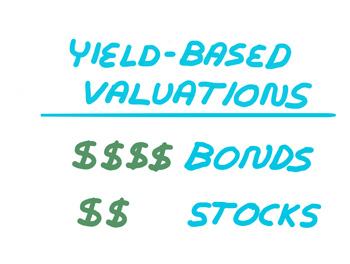
The comparison shows stocks being cheap relative to long-dated Treasury bonds. For the same approximate yield, an investor can get both potential growth of dividends and the lower tax rate levied on stocks. Put another way, investors aren’t paying a higher yield-based valuation to get more potential upside.
One problem with relative yields is that they don’t tell you anything about the underlying prices or absolute valuations. An Audi SUV may be priced relatively less than a comparable Jaguar SUV, but neither vehicle is cheap. Similarly, just because one investment option has a lower valuation than another doesn’t make it a bargain. Relative valuation is merely a comparison of two more assets or securities.
Comparing stocks to bonds isn’t an apples-to-apples comparison either; stocks and bonds are two different things. Stocks provide the opportunity for capital appreciation. Bonds provide the opportunity for capital preservation. Buying and holding Treasury bonds—especially at current yields—is not the path to great wealth but you will get a series of highly predictable cash flows. Stocks have more potential for price appreciation and dividend growth, albeit with a greater risk of falling in price and/or cutting their dividends. There is a reason why bonds are often described as giving investors the confidence to buy stocks.
Nonetheless, there has been a historical precedent for making the comparison. The equity risk premium is the extra return an investor can reasonably expect for holding stocks instead of a risk-free asset. When stocks appear cheap relative to bonds (particularly Treasury bonds), the premium is wider. When stocks appear expensive relative to bonds, the premium is smaller. Yield comparisons give you a quick off-the-cuff method of calculating the premium.
Right now, they are favoring stocks. Here’s what Sam Stovall, CFRA chief investment strategist, wrote in a report that, coincidently, appeared in my email as I was writing this week’s commentary yesterday afternoon: “Since World War II, whenever the S&P 500’s month-end yield exceeded the yield of the 10-year note, the S&P 500 was higher 12 months later by an average 22% and gained in price in 74% of all 31 observations. What’s more, in the 20 times that the 500’s yield bested the 30-year’s, stocks were higher by 12% and rose 80% of the time.”
Despite the favorable track record for stocks when their yields are higher than Treasury bonds and the current low interest rates, a strong argument can still be made for holding bonds. Bonds provide a ballast against the price volatility of stocks. The risk-free nature of Treasury bonds (the U.S. government always pays its bondholders) and low default risk of other high-quality, investment-grade bonds provides certainty of cash flows. Plus, stocks haven’t gone on to rise in price every time the S&P 500’s yield has exceeded the 30-year Treasury bond, as Stovall’s data shows. To the extent your allocation strategy and financial situation calls for maintaining bond exposure, continue to do so. Just lower your expectations for the level of income you will receive from new bonds purchased at current yields or from traditional bond funds.

-
Will Stocks Always Outperform Bonds Over a Multi-Year Period? – Earlier this year, Marist College professor Brian Haughey provided a more detailed framework for comparing stocks against bonds.
-
Stocks vs. Bonds: Why and When? – There is more to the allocation decision than just picking a broad asset class, as both stocks and bonds come with a variety of individual investment characteristics.
More than two out of five individual investors describe themselves as being pessimistic about the short-term outlook for stock prices for the third time in four weeks. The latest AAII Sentiment Survey also shows a continuing trend of unusually low optimism and lower neutral sentiment.
Bullish sentiment, expectations that stock prices will rise over the next six months, declined by 0.5 percentage points to 26.1%. The modest pullback keeps optimism below its historical average of 38.0% for the 27th time this year.
Neutral sentiment, expectations that stock prices will stay essentially unchanged over the next six months, reversed last week’s increase by falling 2.0 percentage points to 31.7%. Nonetheless, neutral sentiment is above its historical average of 31.5% for the 14th time in 15 weeks.
Bearish sentiment, expectations that stock prices will fall over the next six months, rose 2.5 percentage points to 42.2%. Pessimism is above its historical average of 30.5% for the 13th time in 16 weeks.
As noted above, bullish sentiment continues to be at an unusually low level (more than one standard deviation below average) and bearish sentiment is back at an unusually high level. Historically, the S&P 500 index has experienced above-average and above-median returns during the six- and 12-month periods following unusually low levels of optimism and unusually high levels of pessimism.
Many individual investors have been monitoring trade negotiations, particularly between the U.S. and China. Additionally, many AAII members expect a recession to start within the next 12 to 24 months. Also having an influence on sentiment are Washington politics, geopolitics, valuations, corporate earnings, monetary policy and interest rates.
This week’s special question asked AAII members what influence second-quarter earnings are having on their outlook for stock prices. Slightly more than 28% of respondents say earnings have improved their outlook for stock prices. On the other hand, nearly 23% of respondents say that they are anticipating stock prices to fall as the bull “comes to an end.” Approximately 28% say that second-quarter earnings are having little effect on their outlook for stock prices. Finally, 21% of respondents state that they are more uncertain and/or are more focused on ongoing issues such as the trade war and/or future Federal Reserve monetary policy decisions.
Here is a sampling of the responses:
- “I think the economy is strong and the bull market still has room to run. Too much gloom and doom in the market and on TV.”
- “Revisions of consumer spending are lowering the overall trajectory of the economy. I expect second-quarter earnings will fall short of expectations.”
- “Earnings were fine. I’m struggling with geopolitical issues and domestic politics.”
- “None. I’m a long-term investor and try to hold stocks with long-term growth potential.”

Bullish: 26.1%, down 0.5 points
Neutral: 31.7%, down 2.0 points
Bearish: 42.2%, up 2.5 points
Bullish: 38.5%
Neutral: 31.0%
Bearish: 30.5%
August 22, 2019 Dollar-Cost Averaging Works Well for Retirement Contributions
August 15, 2019 To Be Different Than an Index Fund, Diversify by Strategy
August 8, 2019 Two Shorter-Term Strategies for Sector ETFs
August 1, 2019 Magnitude Versus Frequency of Outperformance, Plus the Fed’s Rate Cut

Discussion
No comments have been added yet. Add your thoughts to the discussion!
You need to log in as a registered AAII user before commenting.
Create an account