

Related

PRISM Wealth-Building Process
A thorough review of your wealth-building plan is called for when children become financially independent.
by Charles Rotblut | July 2022

Charles Rotblut leads a class in AAII's new Essential Investing Video Course. Go to https://www.aaii.com/ves for more information and to subscribe.
Having your children move out and become financially independent is a big life stage change for those who become empty nesters (as well as for the young adults themselves).
Apart from the emotions involved, there are financial and lifestyle aspects that will impact your wealth-building and estate plans. Spending may change, goals may evolve or be replaced with new ones and estate plans might need to be revisited. In this article, we address those topics. Key considerations and decisions to be made are discussed. Though we refer to parents, most of the guidance applies to both couples and single parents.
Throughout this article, we reference the PRISM Wealth-Building Process. PRISM provides a framework for aligning your investment decisions with your financial goals. It is designed to evolve as your life does. Step M—Monitoring Your Allocation, Progress and Life Stages—directly ties into this by asking if any life stage changes have occurred within the past year. Figure 1 illustrates the process. (PRISM is among the many benefits all AAII members receive.)
Figure 1. PRISM Wealth-Building Process

In theory, parents should see an increase in their discretionary spending upon becoming empty nesters. No longer having to support (at least not fully) one or more dependents frees up cash in the budget.
Take a look at your current spending trends. Identify how much excess discretionary cash flow you now have. Doing this is more than just a budgeting exercise; it helps you to identify how much money can be redirected toward existing goals, new goals you may have in mind and potential lifestyle changes.
The budget review should also prompt you to revisit the second step of the PRISM process: Recognizing Your Risk Tolerance and Allocation. Larger amounts of cash flow enable you to withstand more volatility in your portfolio’s returns. The reason is that greater cash reduces the amount that needs to be withdrawn from a portfolio.
Not every empty nester’s discretionary cash flow will increase. Some will find themselves needing to support elderly parents or other relatives. Others will see spending redirected, instead of reduced, because of lifestyle changes. Income may also drop due to lifestyle changes. A reduction in cash flow reduces tolerance for risk.
Getting kids through college or other secondary education and into the workforce completes a key goal for many parents. Once children are done with college, other goals—in addition to retirement—can be focused on.
PRISM calls for goals to be revisited whenever a life stage event occurs. Becoming an empty nester is one such event. Since PRISM is an iterative process, those using it would go back to the first step in the PRISM acronym, Prioritizing Your Goals, and determine what has changed and which goals should now be given top priority.
For many new empty nesters, two goals may come to the forefront depending on wealth. One is paying any debt, mortgage or otherwise. The second is boosting retirement savings. Additional discretionary cash flow created by no longer having to support children can be used to accomplish one or both.
Other goals may come to the forefront. There may be a desire to retire early or at least work less. (We’ll get to those goals momentarily.) A second home may be a consideration. Charitable initiatives may come to the forefront.
Whatever the goals are, write them down. The Prioritizing Your Goals worksheet helps you organize your thoughts, including the timing and potential costs of each goal.
If you’ve already completed the PRISM process, pull out your PRISM plan and review your goals. Are they still relevant? Are they prioritized correctly? Are there new goals you wish to add? Are there changes to existing goals you wish to make?
As you review your goals, check your progress toward funding retirement. The Monitoring Your Progress Worksheet—included in PRISM Step M, Monitoring Your Allocation, Progress and Life Stages—can help you determine whether you need to boost the amount you are setting aside for retirement.
If you need to increase how much you save, the tax code can assist you. Annual catch-up contributions to retirement savings can be made by those who are 50 or older. The 2022 limits allow for annual catch-up contributions of $6,500 to be made to workplace retirement plans such as 401(k), 403(b) and 457(b) plans. An additional $1,000 contribution can be made to individual retirement accounts (IRAs) or Roth IRAs. Catch-up contributions to workplace retirement plans are subject to periodic inflation adjustments, but IRA and Roth IRA catch-up contributions are not.
Whenever a life stage event occurs, the impact of lifestyle changes should be included in the review and re-assessment of goals. Becoming an empty nester brings about several potential lifestyle changes that could alter your wealth-building and financial planning decisions.
Are you planning to stay in your current house? Downsize? Move? Buy a second house? All of these choices have financial implications.
If you are staying in your house, are there anticipated remodeling and/or repair expenses? For instance, will you redo your kitchen? Will your roof need replacing within the next few years? Such large expenses would reduce cash flow and require savings to be tapped. The impact of a major expenditure should be considered in the context of your other financial goals, as it could alter what you have available to fund those other goals.
Downsizing is perceived as increasing cash flow by both lowering regular expenditures (housing costs, utilities, etc.) and unlocking equity previously tied up by the current home. This unlocked capital can be used to make further progress toward existing goals or allow you to set new financial goals. It may not always do so, however, depending on the cost and location of your new residence.
If a less expensive residence is chosen, the proceeds will increase your tolerance for risk and potentially help you fund certain goals. Married home sellers filing joint returns can exclude the first $500,000 of capital gains on the sale of a house, provided eligibility requirements are met. The exclusion is $250,000 for single filers. These capital gains are determined not only by the difference between what you paid for the house and then sold it for, but also by any adjustments to your cost basis. These adjustments include both certain fees and closing costs as well as many improvements made to your property. More information can be found in IRS publication 523 (www.irs.gov).
State and local taxes are also a factor. If you move to a higher tax locale, your aftertax cash flow could be reduced. While several states give tax breaks to residents of a certain age, newer empty nesters are often too young to qualify for these breaks.
From the standpoint of your wealth-building plan, it is helpful to consider how the change in housing impacts your ability to meet your goals as well as your ability to tolerate portfolio risk. You may also need to update your will or other estate planning documents if your house is listed in them.
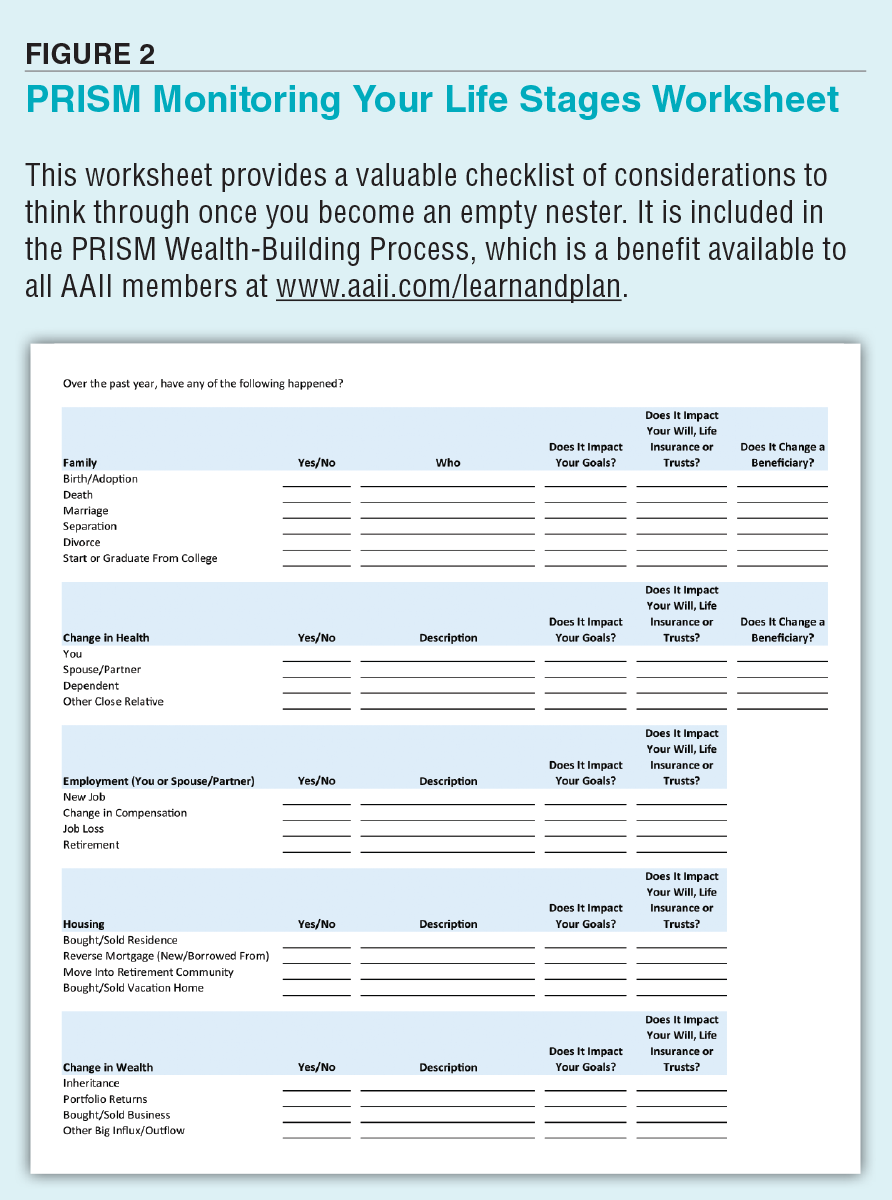
Among the questions the PRISM Monitoring Your Life Stages worksheet asks is whether there has been a change in your or your spouse’s employment (Figure 2). These changes include a new job, the departure from an existing one and/or a change in compensation.
Some people choose to return to work or switch from part-time to full-time work during the empty-nester phase. Other empty nesters may start to transition toward retirement by working part-time or otherwise working fewer hours.
New full-time employment increases earnings, obviously, but may also bring the opportunity to contribute to workplace retirement plans and potentially health savings accounts (HSAs). At age 50, catch-up contributions can be made to 401(k) and similar types of retirement savings accounts, as previously noted. For HSAs, catch-up contributions of up to $1,000 can start at age 55. Both increase the odds of successfully funding retirement and being able to maintain a comparatively more growth-oriented allocation once in retirement.
Married individuals who return to work should compare the investment offerings in their new plan to their and their spouse’s target allocation. The goal should be to maintain the target allocation as defined in the Recognizing Your Allocation worksheet from Step R of the PRISM process.
If the desire is instead to phase into retirement instead of returning to work or working more hours, then the first four steps of the PRISM process will need to be revisited. Is reducing work hours ahead of retirement a previously defined goal? If so, then make updated projections of what you think you will need to fund this goal and compare them against the projections you previously made. If they are close, look at the Monitoring Your Progress worksheet from Step M to see if your savings are where they should be. Combined, these worksheets will help you determine your financial ability to retire when desired.
You will also want to revisit your allocation. Setting aside a certain amount of money into buffer assets—assets whose value will not be affected by downward moves in the financial markets—can allow you to avoid selling stocks during bear markets. AAII founder James Cloonan recommended holding the equivalent of two to four years of living expenses in cash or similar so-called safe assets. Retirement expert Wade Pfau has suggested three years.
Buffer assets may not be necessary if there is an option to return to full-time work. They may also not be necessary if the salary from the reduced working hours is enough to cover living expenses or if there are other sources of cash flow, such as a pension or an annuity.
Another option is to begin practicing retirement. This would involve devoting vacation time to intended retirement activities. This could be accomplished while maintaining employment. Doing so has the advantage of allowing you to try out a desired lifestyle before fully committing to it—timewise and financially. You could spend your vacation time and even long weekends in a locale you are considering moving to or buying a second house in.
Another reason expenditures may not drop after becoming an empty nester is the introduction of new activities. Travel is a good example.
Some AAII members participating in the PRISM Academy have discussed travel as being among their financial goals. If you’ve already listed travel as one of your goals, then you may well have the dollars set aside to fund it. If not, consider how increasing travel will impact your ability to fund other high-priority goals.
There may be other activities that you choose to engage in once becoming an empty nester. Just as is the case with travel, the key questions from a financial planning perspective are: Is the activity a previously stated goal you have been saving for? Will its costs prevent you from achieving other high-priority goals? Does it require withdrawals from savings and, if so, how will they affect your allocation and tolerance for risk?
The size of the expenditures relative to your cash flow (e.g., discretionary income) and wealth matter here. An activity with a large time component but proportionately low cost is very different than one with a higher proportionate cost.
There is no blanket guidance that applies to every situation. Rather, it is a question of whether the expected expenditure(s) are large enough to warrant a review of your PRISM wealth-building plan.
If it has been several years since you’ve reviewed your estate planning documents, beneficiary designations and life insurance policies, a good time to do so is when you become an empty nester. Consider how your life has changed, how your children’s lives have changed and how your needs have changed.
A good place to start is with the inventory of key estate planning information on the PRISM Monitoring Your Life Stages worksheet (not included in the screenshot in Figure 2). This section of the worksheet can serve as a useful checklist of everything you need to look at.
Term life insurance policies are a good place to start. Review the coverage amounts. If you previously based how much life insurance coverage was needed on the desire to provide for your entire family, revisit those amounts. This would also be the case if your mortgage is paid off or is close to being paid off.
In such instances, reducing or outright canceling the policies may be a prudent choice. Converting a term policy to a whole life policy is an option for those seeking to leave a sizable financial legacy to their heirs. (Costs relative to other options should be considered.) Alternatively, you may wish to use the dollars being spent on premiums to buy a long-term care policy, fund a health savings account or boost retirement savings.
Next look at the beneficiary information on your accounts. Is the information correct? Are there any accounts you wish to list your children on as primary or secondary beneficiaries that are not currently set up as such? Are there trusts previously designated as beneficiaries that are no longer needed? Also, consider whether it makes sense to list one or more children as a trusted contact on your financial accounts.
Then, look at your wills, trusts and other key documents such as medical powers of attorney. Has there been a change in your family to account for: a marriage, grandchildren, etc.? Alternatively, do you wish to list one of your adult children as an executor? Do you want to give one or more of your children the ability to make medical decisions on your behalf if necessary?
In making these changes, discuss your estate planning wishes with your children. They should know, at a minimum, where to find key estate planning documents and the listing of your accounts and key contacts. (PRISM’s inventory of key estate planning information is a helpful document to share.) It is also wise to let your estate and financial professionals know who your children are and provide updated contact information for them.
Your PRISM wealth-building plan is designed to evolve as your life changes. Becoming an empty nester is a big life stage change and calls for a thorough review of your wealth-building plan along with your financial planning decisions. Going through this exercise will better prepare you to enjoy the next phase of your life.
We think you’d like this related webinar! The PRISM Academy Webinar: Monitoring Your Allocation, Progress and Life Stages
PRISM Wealth-Building Process

Financial Planning
Level3 Passive Portfolio

You need to log in as a registered AAII user before commenting.
Log InCreate an account