Stocks go on sale when bear markets occur. The drop in prices gives investors the opportunity to pick up many stocks at reduced valuations.
Not all stocks experience the same level of repricing. Some see greater downward price adjustments than others. Depending on the economic backdrop, stocks in certain sectors or industries may even buck the trend by rising in price.
Since the AAII P/E Relative screen is highlighted in this month’s issue, we decided to look at how current price-earnings (P/E) ratios compare to their historical averages. As of mid-September, the median price-earnings ratio for all exchange-listed stocks was 15.6. This is well below the average three-, five- and seven-year price-earnings ratios.
A similar analysis was done at the sector level. We used sector medians for the current price-earnings ratio and the three-, five- and seven-year average price-earnings ratios to avoid the skewing caused by stocks with extremely high price-earnings ratios.
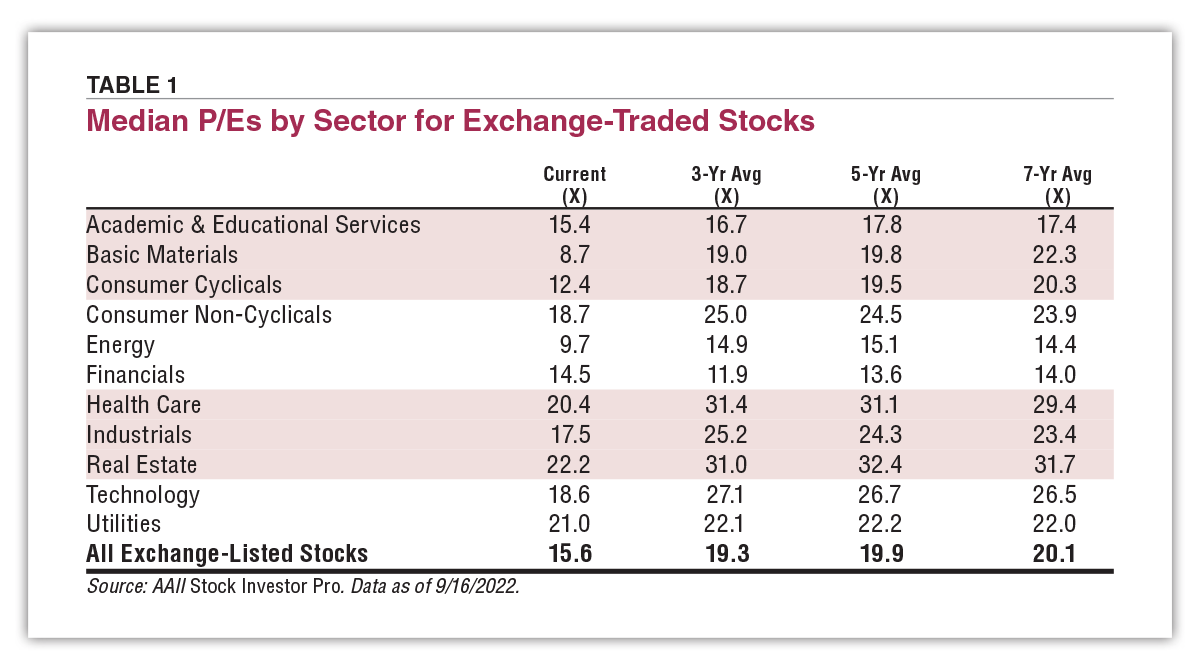
Basic materials and energy have the lowest median sector price-earnings ratios at 8.7 and 9.7, respectively. Companies from both sectors have benefited from high commodity prices. Cyclical stocks can see their valuations fall as earnings near a peak. This occurs because investors expect future earnings to decline and do not want to overpay. Analysts are currently projecting a significant drop in 2023 earnings relative to 2022 for companies like United States Steel Corp. (X) and Exxon Mobil Corp.  (XOM).
The financials sector stands out as the only sector with a current price-earnings ratio above its historical averages. Rising interest rates help increase net interest income (NII) for banks. (NII is the difference between the interest banks charge borrowers and the interest they pay savers.) Still, financials have the fourth-lowest price-earnings ratio of all sectors.
Relative price-earnings ratios tell you whether stocks are cheap or expensive compared to a benchmark. Valuations for the median exchange-listed stock are low relative to the past several years. Absolute price-earnings ratios tell you if stocks are cheap or expensive based on how high or low the ratio is. Health care, real estate and utility sector stocks have median price-earnings ratios above 20—a level some value investors may not consider cheap on an absolute basis.








SHASHI S from NY posted over 4 years ago:
You need to log in as a registered AAII user before commenting.
Log InCreate an account