


Charles Rotblut leads a class in AAII's new Essential Investing Video Course. Go to https://www.aaii.com/ves for more information and to subscribe.
Egg prices, as most of you know, have reached record highs. The eggs index was 53.0% higher in January 2025 than it was one year ago, according to the U.S. Bureau of Labor Statistics (BLS). In comparison, the consumer price index (CPI) was 3.0% higher in January than it was one year ago.
The avian flu has diminished the size of chicken flocks. This, in turn, has led egg prices to rise significantly faster than overall consumer inflation, as the chart shows.
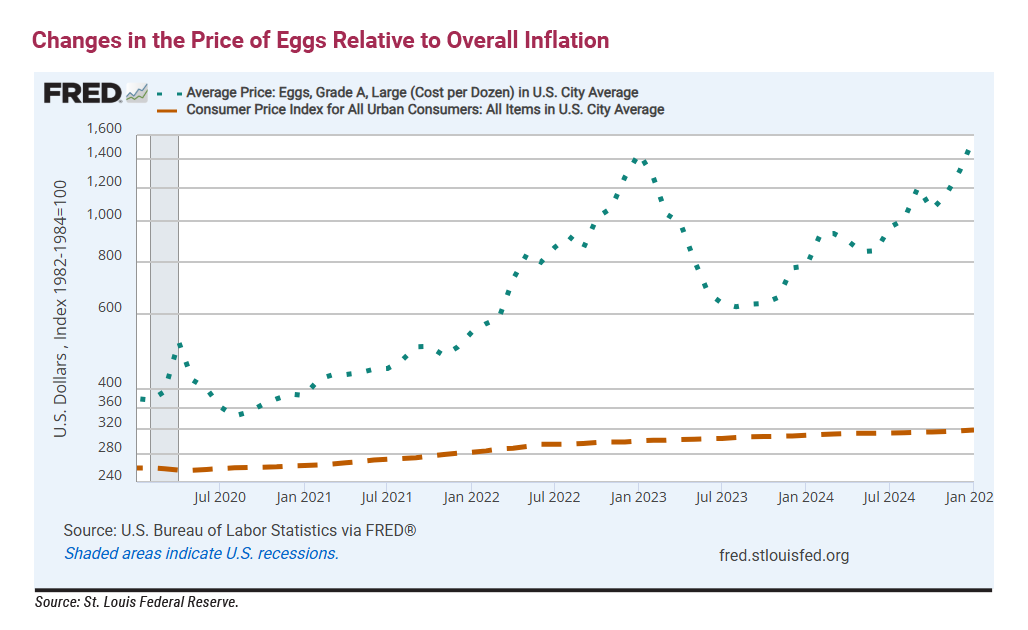
The CPI is a commonly used measure of inflation. It measures the change in prices for a market basket of consumer goods and services. [The chart uses the consumer price index for all urban consumers (CPI-U), which includes food and energy.]
Eggs play a small role in calculating the overall CPI, with a relative importance ratio of just 0.172 out of a total of 100 as of December 2024. (Relative importance is the expenditure weight of an individual component expressed as a percentage of all items.) To put this number into perspective, chicken—a separate category from eggs—has a relative importance of 0.216 in the index, while pork has a 0.288 weight, and beef and veal account for 0.445.
Overall, food at home has an 8.043 weighting in the CPI. This ratio may be smaller or larger relative to what portion of your budget is spent on groceries. Even if food costs are manageable, we notice the price changes more because we shop for groceries regularly. The price from one or two weeks ago is still fresh in our minds.
This anchoring, combined with the outsized increase in the price of eggs relative to overall inflation, is why it is easy to perceive inflation as being higher than it really is.
Another factor to consider is what drives the change in the CPI. Shelter costs were the biggest driver of inflation in January. They have a 35.483 weighting in the CPI. The largest component of shelter costs is the owners’ equivalent rent of residences. This change mostly impacts homebuyers and home sellers. Homeowners who own their property outright or have a fixed mortgage are not directly affected.
Thus, the reported change in CPI may not reflect your personal inflation experience. Plus, we can substitute what we eat—such as by eating cereal or yogurt instead of eggs.



Discussion
FREE REPORT

Get your free copy of our special
report analyzing the tech stocks
most likely to outperform the
market.
ROBERT A from NC posted over 1 year ago:
You need to log in as a registered AAII user before commenting.
Log InCreate an account