


Related

Portfolio Strategies
AAII’s PRISM Wealth-Building Process provides a framework for thinking through what simplification looks like for you.

Charles Rotblut leads a class in AAII's new Essential Investing Video Course. Go to https://www.aaii.com/ves for more information and to subscribe.
All investors face the challenge of managing their portfolios during their later years. Struggles with basic financial management tasks are among the earlier signs of cognitive impairment. Even if one’s financial skills remain strong, other health issues can interfere with staying on top of a portfolio.
In addition, a portfolio can be asked to serve multiple purposes during one’s later years. Retired investors often rely on their savings to help cover current and projected expenses beyond income received from Social Security and, if applicable, a pension. Those expenses include food, shelter, medical care and, if needed, assistance with daily living activities. Many investors also seek to leave a financial legacy, such as an inheritance and/or charitable donations.
The portfolio itself may be spread across several accounts. It is not unusual for someone to have savings accounts, a taxable brokerage account, a traditional individual retirement account (IRA) and a Roth IRA. Retired married couples could have double the number of retirement accounts.
Taxes and withdrawal strategies further complicate late-in-life portfolio management. Investors subject to required minimum distributions (RMDs) must be sure to take them each year before December 31. RMDs may trigger the need to pay estimated taxes as well, which have their own deadlines.
Then there are the investing strategies followed. An investor may use a mix of stocks, exchange-traded funds (ETFs) and other investments to build a customized portfolio. Making the correct decisions about what to hold and what to sell becomes more difficult as one’s cognitive functions decline and/or their health worsens.
Older investors can assist their future selves by simplifying their portfolio while continuing to achieve their dual goals of funding retirement and leaving a financial legacy. In this article, I present a one-page PRISM Wealth-Building Plan for a simplified portfolio. I also address several considerations related to the simplification process.
To demonstrate this portfolio simplification plan, I use a hypothetical married couple. Joel and Margaret are both 80 years old. Joel has medical issues that could worsen, but the couple remain relatively active and healthy otherwise. They own their home and continue to live independently. Their $1.5 million portfolio is split between approximately $1 million in traditional IRAs, $200,000 in Roth IRAs and $300,000 in a taxable brokerage account.
Joel and Margaret are required to take combined annual RMDs of approximately $49,500 from their traditional IRAs. The couple began receiving Social Security benefits at age 70 and currently receive total benefits of $5,500 per month ($66,000 per year).
Their monthly budget, including taxes, is $7,000 per month ($84,000 per year). Since their total pretax income of $115,500 (RMDs + Social Security) exceeds their annual budgeted spending, Joel and Margaret have been reinvesting the excess into their taxable account, allowing their portfolio to continue growing even while taking distributions.
There is no universal age at which investors should take steps to simplify their portfolios before cognitive impairment or other health issues cause problems. Rather, it depends on each investor and their support system.
Warning signs that simplification may be overdue include the following.
Simplifying your portfolio is an act of care—for yourself and for those who may assist you in the future. It is better to be proactive than reactive.
The first step, and the cornerstone, of the PRISM Wealth-Building Process is prioritizing goals.
Like many people, Joel and Margaret have more than one goal. First and foremost, they need to ensure that their expenses are covered through the end of their lives. Joel’s medical issues are a reminder that costs can rise later in life.
The couple also want to leave an inheritance for their children and grandchildren. Ideally, they also want to support their favorite charities.
Joel and Margaret currently have a budget of $7,000 per month. Should Joel eventually need assisted living, they expect their costs to rise to about $12,000 per month. Their costs would rise further if a higher level of care is ever needed.
Margaret is in good health. Her mother lived to age 90, and she thinks she could live past that age.
The couple set a goal of leaving $500,000 in today’s dollars as a legacy. They realize that this amount is subject to change based on their future expenses and portfolio returns.
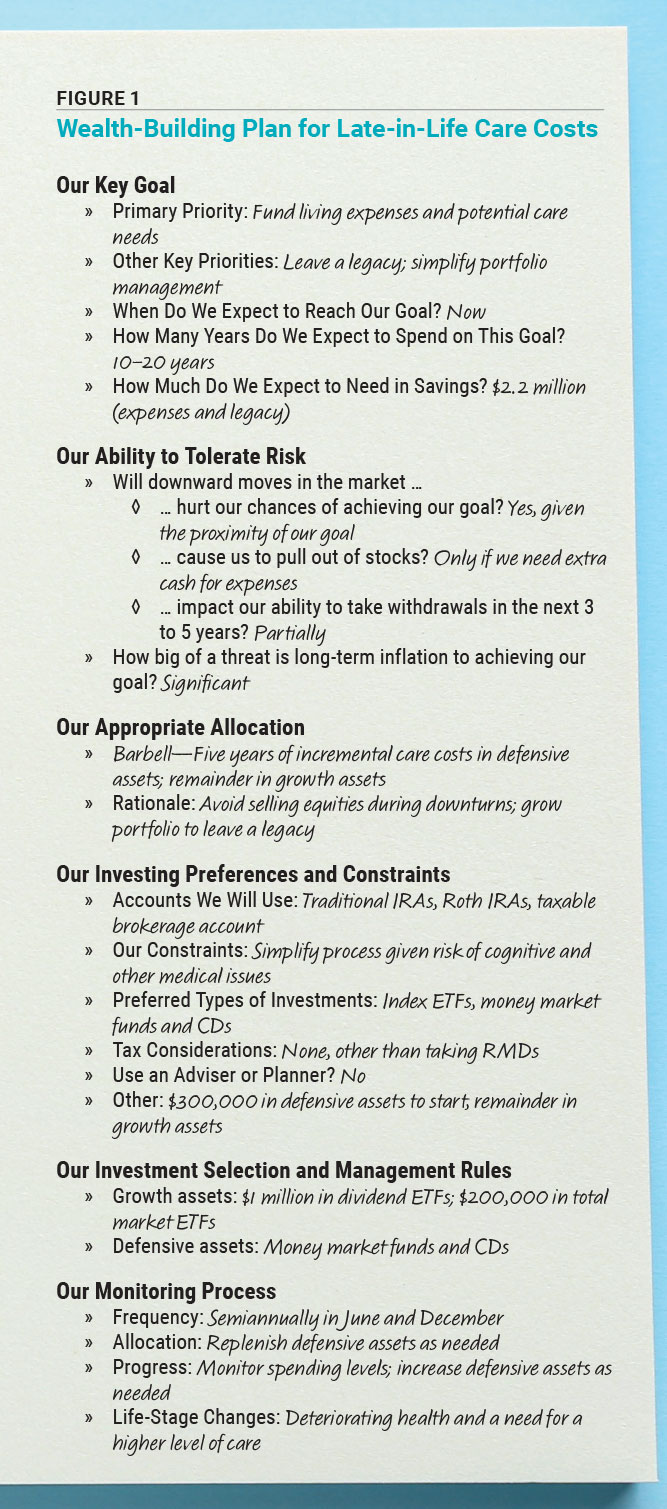
Joel and Margaret are fortunate to currently cover their expenses with Social Security benefits and RMDs. They have previously ridden out bear markets without pulling out of stocks. Now, as they age, Joel and Margaret are becoming more worried about how a severe bear market could impact them.
They are particularly concerned about sequence of returns risk. If a bear market were to coincide with the couple’s spending increases, they could end up selling stocks when prices are down.
Joel and Margaret also realize the importance of holding equities to grow the eventual legacy they wish to leave. Without long-term capital appreciation, any amount currently designated to be passed on will lose value on an inflation-adjusted basis. Thus, they are willing to accept the risk of downward volatility to help their eventual heirs.
The couple view complexity as an additional risk. They do not want to engage in strategies that require a more active approach to portfolio management given the risk of future cognitive decline and other medical issues.
Joel and Margaret’s concern about sequence risk, desire to maintain growth and preference for simplicity may not appear as though they would neatly fit into a simple allocation.
On one hand, a more conservative approach may seem warranted to protect against a bear market. On the other hand, an aggressive approach would help them leave a larger legacy. The couple’s desire for simplicity points to a set-it-and-forget-it allocation.
A barbell approach covers all three of the couple’s priorities by combining defensive assets with growth assets. AAII’s aggressive allocation model and AAII founder James Cloonan’s Level3 withdrawal strategy are both examples of barbell approaches. They combine maximizing wealth growth with a small amount of wealth preservation.
Unlike actual barbells that require weights be evenly distributed on both sides, barbell allocations do not require the conservative and aggressive allocations to be equal. One can be larger than the other.
Joel and Margaret decide to implement this approach. They opt to allocate the equivalent of five years of anticipated spending to defensive assets given the uncertainty over when Joel may need additional care. The remainder will be allocated to growth assets.
Given their projected spending needs, the couple allocate $300,000 to defensive assets. This is equivalent to 20% of their portfolio. This percentage is close to the 25% fixed-income weighting suggested in the transition phase between the aggressive and moderate AAII Asset Allocation Models.
The larger allocation to defensive assets also provides simplicity by giving the couple a bucket they can easily tap when expenses rise. No decisions need to be made about what to sell.
Joel and Margaret then decide to allocate the remainder of their portfolio to growth assets, specifically domestic equities. This will help their portfolio grow at a rate higher than inflation.
As stated above, Joel and Margaret have a joint taxable brokerage account in addition to separate traditional IRAs and Roth IRAs. To avoid making this example too complex, I assume that they have stopped doing Roth IRA conversions.
Joel and Margaret prefer ETFs, which works to their advantage, as they do not have any individual stock holdings to manage. If the couple held individual stocks, they would need to consider at what point declining cognitive ability might impair their judgment about when to sell. Even long-term positions can become unattractive.
Broad market ETFs like Vanguard Total Stock Market ETF  (VTI) provide them with exposure to stocks of different sizes, though such funds are market-capitalization weighted. The couple could choose an equal-weight fund like Invesco Russell 1000 Equal Weight ETF (EQAL) if they wanted to even out their exposure between large- and mid-cap stocks. Dividend ETFs such as ProShares S&P 500 Dividend Aristocrats ETF (NOBL) provide a stream of income.
The couple’s asset location strategy is straightforward: They designate their $1 million in traditional IRAs to dividend-focused ETFs to generate income for RMD distributions. Joel and Margaret instruct the brokerage firm to direct all dividend distributions to sweep accounts, making it easier to meet their RMD requirements. Their $200,000 in Roth IRAs is designated to total stock market index funds to maximize tax-free growth for their heirs. Distributions from Roth IRAs are tax-free, including to heirs, making this the preferable account for growth-oriented holdings.
The couple designate their $300,000 taxable account to defensive assets to cover Joel’s potentially higher care costs. They make use of money market funds and certificates of deposit (CDs) in their taxable account. They prefer the simplicity of these vehicles over bonds. The CDs have different maturing dates, which locks in interest rates at current levels while providing access to cash over the next few years if needed. The varying maturity dates also give the couple the ability to roll the CDs over in the future or move the proceeds to the money market fund should they need to simplify further.
Note that this example assumes Joel and Margaret can implement their barbell allocation immediately. In reality, many investors at age 80 will have to sell equity holdings and potentially bond holdings to build up their allocation of defensive assets. This may require a gradual transition to avoid significant tax consequences and higher Medicare premiums. A phased two-to-three-year build of the defensive bucket through excess RMDs, dividends and tax-efficient sales is more realistic. Investors facing imminent care needs may consider consulting with a tax professional about the most efficient way to build liquidity quickly.
The final step of the PRISM process involves monitoring portfolio allocation, progress toward goals and life-stage changes. Joel and Margaret will review their portfolio semiannually—in June and December—to assess their allocation, spending and any life-stage changes.
By limiting the number of investments held and clearly defining what their barbell approach looks like, Joel and Margaret have simplified the monitoring process. The couple will continue to allocate any excess amounts from their RMDs into their taxable account. If a large enough buffer of defensive assets has been established, any excess RMDs will be reinvested into equity ETFs for future capital appreciation.
As long as five years of projected spending is maintained in defensive assets, the growth side of the barbell can continue growing without regular rebalancing. This is because the amount allocated to defensive assets is determined by a projected dollar amount ($300,000 for five years of incremental care costs) rather than a portfolio allocation percentage. However, if equity gains push the growth allocation significantly above 85% of the total portfolio, the couple may consider modest transfers to replenish defensive assets and maintain their risk guardrails.
When Joel requires assisted living, he and Margaret will draw an additional $5,000 per month ($60,000 annually) from their defensive bucket to cover the estimated cost. The RMDs will continue but will now fully be needed to help cover spending. This approach allows the growth side of the barbell to continue compounding for Margaret’s potential future care needs and the couple’s legacy goals.
Progress toward goals will be measured in terms of how the couple’s spending evolves. As more is needed to fund care, less will be left for legacy purposes. Research on safe withdrawal rates finds that withdrawals of up to 6.0%–6.5% of total savings can be taken at age 80. This level provides greater spending power without significantly risking the chance of either spouse outliving their savings.
Life-stage changes would involve Joel and Margaret’s health. Deteriorating health and/or a need for a higher level of care could require a larger allocation to defensive assets. The actual adjustment will depend on the projected cost of the necessary care relative to the size of the portfolio.
The other big life-stage change would be the death of either spouse. Assuming Joel dies first, Margaret would step up from her spousal Social Security benefit to Joel’s full benefit. While her individual benefit would increase, the household would lose her spousal benefit, reducing total Social Security income from $5,500 per month to approximately $3,500 per month. Margaret’s spending could decrease if she continues to live at home, but it could remain elevated if she requires care. Margaret will also inherit Joel’s IRA, which will increase the total amount of RMDs she is required to take each year.
The couple’s adult children should be prepared to assist Margaret more actively with portfolio management at this transition point. The couple have already shared their PRISM plan with their adult children. Joel and Magaret also took the additional step of designating their adult children as authorized agents on all accounts. Authorized agents have ability to assist with portfolio management, including making withdrawals. (You must fully trust that anyone you make a designated agent will always put you first when making decisions.)
As we reach our later years, the risk of developing cognitive and other medical conditions increases significantly. These changes can adversely impact our ability to effectively manage our portfolios.
Simplification allows you to adjust your approach while continuing to invest. It is not about giving up control or future growth; rather, it is about reducing the number of decisions you need to make. Simplification helps to preserve your portfolio and progress toward your goals.
The PRISM Wealth-Building Process provides a framework for thinking through what simplification looks like for you.
Joel and Margaret’s one-page PRISM plan only specifies what a simplified approach looks like for them. Their PRISM plan also builds in safeguards by limiting the number of decisions they need to make and increasing the odds of the portfolio surviving a bad bear market.
Portfolio Strategies

Portfolio Strategies


J M from NJ posted 9 months ago:
JOHN L from NJ posted 9 months ago:
BARRY J from TX posted 8 months ago:
BARRY J from TX posted 8 months ago:
ROBERT A from NC posted 8 months ago:
JARED G from CA posted 8 months ago:
NORMAN N from FL posted 8 months ago:
GERALD B from IL posted 8 months ago:
JOSEPH R from CA posted 8 months ago:
CHAR N from NY posted 8 months ago:
DONALD G from TN posted 8 months ago:
NEIL S from TX posted 7 months ago:
You need to log in as a registered AAII user before commenting.
Log InCreate an account