Conventional wisdom holds that buying index (“passive”) mutual funds and exchange-traded funds (ETFs) is an effective way to beat actively managed funds. Index funds tracking broad-based indexes are difficult to beat over extended periods because of their low costs. For many investors, they are a good option but are not the only way to beat the returns of actively managed funds.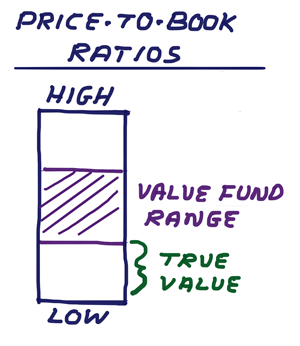
A second way would be to not invest like a mutual fund; rather, hold a truly diversified portfolio of stocks. Such a portfolio would not be just different in terms of which stocks it holds, but also different in the types of stocks it holds. It would also differ in size and even turnover.
A simple way to start would be to truly emphasize value; not just value in name but by holding true value stocks. Such stocks have price-to-book (P/B) ratios ranking in the lowest 40%, or even the lowest 20%. These stocks currently trade with price-to-book ratios below 1.5 and 1.0, respectively.
Couldn’t you simply buy a value fund instead? Theoretically, the answer would be yes. In reality, it’s much harder to get exposure to such stocks through a mutual fund. An analysis of 574 value funds found most holding more expensive stocks. The weighted price-to-book ratios were in the top 50% to 80% range for “the bulk” of such funds. (We’ll discuss the study further in the Dispatches section of the February AAII Journal.)
One possible explanation would be a simple lack of reliance on the price-to-book ratio. Fund managers could be looking at a different valuation ratio. Yet, when the researchers looked at the oft-used price-earnings (P/E) ratio, they again found a lack of a deep value focus. Most value funds stayed away from the cheapest 25% of stocks. Instead they held stocks with price-earnings ratios closer to the midpoint for all stocks. (Based on current levels, a price-earnings ratio of 11.4 or less would rank in cheapest 25%. A stock in the 50th percentile would have a price-earnings ratio of 17.1 or lower.)
Even if we assume that the lack of an identifiable value focus is simply due to the use of other means of assessing relative valuation (cash flow measures, yield, etc.), there are other ways to invest differently. Mutual fund portfolios showed no clear preference for stocks possessing traits such as profitability (defined loosely as pretax return on equity), investment (year-over-year change in total assets) or momentum (relative price performance).
Putting it all together, placing a strong emphasis on specific traits (“factors”) will allow you to invest differently than a mutual fund. Seek out stocks with low price-to-book or price-earnings ratios, high levels of profitability, low levels of investment or strong price momentum. Better yet, seek ways to combine two or more of these traits—or even other traits like size and quality. Doing so will not only allow you to take advantage of the academic research about what factors lead to higher returns, it will also lead you to stocks potentially overlooked by mutual fund managers and that may have greater odds of being mispriced.

- Fund Manager Tenure Based on Peer Returns – Many mutual funds focus more on how they compare to their competitors than beating their respective benchmarks.
- Using Book Value to Judge a Stock’s Worth – In this 2015 AAII Journal article, I discussed the price-to-book ratio in greater detail and gave suggestions on what to pair it with.
- Comparing the Most Popular Online Brokers – The seven discount brokers most used by AAII members offer a comparable suite of tools and services but vary in subtle ways.
- Option Prices Adjust to Reflect Extreme Weather Events – Given this week’s polar vortex (it was –22 degrees at my train station this morning!), you may find it interesting to know that the financial markets do react to weather.
Earnings season will remain in full stride, with nearly 100 members of the S&P 500 index scheduled to report. Included in this group is Dow Jones industrial average component Walt Disney Co. (DIS), which will report on Tuesday.
The week’s first economic report will be the November factory orders, released on Monday. Tuesday will feature the January Institute for Supply Management (ISM) non-manufacturing index. Fourth-quarter productivity will be released Wednesday. November international trade data, which was originally scheduled for January 7, is delayed until February 6 because of the government shutdown.
Three Federal Reserve officials will make public appearances this week: Cleveland president Loretta Mester on Monday; chairman Jerome Powell on Wednesday; and St. Louis president James Bullard on Thursday.
The Treasury Department will auction off $38 billion in three-year notes on Tuesday, $27 billion in 10-year notes on Wednesday and $19 billion in 30-year bonds Thursday.
- Mighty Minis: Tiny Titans Stand Tall in 2018
- The Mathematics of Retirement Portfolios
- The Model Shadow Stock Portfolio’s Drawdowns and Rewards
The percentage of individual investors who describe their short-term outlook for stocks as “neutral” is at its highest level in nearly six months. The latest AAII Sentiment Survey also shows a drop in optimism and a slight decrease in pessimism.
Bullish sentiment, expectations that stock prices will rise over the next six months, fell by 5.9 percentage points to 31.8%. Optimism remains below its historical average of 38.5% for the 18th time in 21 weeks.
Neutral sentiment, expectations that stock prices will stay essentially unchanged over the next six months, rose 6.5 percentage points to 36.5%. Neutral sentiment was last higher on August 1, 2018 (38.8%). The historical average is 31.0%.
Bearish sentiment, expectations that stock prices will fall over the next six months, declined 0.6 percentage points to 31.8%. Pessimism is above its historical average of 30.5% for the 19th time in 21 weeks.
At current levels, all three sentiment indicators are within their typical historical ranges.
The survey period runs Thursday through Wednesday, with reminders to take the survey sent out on Monday. Most of this week’s responses were recorded before yesterday’s Federal Open Market Committee (FOMC) meeting statement was released.
This week’s special question asked AAII members to share their thoughts about the recent rebound in stock prices. Nearly half (47%) of all respondents are unsure about whether it is sustainable. Many think downside volatility could return, earnings have peaked or other negative factors could play a role. A few mention the ongoing trade war with China as a point of uncertainty. About 12% of respondents think politics are affecting the markets, with some bringing up the government shutdown. Slightly more than 21% describe the rebound as a bounce from last year’s decline or reflective of an oversold market. An additional 11% think the rally is sustainable.
Here is a sampling of the responses:
- “Just a rebound from the sell-off at the end of December that was not justified given the financial health of companies.”
- “An aberration. The economy is still punch drunk on low interest rates.”
- “I think it will continue throughout most of 2019.”
- “I don’t think it will go much further. We are at the tail end of the economic upswing and the boom in corporate profits is over.”
- “Headline news is driving investors crazy. Trade with China is another big factor.”

Bullish: 31.8%, down 5.9 points
Neutral: 36.5%, up 6.5 points
Bearish: 31.8%, down 0.6 points
Bullish: 38.5%
Neutral: 31.0%
Bearish: 30.5%
Local Chapter Meetings

January 24, 2019 AAII Members Share Their Memories of John Bogle
January 17, 2019 A Few Personal Thoughts in Remembrance of John Bogle
January 10, 2019 Brokers Announce New Stock Exchange: What We Know
January 3, 2019 The Stretch of Low Optimism Continues