

Implementing Your Portfolio Strategy
by Charles Rotblut | September 17, 2020
Over the past few weeks, I’ve been offering guidelines for including various types of investments in your portfolios. If you haven’t read those commentaries yet or missed one or two, here’s the list:
-
Mutual funds and exchange-traded funds (ETFs)
-
Bonds and bond funds
-
Stocks (blend/diversified)
- Stocks (value and growth)
This week, I will tie these commentaries together. The focus will be on implementing your portfolio strategy and where you can find ideas on AAII.com.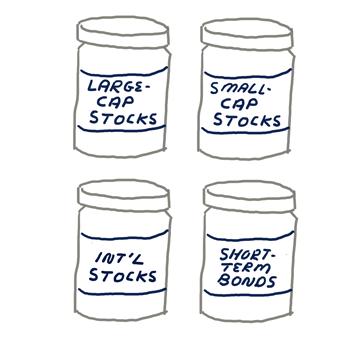
The project we’ve code-named as “The AAII Way” views the process of choosing specific investments as how you put your allocation into action. If you use the worksheets we’ve created, you will 1) identify your goals; 2) define your tolerance for risk; 3) select an allocation strategy based on both; 4) identify your investing preferences and constraints; and 5) select the appropriate investments. This process ties what you hold in your portfolio to what makes sense given your investing profile and goals.
There is a great deal of flexibility for selecting investments within this framework. Investments can be chosen from the universe of exchange-listed stocks, bonds, ETFs and mutual funds. The only restrictions most individual investors face is where they invest [e.g., a 401(k) plan will have a more limited menu] and their level of wealth (lower levels of wealth increase the need to use mutual funds or ETFs for diversification).
Implementing the process requires matching investment categories with your allocation needs. Large-cap stocks or large-cap funds should be sought to fill the large-cap portion of your allocation. Intermediate-term bonds or intermediate-term bond funds should be sought to fill this portion of your allocation strategy. It may help to visualize the process as filling jars. Each jar is labeled; you simply need to fill it with the appropriate ingredients.
Choosing exactly what goes into a given jar and knowing when to replace one or more of the items in a jar is determined by your preferences and rules. Index and fund investors will want to focus their attention solely on mutual funds and/or ETFs. Fully hands-on investors will be interested in individual stocks and bonds. Many of you reading this may have feet in both camps, which is what we describe as being a partially hands-on investor.
The specific selection of securities is then based on your rules. Here are some brief suggestions (see the aforementioned commentaries for more):
- Bonds—Taxable or municipal (depending on type of account used); good credit quality; appropriate time to maturity; awareness that higher yields signal higher risk; aim to hold individual bonds until maturity
- Mutual Funds/ETFs—Low cost; outperform category peers over time; maintain stated objective and strategy
- Stocks—Use quantitative metrics for analyzing; determine whether to seek a blend or a purposeful style tilt (value, growth, size, etc.); sell when stock no longer possesses desired characteristics (sales stop increasing for a growth stock, a value stock’s valuation becomes expensive, a dividend-paying stock cuts its dividend, etc.)
As far as finding investments is concerned, we have several resources you can use on AAII.com. Many of these resources are available to AAII members, some require a premium subscription. The table below lists them and shows the types of investments you can expect to find in each.
AAII Resources for Finding Investment Ideas
|
|
Equites: Blend |
Equites: Growth |
Equites: Value |
Equites: Income |
Bonds: All |
Allocation |
|---|---|---|---|---|---|---|
| AAII Stock Screens | ? | ? | ? | ? |
|
|
| Model Shadow Stock Portfolio |
|
|
? |
|
|
|
| Mutual Fund Guide | ? | ? | ? | ? | ? | ? |
| ETF Guide | ? | ? | ? | ? | ? | ? |
| A+ Investor | ? | ? | ? | ? | ? | ? |
| AAII Dividend Investing |
|
|
? | ? |
|
|
| Stock Superstars Report | ? | ? | ? | ? |
|
|
| VMQ Stocks |
|
|
? |
|
|
|

-
Diversification: How Many Stocks Will Suffice? – This 1990 AAII Journal article found that risk drops significantly once at least 20 stocks are held in a portfolio.
-
How to Take Advantage of Risk Factors – Tilting your portfolio to stocks with certain characteristics can improve returns. Find out how to do it.
Pessimism among individual investors about the short-term direction of the stock market declined but continues its streak of staying above 40%. The latest AAII Sentiment Survey also shows higher levels of optimism. Neutral sentiment is slightly lower this week.
Bullish sentiment, expectations that stock prices will rise over the next six months, rebounded 8.3 percentage points to 32.0%. Bullish sentiment remains below its historical average of 38.0% for the 28th consecutive week and the 33rd week this year.
Neutral sentiment, expectations that stock prices will stay essentially unchanged over the next six months, fell by 0.2 percentage points to 27.6%. This is the 34th time out of 36 weeks that neutral sentiment is below its historical average of 31.5%.
Bearish sentiment, expectations that stock prices will fall over the next six months, dropped by 8.1 percentage points to 40.4%. Bearish sentiment is above its historical average of 30.5% for the 30th consecutive week and the 32nd time this year.
Pessimism continues to stay at an unusually high level. Pessimism is above 40% for the 25th time out of the past 28 weeks. Both bullish and neutral sentiment are within their typical historical ranges.
The persisting high level of pessimism reflects concerns about the coronavirus pandemic, the economy and the upcoming election. The recent decline in the Nasdaq composite may have also played a role. Other factors influencing AAII members’ sentiment include the economy, valuations and interest rates.
In this week’s special question, we asked AAII members which factors are most influencing their six-month outlook for stocks. Note that some members name more than one factor.
We received over 100 responses, of which 41% of respondents say that the uncertainty surrounding the outcome of the upcoming election is the most influential factor on their market outlook. This compares to 31% of respondents who say that the country’s ability to manage the coronavirus pandemic and the ability to find a vaccine in the near future are the most influential factors.
About 11% of respondents say that the unemployment rate in the U.S. is the most influential factor. In addition, 10% of respondents say that the Federal Reserve’s policies, low interest rates and tax law changes are the most influential factors. Lastly, about 7% of respondents say that the overly optimistic market valuations and the likelihood that a bubble burst will occur are the most influential factors on their six-month outlook.
Here is a sampling of the responses:
- “Markets are beginning to look at the elections, and the uncertainty—if not the outcome—does not bode well for the near future.”
- “Politics and the likelihood of political change—either further to the right or further to the middle—both affect those who buy and sell. I suspect the stock market will do well although individual companies may suffer severely.”
- “The stock market will ignore economic reality in the hopes that a coronavirus vaccine will be available and solve the pandemic quickly.”
- “I feel there is too much uncertainty to have any firm conviction plus, minus or neutral. In my mind, all of that uncertainty derives from the upcoming general election.”

Bullish: 32.0%, up 8.3 points
Neutral: 27.6%, down 0.2 points
Bearish: 40.4%, down 8.1 points
Bullish: 38.5%
Neutral: 31.0%
Bearish: 30.5%
September 10, 2020 Guidelines for Adding and Removing Stocks, Part 2
September 3, 2020 Guidelines for Adding and Removing Stocks, Part 1
August 27, 2020 Considerations for Picking a Mutual Fund or ETF
August 20, 2020 Stocks, Funds or Both?

Discussion
No comments have been added yet. Add your thoughts to the discussion!
You need to log in as a registered AAII user before commenting.
Create an account