

Ideas for Implementing Your Fixed-Income Allocation
by Charles Rotblut | August 13, 2020
Our moderate and conservative allocation models call for holding fixed-income assets. Though interest rates are painfully low for savers, bonds both provide a source of income and help to smooth the volatility of portfolio returns.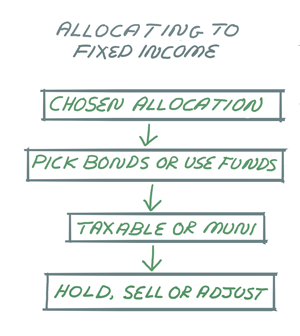
Determining how you will allocate to bonds stems from the decisions many of you have already made through The AAII Way. I’m going to walk you through how to use those decisions to create a framework that guides the choice of which investments you hold in your portfolio. (I will do the same for stocks in a forthcoming Investor Update.)
Let’s start with your goals and your chosen allocation model. If your risk tolerance is conservative and/or you will need the money in the next few years, a short-term bond or bond fund makes sense. Preservation of wealth matters more in this case than a higher stream of income. If access to the money is important (e.g., you will to make a withdrawal within a few years but the timing of the withdrawal is uncertain), money market funds and savings accounts are an alternative.
If your timeline is longer or your need for income is staggered, then you have more options. One would be to hold intermediate-term bonds. Another is to ladder your bonds or bond funds. This involves buying bonds or defined-maturity bond funds with different maturities. Doing so spreads out interest-rate risk.
Making these decisions first helps you to narrow the field of which fixed-income investments to look at. The other part is to look at The AAII Way worksheet for determining how your portfolio will be managed. This will drive your decision about what type of investments you look at.
You will also need to decide the type of bonds you want to target. At a broad level, the choice is between taxable (which are best suited for tax-preferred accounts like IRAs and Roth IRAs) and municipal bonds (which are better suited for taxable accounts). Within the taxable category, there is a choice between Treasuries (lowest credit risk) and corporates (higher relative yields, but more credit risk). Those concerned about potential future inflation could also consider inflation-protected bonds (aka TIPS). We don’t believe there is a blanket rule that applies to every investor; rather, we think you should tailor your rules based on your investing profile and personal preferences. In the AAII Journal archives, there are several articles discussing the different types of bonds.
The most common way individual investors get exposure to fixed income is to buy and hold bond mutual funds or exchange-traded funds (ETFs). Even many who otherwise consider themselves to be hands-on investors opt to use funds to fulfill this part of their allocation. Our mutual fund guide and ETF guide are good sources for finding such funds. Use your preferences about indexing versus active management as well as your preferences for certain bond categories to help guide your decision about which funds to consider. A+ Investor subscribers can use the mutual fund screener and the ETF screener to search for funds with specific traits.
Fully hands-on investors will opt for buying individual bonds. Investors who work with an adviser may also opt for this route. Doing it yourself requires a willingness to research bonds and an understanding of how buying them differs from buying stocks. Long-time AAII Journal contributors Hildy and Stan Richelson wrote what they described as a toolkit for buying bonds.
Lastly, use your allocation preferences to determine how much you should allocate. If the allocation calls for 30% to intermediate-term bonds (as suggested by AAII’s revised moderate allocation model), then that’s the approximate dollar amount you will want to put into those bonds or funds targeting them.
As for selling, the rules again depend on your allocation and how you invest. Invest in bonds and defined-maturity bond funds with the intent to hold them until maturity unless there is a deterioration in credit quality of the individual bonds or a need to liquidate those investments to access cash. Positions in bond mutual funds and ETFs can be adjusted for purposes of periodic portfolio rebalancing, to transition to a different allocation or to help fund required minimum distributions (RMDs). Other reasons to sell include a deterioration in the fund’s performance relative to its category peers or a change in the fund’s objective/strategy. The mutual fund compare tool and the ETF compare tool show how a fund you own compares against funds you may be considering as replacements. (It’s available to all AAII members.) A+ Investor subscribers can also access the Grades tab of My Portfolio to monitor how a fund or ETF is faring against its category peers.
As noted above, we’ll walk you through a similar exercise using equities in a forthcoming AAII Investor Update. Along with it, we will provide a new AAII Way worksheet to help you record your preferences for implementing your allocation.
Try out The AAII Way worksheets we’ve created so far and give us your feedback in the comments section for each. We want them to be useful to you.
1. Identifying and Prioritizing Your Financial Goals Worksheet
2. Our Revised Risk Tolerance Worksheet
3. A Worksheet for Determining How Your Portfolio Is Managed

-
A Fresh Look at Defined-Maturity Bond Funds – These funds mature on a specified date like bonds but are also professionally managed and benefit from economies of scale like other funds.
-
Laddered Bond Portfolios – Laddering a bond portfolio involves building a portfolio of individual bonds with staggered maturities; this 2009 AAII Journal article offers suggestions on how to do it.
Optimism among individual investors about the short-term direction of the stock market experienced its biggest weekly percentage-point move since March 2020. The latest AAII Sentiment Survey also shows lower levels of neutral and bearish sentiment.
Bullish sentiment, expectations that stock prices will rise over the next six months, rose 6.7 percentage points to 30.0%. Nonetheless, optimism remains below its historical average of 38.0% for the 23rd consecutive week and the 28th week this year.
Neutral sentiment, expectations that stock prices will stay essentially unchanged over the next six months, declined 1.3 percentage points to 27.8%. This is the 29th time out of 31 weeks that neutral sentiment is below its historical average of 31.5%.
Bearish sentiment, expectations that stock prices will fall over the next six months, declined 5.5 percentage points to 42.1%. Pessimism is above its historical average of 30.5% for the 25th consecutive week and the 27th time this year.
Bullish sentiment rose to a four-week high. Optimism is also at or above 30% for just the second time in nine weeks. This week’s upward move puts bullish sentiment back within its typical historical range.
Bearish sentiment remains at an unusually high level for the 21st time out of 23 weeks.
This week’s special question asked AAII members for their opinion about the current valuation of stocks. Nearly two-thirds (64%) of respondents say that stocks are overvalued, and valuations are too optimistic. A majority within this group believe the stock market is overvalued given low interest rates and the Federal Reserve’s fiscal and monetary actions. This compares to 19% of respondents who say that the current market valuations contain a mixture of overvalued, undervalued and fully valued stocks. Many believe growth stocks are overvalued while value stocks are undervalued. About 11% of respondents state that the majority of stocks are fully or fairly valued.
Here is a sampling of the responses:
- “Reasonable for the beginning of a new bull market and low interest rates.”
- “The bulk of the stock market is fairly valued, given the low rate of return on cash and bonds. However, it’s easily subject to devaluation should interest rates suddenly rise.”
- “I think stocks are artificially high due to the Fed’s low interest rates and the likelihood that at some point in the near future inflation will return as a result of monetary and fiscal policies.”
- “There is a mixed bag. Some are wildly overvalued, but some are substantially undervalued.”
- “By conventional or traditional measurements, they are fully or overvalued. However, I believe that as the dollar is becoming devalued and inflation is looming, stocks will continue to appreciate.”

Bullish: 30.0%, up 6.7 points
Neutral: 27.8%, down 1.3 points
Bearish: 42.1%, down 5.5 points
Bullish: 38.5%
Neutral: 31.0%
Bearish: 30.5%
August 6, 2020 Investment Expenses Are a Drag; Tips for Reducing Them
July 30, 2020 Comparing and Contrasting the Types of Investment Accounts
July 23, 2020 How Will You Implement Your Portfolio Strategy?
July 16, 2020 What Type of Individual Investor Are You?

Discussion
No comments have been added yet. Add your thoughts to the discussion!
You need to log in as a registered AAII user before commenting.
Create an account