

Stocks, Funds or Both?
by Charles Rotblut | August 20, 2020
Last month, we when released The AAII Way worksheet for determining how your portfolio will be managed, we asked you to consider the level of involvement you want. The considerations on the worksheet included how much control you want, how comfortable you are researching and monitoring investments and how often you would like to review your holdings.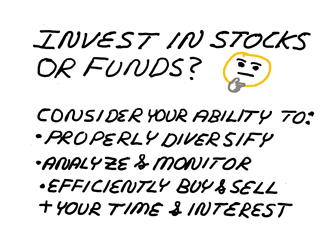
How you answered each question provides a framework for determining how you will implement the equity portion of your allocation. Some of you will (and currently do) own individual stocks. Exchange-traded funds (ETFs) and/or mutual funds will be favored by others reading this. Chances are many of you use a blend of stocks and the broad category of funds (mutual funds, ETFs and even closed-end funds).
If you’ve identified yourself as a fully hands-on investor, you’ve already made up your mind about the stocks versus funds argument. The same would be for those of you who are dyed-in-the-wool index investors. Even still, there are additional decisions to be made for both groups. I’m going to address those over the next two weeks.
This week, I’m going to address a choice that many of you who use stocks and funds (aka, partially hands-on investors) face: When do you opt for individual stocks and when do you opt for funds?
There are four basic ways to think about the answer. They are:
- Are you able to create a diversified portfolio?
- Do you have the time and interest?
- Can you analyze and monitor?
- Can you efficiently buy and sell?
Diversified Portfolio—A range of 10 to 30 stocks is suggested to achieve reasonable diversification. The low end of this range assumes all of the stocks are from different industries and sectors, have different individual characteristics and are approximately equally weighted. (Equal weighting means assigning a similar dollar amount to each stock.) The higher end of the range provides more leeway but still requires a mix of stocks. (Owning 30 tech stocks is not being diversified.)
The ending of commissions lowers the threshold for accomplishing this, but a certain level of wealth is still required. Those with small balances will find it easier to achieve proper diversification by holding mutual funds and/or ETFs. Our mutual fund and exchange-traded fund guides can help you find suitable funds.
Time and Interest—Selecting and investing in individual stocks requires the time to identify, research and track them. It also requires an interest in doing this type of work. There are certainly shortcuts you can use, such as tracking one or more of AAII’s model portfolios (e.g., Model Shadow Stock Portfolio, AAII Dividend Investing, etc.) or using stock factor and stock guru screens, but you should analyze a stock before buying it.
The process can be rewarding for those who have the time and interest to do so. I personally enjoy analyzing stocks, but not everyone does. Even if the interest is there, the time may not be. This is where being honest about what you enjoy doing and how much time you have available to do the analysis is really important. There’s no shame in delegating to a fund manager. If you do have the time, interest and a disciplined process, it can be fruitful to pick individual stocks.
Analyze and Monitor—To be a successful stock-picker, you need to know how to analyze a stock and have the ability to monitor it. We have an extensive archive of articles discussing which traits to seek out in a stock and what to watch out for. A (very) short list would include looking for stocks with a reasonable valuation, profits, positive cash flow, a reasonable level of debt and a growing dividend (if a dividend is desired). Traits like growth and momentum can also be sought out.
In addition to analyzing stocks, you will need a process for monitoring them. This involves checking the stock on a routine basis (not necessarily daily and certainly not on an intraday basis) to ensure the reasons you bought it still apply. A portfolio tracker like My Portfolio can help, though you should still pay attention to corporate earnings releases and conference calls. You should also have written guidelines listing what would prompt you to buy and sell a stock. (The My Notes section of My Portfolio can be used to list specific notes for each stock, as well as funds.)
At the same time, you should be cognizant of where the scope of your knowledge and access to information ends. Foreign stocks are good examples. The accounting rules are often different. The same with the disclosure requirements. There can also be language barriers. In such instances, using a fund can make more sense.
Efficiently Buy and Sell—When brokerage commissions existed (and were much higher before being largely ended last year), wealth mattered. Bid/ask spreads—the difference between what buyers are bidding and sellers are asking—also mattered more prior to the decimalization of stock prices. Bid/ask prices and other transaction costs still matter for smaller-company stocks and for less-frequently traded ETFs.
Where this consideration really comes into play is with international stocks. While there are several hundred foreign companies listed on the U.S. exchanges, the vast majority are not. This creates hurdles to buying them and higher transaction costs even when you can do so. Because of this, using some type of fund can be a much more efficient way of getting exposure to international equities.
Our newest worksheet is intended to help you keep track of the reasons why you are using a stock, bond or fund to fulfill each part of your allocation strategy. It can also be used to track the specific rules you are going to follow. A spreadsheet version and a PDF version are available.
Try out The AAII Way worksheets we’ve created so far and give us your feedback in the comments section for each. We want them to be useful to you.
1. Identifying and Prioritizing Your Financial Goals Worksheet
2. Our Revised Risk Tolerance Worksheet
3. A Worksheet for Determining How Your Portfolio Is Managed
4. Financial Account Inventory Worksheet
5. Investment Expense Tracking Worksheet
6. Portfolio Composition & Notes—NEW!

-
Active Versus Passive: Which Do You Choose? – I discussed this choice in the December 2010 AAII Journal.
-
Active Management Stinks, But It Doesn’t Have To – The lessons suggested by Daniel Crosby not only apply to selecting funds, but also to those of you who are selecting individual stocks.
Pessimism among individual investors about the short-term direction of the stock market extended its streak of staying above 40%. The latest AAII Sentiment Survey also shows modestly higher levels of bullish sentiment and a small decline in neutral sentiment.
Bullish sentiment, expectations that stock prices will rise over the next six months, rose 0.4 percentage points to 30.4%. Though at a five-week high, optimism remains below its historical average of 38.0% for the 24th consecutive week and the 29th week this year.
Neutral sentiment, expectations that stock prices will stay essentially unchanged over the next six months, declined 0.6 percentage points to 27.2%. This is the 30th time out of 32 weeks that neutral sentiment is below its historical average of 31.5%.
Bearish sentiment, expectations that stock prices will fall over the next six months, rebounded by 0.3 percentage points to 42.4%. Pessimism is above its historical average of 30.5% for the 26th consecutive week and the 28th time this year.
Pessimism is above 40% for the 22nd time out of the past 24 weeks. Bearish sentiment readings above 40.2% are unusually high (more than one standard deviation above average). Both bullish and neutral sentiment are within their typical historical ranges.
The ongoing high level of pessimism reflects concerns about the coronavirus pandemic and the economy. However, some AAII members have been encouraged by the rebound in the stock market from its March lows. Other factors influencing AAII members’ sentiment include the economy, corporate earnings, valuations, the November elections and interest rates.
This week’s special question asked AAII members what impact the impasse over a new coronavirus relief bill is having on their outlook for stocks. One out of three respondents (33%) say that the impasse over a new coronavirus relief bill is having little to no impact on their outlook for stocks. This compares to 22% of respondents who say that the impasse is having a negative impact on their outlook for stocks. An additional 14% of respondents say that they are more concerned about the impact of the upcoming election on the market.
Other factors listed as affecting individual investors’ outlook include market volatility (named by 13% of respondents), the long-term impact of debt (named by 8% of respondents) and the possibility of another market correction (named by 7% of respondents).
Here is a sampling of the responses:
- “The continued impasse and possible lack of agreement before the election will cause me to significantly reduce my holdings. I expect (as has often been historically the case) a substantial sell-off in October.
- “I don’t believe that the impasse has any effect on the market. Investors should be aware by now that the government is dysfunctional.”
- “Little impact. Of more concern to me is there being a coherent federal leadership in addressing the pandemic, the disconnect between the haves and have less and addressing economic and ‘people’ effects of the pandemic.”
- “In the short term, I expect major indexes to react negatively. Once additional stimulus is in place and there is further definition on dealing with the coronavirus, upward movement will reoccur into next spring, regardless of which party wins in November.”

Bullish: 30.4%, up 0.4 points
Neutral: 27.2%, down 0.6 points
Bearish: 42.4%, up 0.3 points
Bullish: 38.5%
Neutral: 31.0%
Bearish: 30.5%
August 13, 2020 Ideas for Implementing Your Fixed-Income Allocation
August 6, 2020 Investment Expenses Are a Drag; Tips for Reducing Them
July 30, 2020 Comparing and Contrasting the Types of Investment Accounts
July 23, 2020 How Will You Implement Your Portfolio Strategy?

Discussion
No comments have been added yet. Add your thoughts to the discussion!
You need to log in as a registered AAII user before commenting.
Create an account