

Considerations for Picking a Mutual Fund or ETF
by Charles Rotblut | August 27, 2020
If your investing plan calls for incorporating funds into your portfolio strategy, you will first need to answer two basic questions: Which areas of your allocation are looking to fill? Are you going to invest in mutual funds or exchange-traded funds (ETFs)?
The process of picking a fund should always start with your allocation strategy. Researching a great-performing small-cap value fund when you need to fill the bond component of your portfolio doesn’t help much. It’s akin to looking at kitchen appliances when your air conditioner has stopped working in the middle of the summer heat; you should focus on finding someone who does air conditioning repairs. 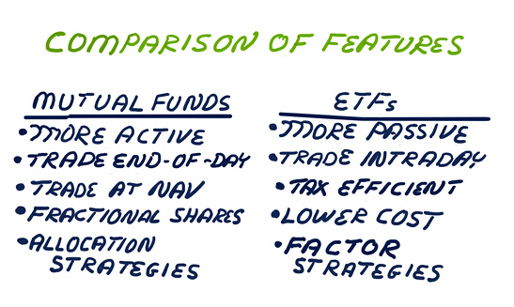
Once you decide which asset class to target, you can start to drill down by fund group and category. From there you can pick the best fund for your needs. Look at returns over several time periods (as opposed to simply one year or even shorter time periods), the level of risk relative to peers and the expense ratio. If the fund is to be held in a taxable account, look at the tax-cost ratio. These analyses can be done using our mutual fund and ETF comparison tools. You can find even more useful tools and data—including lists of consistent performers and performance benchmarks—in the mutual fund and ETF sections of AAII.com.
Your choice of which type of fund to invest in starts with the account you are using. Participants in workplace retirement plans like 401(k) plans are generally limited to mutual funds. Most robo-advisers use ETFs. If you have an account with a mutual fund provider, then your options depend on the company. If your account is with a mutual fund company without a brokerage arm, then you are limited to mutual funds. Fidelity and Vanguard are among the small group of fund families to allow taxable, IRA and Roth IRA account holders (as well as those with similar types of accounts) to buy stocks, ETFs or mutual funds.
The major discount brokerage firms do not charge commissions on ETF trades. Certain mutual funds can be traded on a no-transaction basis, though the list of funds varies by broker. (Minimum holding periods may be required, though you shouldn’t be jumping in and out of mutual funds anyway.) Mutual funds facilitate fractional share purchases, which is helpful for those who dollar-cost average as well as those with smaller account balances. Fidelity (only via its app) and Interactive Brokers allow fractional share purchases of ETFs as well.
Mutual funds are bought and sold at their net asset value (NAV) at the end of the day. When you put $100 into a mutual fund (assuming no transaction fees or front-end loads), you are investing in $100 of the fund’s assets. Active management remains predominantly in the mutual fund arena (the number of actively managed ETFs is small). Mutual funds also offer far more options than ETFs for those seeking to hand over portfolio allocation to a fund manager. Target-date funds are one such example.
ETFs can be bought and sold throughout the trading day. While the largest ETFs trade at or very close to their NAV, the smaller ones can trade at premiums or discounts to their NAVs. In the latter case, investing $100 may get you more or less than $100 in assets. The overwhelming majority of ETFs track indexes. How purely passive they are depends on one’s perception. Much of the growth in indexed factor (aka, smart beta) approaches has occurred on the ETF side. (Many mutual funds follow a style, like value or growth, but do not specifically use a quantitative factor strategy.)
Pure index investors can find both ETFs and mutual funds tracking the broad traditional indexes. The expense ratios are comparable at the lower end.
In many cases, mutual funds and ETFs can be interchanged. Investors seeking active management, allocation strategies and the ability to dollar-cost average may find mutual funds more suitable. ETFs work well for getting index-based approaches to factors, styles and/or sectors and industries. They also offer the ability to buy and sell on an intraday basis. This characteristic matters if you are looking to put excess cash to work in your portfolio and/or need a temporary placeholder to invest in after having sold a stock but don’t yet have a replacement candidate in mind.
ETFs have an edge when it comes to taxes. ETF sponsors interact with authorized participants (APs). These large institutional investors and trading firms are comfortable taking in-kind distributions, which means accepting securities in lieu of cash. While mutual funds may allow in-kind distributions, the thresholds are too high for most individual investors. The combination of having a greater demand for cash redemptions and the lack of in-kind redemptions to use for removing securities that have risen in value since purchase causes higher taxable distributions to be passed along to mutual fund shareholders. Investors have no control over the timing of such distributions and there are years when mutual funds can have both disappointing returns and high capital gains distributions. ETFs’ use of APs prevents this from happening. Note that not all ETFs are tax-efficient; depending on the strategy followed, some ETFs can have high tax-cost ratios as well.
One way to get around the tax issue is to use tax location. Hold more tax-efficient funds in taxable accounts. Place less tax-efficient funds in tax-preferred accounts such as traditional IRAs and Roth IRAs. For example, you could hold index-based ETFs in your taxable accounts and actively managed mutual funds in your retirement accounts. Doing so would allow you to avoid paying taxes on the mutual fund distributions. (The tax-cost ratio, which is included in our mutual fund and ETF guides, shows you how tax-friendly or unfriendly a particular fund is.)
Try out The AAII Way worksheets we’ve created so far and give us your feedback in the comments section for each. We want them to be useful to you.
1. Identifying and Prioritizing Your Financial Goals Worksheet
2. Our Revised Risk Tolerance Worksheet
3. A Worksheet for Determining How Your Portfolio Is Managed
4. Financial Account Inventory Worksheet

-
An Inside Look at Exchange-Traded Funds – A more in-depth explanation of the differences between ETFs and mutual funds.
-
Guide to the Top Mutual Funds – Useful performance, expense ratio, tax and portfolio data on nearly 25,000 mutual funds.
-
Guide to the Top ETFs – Useful performance, expense ratio, tax and portfolio data on the approximate 2,400 ETFs traded in the U.S.
For the first time in 11 weeks, pessimism among individual investors about the short-term direction of the stock market is no longer unusually high. At the same time, the latest AAII Sentiment Survey shows optimism at an 11-week high. Neutral sentiment is slightly higher this week as well.
Bullish sentiment, expectations that stock prices will rise over the next six months, rose 1.7 percentage points to 32.1%. Optimism was last higher on June 10, 2020 (34.3%). Though at an 11-week high, bullish sentiment remains below its historical average of 38.0% for the 25th consecutive week and the 30th week this year.
Neutral sentiment, expectations that stock prices will stay essentially unchanged over the next six months, increased by 1.1 percentage points to 28.3%. This is the 31st time out of 33 weeks that neutral sentiment is below its historical average of 31.5%.
Bearish sentiment, expectations that stock prices will fall over the next six months, fell by 2.8 percentage points to 39.6%. Pessimism was last lower on June 10, 2020 (38.1%). Nonetheless, bearish sentiment is above its historical average of 30.5% for the 27th consecutive week and the 29th time this year.
As noted above, pessimism is now below the 40.2% threshold for what counts as an unusually high reading. Both bullish and neutral sentiment are also within their typical historical ranges.
The ongoing high level of pessimism reflects concerns about the coronavirus pandemic and the economy. However, some AAII members have been encouraged by the rebound in the stock market from its March lows. Other factors influencing AAII members’ sentiment include the economy, corporate earnings, valuations, the November elections and interest rates.
This week’s special question asked AAII members what their perception is of the current state of the housing market. About half of all respondents (51%) describe the housing market as strong. High demand and tight supply, as well as low interest rates were among the reasons given. Many of these respondents describe the housing market as “hot,” “bullish” or “booming.”
About 18% of respondents believe the housing market is entering bubble territory, claiming it is a “disaster waiting to happen” and blaming low interest rates, speculation and fear of being left out. Only 3% of respondents say that they believe the housing market is performing poorly, while 12% say the market is doing poorly only in cities.
Here is a sampling of the responses:
- “The housing market is ‘hot.’ Why? Limited supply and low mortgage rates are a couple of reasons. But another factor may be that a home in the suburbs may be better than a condo or apartment in the city when you are no longer required to work at your employer’s office. And then, of course, family size may require more room when everyone is on a computer.”
- “The housing market has bounced back smartly during the pandemic, fueled by low interest rates and excess consumer capital chasing goods. However, I still worry that the current hot run of the housing market can’t be sustained if employment does not improve and unemployment remains below 10%.”
- “New construction of residential homes appears to be buoyed by Americans’ desire to get out of the city as a result of the pandemic. And then to add historically low interest rates, it appears that the outlook is bullish. This may be tempered, however, by job loss as a result of the recent economic downturn generated by the virus. The unemployed cannot get a mortgage. The upturn may not be long-lived.”
- “If you have the money or can get the money, buy a home! With rates as low as they are, buy a home. It’s also a great time to sell if you have a place to move into. You should be able to get your selling price or higher.”
- “The housing market is in bubble territory in most locations. It is being fueled by abnormally low interest rates, fear of being left out and speculation.”

Bullish: 32.1%, up 1.7 points
Neutral: 28.3%, up 1.1 points
Bearish: 39.6%, down 2.8 points
Bullish: 38.5%
Neutral: 31.0%
Bearish: 30.5%
August 20, 2020 Stocks, Funds or Both?
August 13, 2020 Ideas for Implementing Your Fixed-Income Allocation
August 6, 2020 Investment Expenses Are a Drag; Tips for Reducing Them
July 30, 2020 Comparing and Contrasting the Types of Investment Accounts

Discussion
C. Hollinger from Nj posted over 6 years ago:
T. Rowe Price has a brokerage.
John Hallquist from Tennessee posted over 6 years ago:
Some of Vanguard's index funds have both mutual fund share classes and ETF share classes. They offer a one way conversion from the mutual fund class to the ETF class. Is there any value in this conversion?
You need to log in as a registered AAII user before commenting.
Create an account