

Five Bear Market Moves for Tax-Savvy Investors
by Charles Rotblut | July 07, 2022
Bear markets provide opportunities for tax-savvy investors. Every drop in stock prices gives you the opportunity to do more for the same tax impact you would incur if asset prices were higher.
Here are tax-savvy moves you can consider making during the current bear market.
-
Do a Roth IRA Conversion for Less—Bear markets put Roth IRA conversions on sale. If you were planning on doing a Roth IRA conversion at some point this year, now is an ideal time. Relative to the start of the year, you could save 20% or more on every dollar converted.
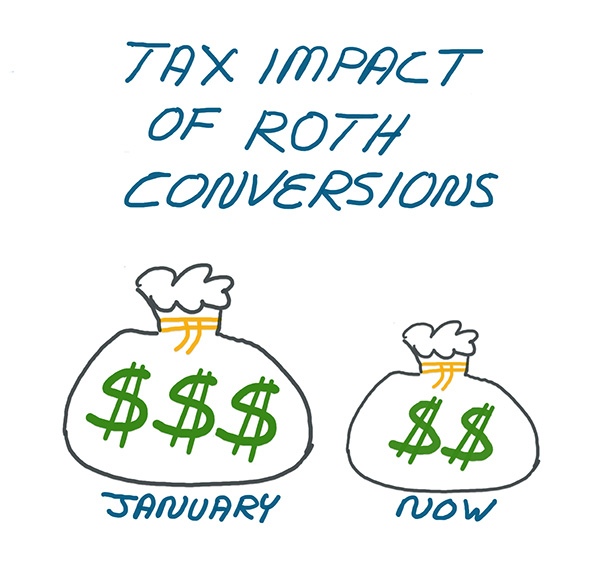
How is this possible? The IRS only cares about the dollar amount converted. So, the tax cost of moving a certain number of shares from a traditional to a Roth IRA decreases as the share price falls. Alternatively, you can now move even more assets to a Roth than you could at the start of the year for the same cumulative tax bite.
-
Accelerate Planned Contributions to Savings Accounts—If you are planning to contribute a certain dollar amount to a traditional IRA, Roth IRA, health savings account (HSA), 529 plan or another type of investment account this year, consider doing it sooner rather than later. This is especially true if you will allocate those dollars to stocks or stock funds. Your buying power is increased because prices are down. This only works, of course, if you are willing to invest those contributions before stocks rebound.
-
Harvest Tax Losses—If you are holding investments in a taxable account that have fallen in value since purchase, consider whether it makes sense to temporarily sell them. When doing so, wait at least 30 days before repurchasing them to avoid triggering the wash-sale rule. During this 30-day period, you can buy a similar but not “substantially identical” investment. This may be shares of a direct competitor to the company you had invested in or a similar fund to the one you just sold. An example would be to harvest losses in an S&P 500 index fund and then buy a Russell 1000 index fund. Highly correlated but not substantially identical funds.
-
Reset Your Cost Basis—You can reset the cost basis for any investment you hold in a taxable account by selling it and repurchasing it. If you have a gain in the stock, you can immediately repurchase it without having to wait 30 days. This strategy works particularly well if you’ve also harvested offsetting losses. (If you sell a stock at a loss and then rebuy it within 30 days, your cost basis also gets reset but you lose the ability to claim a capital gains loss on the sell transaction.)
- Delay Taking Your RMD—If you typically take part or all of your retirement plan’s required minimum distribution as an in-kind distribution (e.g., shares of stock), it may be worthwhile to wait until late in the year to see if stock prices rebound. The higher the share price, the fewer shares you will need to withdraw to satisfy the RMD amount. Keep in mind that the full RMD must, in practical terms, be taken by December 30 as December 31 falls on a Saturday this year. (Those who turned 72 this year have, in practical terms, until March 31, 2023, to take their full RMD, as April 1 also falls on a Saturday next year.)

- Capital losses offset capital gains up to $3,000 each year. This 2010 AAII Journal article explains the rules regarding deducting capital losses.
- The July AAII Journal is now online. In this month’s editor’s note, I discuss how bear markets are a normal part of investing.
- AAII assistant editor Anine Sus questions whether cannabis counts as a sustainable investment in her new My Investing Discoveries blog post.
- A new Individual Investor Show on short-term bond funds and ETFs has dropped. If the current market has you feeling more conservative, go to your favorite podcast app—including Apple Podcasts—to hear the latest on these less-volatile investment options.
- I’ll explain how having defined goals can help give you clarity during bear markets in a live webinar on Wednesday.
Members are looking for your input. Can you help with this question from the Sustainable Investing (ESG) Community?
“What types of governance properties do you prioritize when choosing a company to invest in?”
Tap the button and then choose the Join the Community button on the right to answer this question in the AAII Community.
Answer This Question in the AAII Community »
AAII Sentiment Survey
The percentage of individual investors expecting stocks to decline further is above 50% for the seventh time in 11 weeks. The latest AAII Sentiment Survey also shows both optimism and neutral sentiment falling.
Bullish sentiment, expectations that stock prices will rise over the next six months, dropped 3.4 percentage points to 19.4%. Bullish sentiment is below its historical average of 38.0% for the 33rd consecutive week and is at an unusually low level for the 22nd time in 26 weeks.
Neutral sentiment, expectations that stock prices will stay essentially unchanged over the next six months, declined 2.7 percentage points to 27.8%. Neutral sentiment is below its historical average of 31.5% for the 10th time in 11 weeks.
Bearish sentiment, expectations that stock prices will fall over the next six months, jumped 6.1 percentage points to 52.8%. Bearish sentiment is above its historical average of 30.5% for the 32nd time out of the past 33 weeks and is at an unusually high level for 21 out of the last 25 weeks.
The bull-bear spread (bullish minus bearish sentiment) is –33.4% and is unusually low for the 23rd time in 26 weeks.
Historically, the S&P 500 index has gone on to realize above-average and above-median returns during the six- and 12-month periods following unusually low readings for bullish sentiment and for the bull-bear spread. Unusually high bearish sentiment readings historically have also been followed by above-average and above-median six-month returns in the S&P 500. The S&P 500 has underperformed following periods of below-average neutral sentiment, though the link is weaker.
Continued volatility in the major stock indexes along with inflation, corporate earnings and increased chatter about the possibility of a recession are all likely weighing on individual investors’ short-term expectations for the stock market. Also influencing sentiment are monetary policy, the coronavirus pandemic, politics and the ongoing invasion of Ukraine by Russia.
Bullish: 19.4%, down 3.4 points
Neutral: 27.8%, down 2.7 points
Bearish: 52.8%, up 6.1 points
Bullish: 38.0%
Neutral: 31.5%
Bearish: 30.5%
See more Sentiment Survey results.

AAII Asset Allocation Survey
Cash allocations rose to their highest level in more than two years in the June AAII Asset Allocation Survey. Equity allocations, meanwhile, fell for the sixth time in seven months.
Stock and stock fund allocations declined 2.5 percentage points to 64.6%. This was the smallest exposure to equities since November 2020 (63.2%). However, the decrease was not small enough to keep equity allocations from staying above their historical average of 61.5% for the 25th consecutive month.
Bond and bond fund allocations increased 0.3 percentage points to 14.1%. Bond and bond fund allocations are below their historical average of 16.0% for the 16th consecutive month.
Cash allocations increased by 2.1 percentage points to 21.2%. Cash exposure was last higher in April 2020 (23.0%). Even with the increase, June was the 26th consecutive month that cash allocations have been below their historical average of 22.5%.
The historical averages for equity and cash allocations were updated this month. The historical average for stocks and stock funds was raised from 61.0% to 61.5%. The historical average for cash was lowered from 23.0% to 22.5%.
Stock prices fell in June. In addition, optimism in our weekly Sentiment Survey was at an unusually low level throughout most of June. Sentiment does not always result in altered allocations as many AAII members follow a long-term approach to investing.
- Stocks and Stock Funds: 64.6%, down 2.5 percentage points
- Bonds and Bond Funds: 14.1%, up 0.4 percentage points
- Cash: 21.2%, up 2.1 percentage points
- Stocks: 30.7%, down 0.5 percentage points
- Stocks Funds: 34.0%, down 1.9 percentage points
- Bonds: 3.4%, up 0.3 percentage points
- Bond Funds: 10.8%, up 0.0 percentage points
- Stocks/Stock Funds: 62.0%
- Bonds/Bond Funds: 16.0%
- Cash: 22.0%
Take the Asset Allocation Survey.
June 30, 2022 Four Ways to Identify Companies at Risk of Going Bankrupt
June 23, 2022 Traders Misjudge Volatility Following Big Moves in the VIX
June 16, 2022 The Fed's Rising Expectations for Interest Rates
June 9, 2022 Combining Growth and Value Boosts Large-Cap Returns

Discussion
Rob from NC posted over 4 years ago:
Number 4 is very important and probably underused. In 2022, single person can harvest up to $54,625 in long-term capital gains without paying a penny in federal income tax (twice that much for a married couple). Of course, this is assuming they have no other income and are taking the standard deduction. But if a person has, say, $30,000 of earned income, that leaves them with $24,625 of long-term gain that they could harvest without any additional federal tax. This offers an excellent opportunity to constantly bump up one's basis in a "taxable" account without incurring taxes.
Dilbert from CA posted over 4 years ago:
What are you talking about ... ? If you sell an investment, the IRS is always waiting to get paid if you have a gain. The only question is: is it a short-term gain, or is it a long-term gain ... ? The answer to the last question determines how much you pay, but you must pay ... !
Rob from NC posted over 4 years ago:
Dilbert, I'm not making this up. Look up the federal long-term capital gains rates for 2022. You will see a 0% tax rate for the first $41,675 for a single person; 0% tax rate for the first $83,350 for a married couple filing jointly. But that refers to TAXABLE income, so you have deductions you can take from your total income. If you are single and the only income you have is from long-term capital gain (and qualified dividends, which are taxed at the same rate as long-term gains), and assuming you take the standard deduction ($12,950), you can harvest $54,625 in long-term capital gain (and qualified dividends) without paying a penny in federal income tax. This is yet another reason NOT to invest in bonds. Assuming the same deduction for a single person with the same income ($54,625) in taxable bond interest, that person would owe $4,795.50 according to the IRS's tax brackets for 2022. (Caveat: If you already have $54,625 in earned income with the standard deduction, you will get hit with taxes on long-term capital gain above that level, but it will only be at a 15% rate until you climb above $450,000 or so.)
Dave G from Texas posted over 4 years ago:
Charles, as to point #1, what you say is "technically" correct - if you have $1000 to spare for a tax conversion you can convert more shares the lower the price is. However, it is not true that this "gains" you any after-tax spendable income, for your hard-earned pretax dollars. In fact, for the average person, they may actually be putting more money into a place (the Roth) which will give them less spendable income as opposed to getting "something on sale" as you imply. In other words, if their retirement tax rate turns out to be less than the conversion tax rate the more money they convert to a Roth the smaller their spendable income will be. The price they convert it at makes no difference. To see this do not think of this example in terms of dollars but in terms of stock shares and then relate "pretax money earned" to aftertax money spent. The point where the "teeter toter" is balanced is with equal tax rates in and out. Think of a country that has a fixed tax rate of 25% for all money spent or earned. Now look at your same problem in this way: Investor A earns $1000 and buys 100 shares of company ABC in the IRA. The price of those shares grows 10x over 30 years, he takes them out gives 25 shares to the IRS ($2500) and keeps the 75 for himself which is worth $7,500. Investor B starts out at the same time with 100 shares of ABC company, but she knows that 25 of those shares will always belong to the IRS no matter what she does. One day when the price of those shares is $1, she converts the shares and thus gives 25 shares to the IRS ($25). At the end of 30 years Investor B still has 75 shares worth $7,500. Investor B can accomplish the same thing by putting $750 into the Roth directly and buying the 75 shares at $10 and watching the price drop to $1 and grow to $100 per share later.
Dave G from Texas posted over 4 years ago:
Charles, as to point #5, this is a similar problem as to #1. If your RMD is $20,000, it makes little difference (unless you know the future) whether this is 10 shares or 200 shares of stock. At the time it is still $20,000 and that is what you will have to pay the tax on. As you know there is absolutely no guarantee on which way the market will go and the risk is essentially equal up or down IMO. The more prudent advice is to not try and time the stock market but as most good financial planners would tell you if you need to pay any bill and the RMD is a kind of bill, you should have the cash in your account to do so ahead of time. In this case, if you don't need the money and are doing in-kind withdrawals you still should do a withdrawal for the taxes that should actually be part of the RMD requirement. In that way, you transfer fewer shares and don't have to worry about quarterly tax payments. I have a couple of years to go but my plan is to fund as much as possible of the RMDs with dividends and distributed capital gains. The planning is starting this year to "unhook" the reinvested dividends so that this can happen. You never want to be forced to sell either equities or bonds in a depressed market and many times like now equities and bonds are equally depressed depending on which ones you own.
You need to log in as a registered AAII user before commenting.
Create an account