

Putting Money Into the Market, the Fed and the January Barometer
by Charles Rotblut | February 01, 2024
Get ready for an enriching experience at the MoneyShow Conference 2024 in Las Vegas! Starting February 21, join AAII’s Raymond Rondeau and Wayne Thorp for insightful sessions ranging from gaining an advantage in today’s market environment to implementing advanced stock screening methods. This is a great opportunity to network, learn and grow. Click here to secure your spot today!
“Is now a good time to invest?”
This question, or some version of it, is the most recurring question that those of us who work in finance get. A related question we often get is “I have X amount in cash, should I put it in the market now or wait?” We can also reverse the question to be “Should I take a withdrawal, such as a required minimum distribution (RMD), now or wait?”
 If you are looking at a time horizon of approximately 10 years or longer, then going with a very large allocation to stocks makes sense based on how the stock market has historically performed. A shorter time frame of at least five years works if you can handle shorter-term volatility and a higher potential for some loss of capital. Shorter periods are not suggested because there may not be enough time to recover from an ill-timed bear market.
But what about being tactical or otherwise focusing on what is happening right now? Nobody has a working crystal ball. However, the Federal Reserve and the January effect both provided optimism for how stocks could perform over the remainder of this fiscal year.
Yesterday, the Federal Open Market Committee (FOMC) dropped the “any additional policy firming that may be appropriate” language from its meeting statement. This is a step toward interest rate cuts. It is still uncertain when the first interest rate cut will occur or how many will occur this year, but—barring any surprises—they are coming.
Notably, federal funds futures traders have not changed their expectations for where interest rates will be in December. This morning, CME FedWatch tool implied a 43.7% chance of an interest rate target between 3.75% and 4.00% following 2024’s last FOMC meeting. Three weeks ago, traders were pricing in a 40.4% chance of the target being at this level. The current target is still 5.25% to 5.50%.
Interest rate cuts by the Fed should, in turn, lower the interest rates paid by money market funds, certificates of deposit (CDs) and other cash equivalents. Plus, there is no capital appreciation and the interest paid by them is subject to ordinary tax rates. So, investment dollars sitting in these accounts come with both an opportunity risk and the risk of losing future purchasing power. (Purchasing power is the ability to buy goods and services with the dollars you have.)
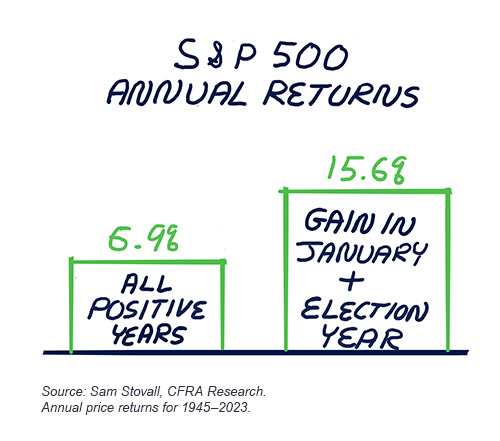
The January Barometer was also triggered yesterday. This barometer holds that as goes January, so goes the rest of the year—particularly when it comes to gains. Since 1938, The S&P 500 index has realized additional gains over the 11 months of February through December 67.4% of the time following a positive start, notes Jeffrey Hirsch of the Stock Trader’s Almanac. The record is even better when it’s an election year. During “the nine election years with positive January returns [since 1945], the S&P 500 gained an average 15.6% and rose in price 100% of the time,” observed Sam Stovall of CFRA Research in a note published earlier this week.
The sample size for election years is small and historical odds are never guaranteed to continue. Still, the stock market tends to rise more often than not. It just tends to do much better when the S&P 500 starts a year by posting a positive return in January.
Even if you put little credit in the January Barometer, it’s still helpful to realize that stocks have historically risen more than they’ve fallen. The S&P 500 has risen during nearly three-quarters of all six-month periods since we started the AAII Sentiment Survey in June 1987.
Combined, these data points argue for making a lump-sum investment with dollars slated for longer-term investing when you are able to, including through individual retirement account (IRA) contributions. Likewise, delaying RMDs to the end of a calendar year leaves more in your account to grow. Both require the ability to financially and psychologically tolerate shorter-term drops in the stock market.
It is reasonable to use a dollar-cost averaging approach instead if you are concerned about the timing of putting a large amount of money to work at once. It lessens timing risk and can be psychologically easier to follow for many people.

-
Has the January Effect Widened?
A study hypothesized that the January effect may have expanded to include the second half of December and the first half of February. -
Getting a Start With Dollar-Cost Averaging
Dollar-cost averaging and value averaging allow investors to ease into the market over time, which reduces timing risk. -
A One-Page Wealth-Building Plan for Leaving an IRA Inheritance
From the January 2024 AAII Journal: How to create a high-level summary of an intended bequest that ensures you reach your goal. -
Preparing for a No-Buy Year
Anine Sus adopts the “no-buy” strategy for 2024 to ensure she’ll have enough money to gain momentum on all her goals this year. Find out more in her My Investing Discoveries blog post.
AAII Sentiment Survey
Optimism among individual investors about the short-term outlook for stocks skyrocketed in the latest AAII Sentiment Survey. Meanwhile, neutral sentiment plummeted while pessimism slightly declined.
Bullish sentiment, expectations that stock prices will rise over the next six months, increased 9.8 percentage points to 49.1%. Bullish sentiment is at an unusually high level and is above its historical average of 37.5% for the 13th consecutive week. Optimism was last higher on December 21, 2023 (52.9%).
Neutral sentiment, expectations that stock prices will stay essentially unchanged over the next six months, decreased 8.2 percentage points to 26.4%. Neutral sentiment is below its historical average of 31.5% for the first time in three weeks. Neutral sentiment was last lower on December 7, 2023 (25.3%).
Bearish sentiment, expectations that stock prices will fall over the next six months, decreased 1.6 percentage points to 24.5%. Bearish sentiment is below its historical average of 31.0% for the 13th consecutive week.
The bull-bear spread (bullish minus bearish sentiment) increased 11.4 percentage points to 24.5%. The bull-bear spread is above its historical average of 6.5% for the 13th consecutive week.
This week’s special question asked AAII members what impact the record high of the S&P 500 index had on their short-term outlook for stocks.
Here is how they responded:
- Made me greatly optimistic: 6.6%
- Made me somewhat optimistic: 45.7%
- No impact: 15.5%
- Made me somewhat pessimistic: 25.9%
- Made me greatly pessimistic: 5.7%
Bullish: 49.1%, up 9.8 points
Neutral: 26.4%, down 8.2 points
Bearish: 24.5%, down 1.6 points
Bullish: 37.5%
Neutral: 31.5%
Bearish: 31.0%
See more Sentiment Survey results.

AAII Asset Allocation Survey
Individual investors’ allocation to equities slightly increased in the January Asset Allocation Survey.
Stock and stock fund allocations increased 0.6 percentage points to 67.0%. Stock and stock fund allocations are above their historical average of 61.5% for the 44th consecutive month.
Bond and bond fund allocations decreased 0.2 percentage points to 16.1%. Bond and bond fund allocations are above their historical average of 16.0% for the third time in 35 months.
Cash allocations decreased 0.4 percentage points to 16.9%. Cash allocations are below their historical average of 22.5% for the 14th consecutive month.
Optimism in the weekly AAII Sentiment Survey was above its historical average and pessimism was below its historical average at the end of January.
- Stocks and Stock Funds: 67.0%, up 0.6 percentage points
- Bonds and Bond Funds: 16.1%, down 0.2 percentage points
- Cash: 16.9%, down 0.4 percentage points
- Stocks: 30.5%, down 0.1 percentage points
- Stocks Funds: 36.4%, up 0.7 percentage points
- Bonds: 5.5%, up 0.2 percentage points
- Bond Funds: 10.6%, down 0.4 percentage points
- Stocks/Stock Funds: 62.0%
- Bonds/Bond Funds: 16.0%
- Cash: 22.0%
Take the Asset Allocation Survey.
January 25, 2024 Optimism Among Individual Investors Bounced Back Last Year
January 18, 2024 January Charts of Interest: Quality Boosts Returns
January 11, 2024 My Initial Observations on the New Spot Bitcoin ETFs
January 4, 2024 Where Market Indicators Stand as We Start 2024

Discussion
Barry from TX posted over 2 years ago:
Charles, your conclusion in this article that, “Combined, these data points argue for making a lump-sum investment with dollars slated for long-term investing when you are able to including through IRA contributions” could mark you with the “Curse of Jacob Raskob.” As you know, he was the GM executive who, in a three-part Ladies’ Home Journal article with the title “Everybody Ought to Be Rich,” claimed that America was on the verge of a tremendous industrial expansion. He maintained that by putting just $15 a month into good common stocks, investors could expect their wealth to grow steadily to $80,000 over the next 20 years. On Sept 3, 1929, a few days after Raskob’s plan appeared, the DJIA hit a historic high of 381.17. Seven weeks later, stocks crashed. The next 34 months saw the most devastating drop in share values in US history. By July 8, 1932, when the carnage was finally over, the DIA stood at 41.22. The market value of the world’s greatest corporations was down an incredible 89%. Millions of investors’ life savings were wiped out, and thousands of investors who had borrowed money to buy stocks were forced into bankruptcy. America was mired in the deepest economic depression in its history.” From “Stocks for the Long Run,” Jeremy Seigel, 1994, p.16. The latest AAII survey data shows a large increase in AAII members stampeding into stocks. Of course, the AAII survey data indicate that Fear of missing out: (FOMO) was rampant before you conjured up the probabilities of the Ghosts of January Effects Past, FOMCs Present, AAII Members Present, and federal funds futures traders Future are all wagering on. If only we had Ben Abbott and Lou Costello to do the googly-eyed double takes as these ghosts stand behind them.
Barry from TX posted over 2 years ago:
To balance all the ghoulishness above, as one of the lesser needy-greedy members of the AAII congregation, I offer this contrarian perspective. Many of the gurus modeled in the AAII stock guru screens advise that the time to invest is when everyone else is fearful and the time to be contrarian is when everyone else is “irrationally exuberant.” The mean-variance optimizing calculations for my conservative 35% value stocks / 65% MMFs portfolio estimate that I am reducing my portfolio risk from an SD of 20 to an SD of 10 or about 50%. I have also calculated that I can offset a 30% loss (one of those dreaded “drawdowns”) on the 35% invested (a loss of 10% of my wealth) by moving 10% of my 65% cash into market opportunities. Of course, this just might be a once-in-a-lifetime tech boom, I miss out, and all the nouveau-rich sneer at me from their Aspark Owls, Lotus Evijas, or Pininfarina Battistas. Oh, that’s right, we had one of those tech booms before in 1998-2000. How did that one work out? I am guessing the vocal “buy and hold” crowd is “sitting and waiting” this stampede out. The question for them is how long it will take for the 40% market upside needed to offset a 30% “drawdown” take. Depending on whose data you choose to look at, it could be as few as 2-3 years or as long as 13 years on average. I guess I will have to hope that my 35% value stocks to produce that 40% return for me over that time. I will be “irrationally exuberant” NOT to have to fill a 30% drawdown in my 65% MMF holdings which would require filling a 30% hole in my portfolio. As Cloonan said, REAL risk is losing your grubstake, but those SD calculations (you know the non-real "risk" that the risk-deniers say does not exist) sure make it easier to plan for the expected and unexpected. Sorry for being so preachy. I guess I'll do my Church Lady dance now and take a nap.
You need to log in as a registered AAII user before commenting.
Create an account