

My Initial Observations on the New Spot Bitcoin ETFs
by Charles Rotblut | January 11, 2024
Featured Tickers: DEFI GBTC
GBTC
Yesterday, the U.S. Securities and Exchange Commission (SEC) approved 11 spot bitcoin exchange-traded funds (ETFs). Unlike previous bitcoin exchange-traded products that indirectly provide exposure to bitcoin, these 11 ETFs are designed to directly track the prevailing market (“spot”) price of bitcoin.
The 11 ETFs are: Grayscale Bitcoin Trust  (GBTC), Bitwise Bitcoin ETF (BITB), Hashdex Bitcoin Futures ETF (DEFI), iShares Bitcoin Trust (IBIT), Valkyrie Bitcoin fund (BRRR), ARK 21Shares Bitcoin ETF (ARKB), Invesco Galaxy Bitcoin ETF (BTCO), VanEck Bitcoin Trust (HODL), WisdomTree Bitcoin fund (BTCW), Fidelity Wise Origin Bitcoin fund (FBTC) and Franklin Bitcoin ETF (EZBC).
Details on these spot bitcoin ETFs are still slim. This morning, I noticed that iShares and Invesco have prospectuses available for their new ETFs. Grayscale has a press release about the Grayscale Bitcoin Trust. This trust moved to the NYSE Arca exchange this morning. Previously, it traded on the over-the-counter (OTC) markets.
Historically, Grayscale Bitcoin Trust has traded at both premiums and discounts to the underlying value of the bitcoin each share represented. In 2023, the trust realized a price return of 317.6% versus a 148.7% return for the underlying value of its assets. The big difference was due to speculation about the SEC approving both Grayscale’s application and other firms’ applications for spot bitcoin ETFs. Over the last five years, the trust has underperformed the value of the bitcoin it represents by 4.6 percentage points.
Hashdex is converting the Hashdex Bitcoin Futures ETF. Previously, the ETF used bitcoin futures contracts instead of the actual spot price of bitcoin. It has a much shorter history than Grayscale Bitcoin Trust.
The SEC found itself increasingly under pressure to approve spot bitcoin ETFs after denying them for many years. In the accelerated approval issued yesterday, the SEC cited a U.S. Court of Appeals ruling against its prior denial of a Grayscale application for a spot bitcoin ETF. The court opined that the SEC had failed to adequately explain its reasoning for denying Grayscale’s application.
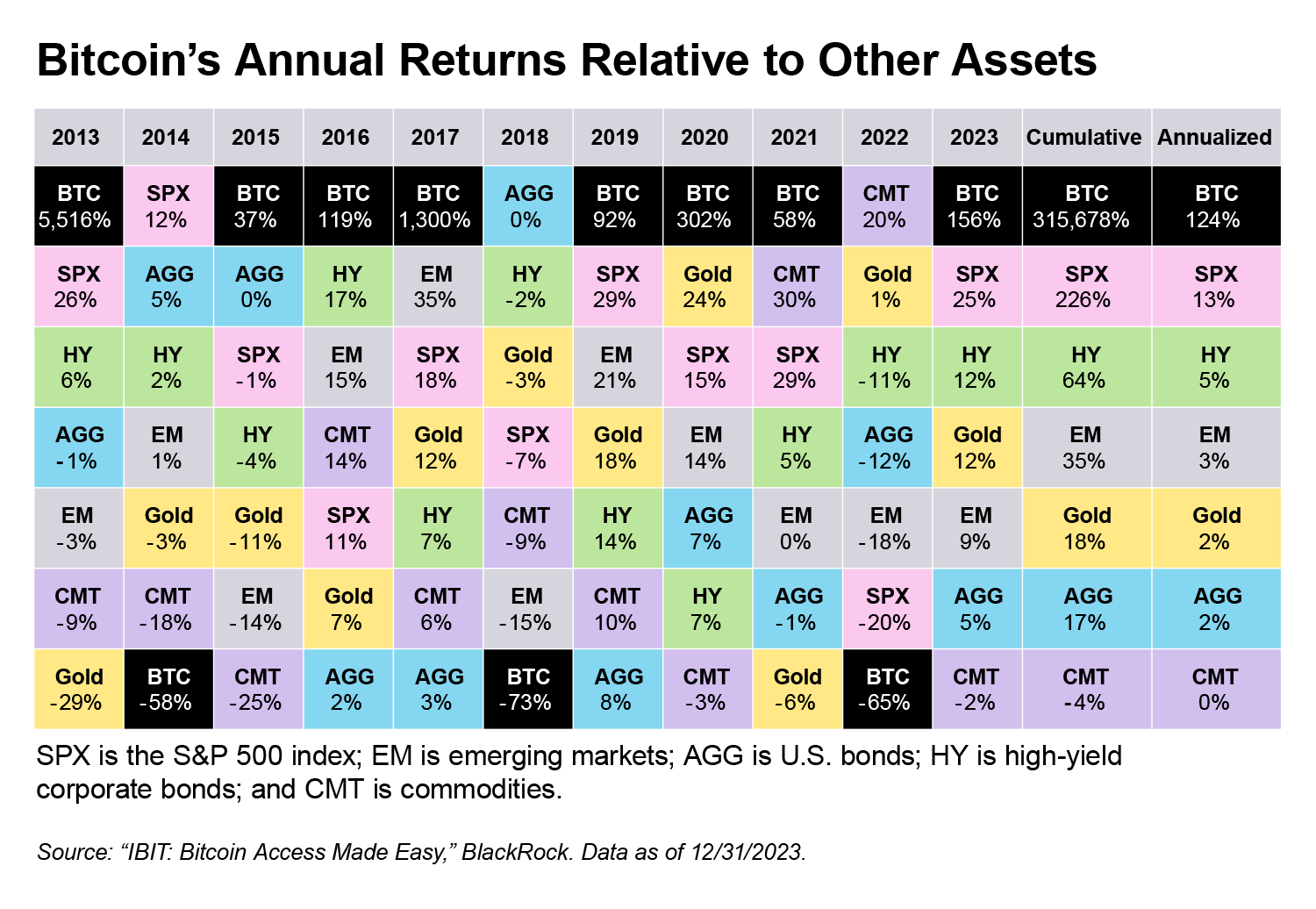
Proponents of the change say this will make it easier for investors to get exposure to bitcoin and will reduce the chances of fraud occurring. Stricter rules and procedures have been put in place to avoid the vacuum Sam Bankman-Fried and others tried to operate in. Proponents also argue that bitcoin provides additional diversification benefits to portfolios. The above table from BlackRock shows how bitcoin has performed relative to other assets.
Nonetheless, a risky asset is a risky asset. Bitcoin has not only experienced a high level of volatility, but it also remains highly speculative. When a high-risk asset is placed into an ETF or something similar, it remains a high-risk asset. The only thing changing about bitcoin is that it will be easier and cheaper to trade for most investors.
Furthermore, this is the first time that spot bitcoin ETFs will be available in the U.S. It is uncertain how much they will attract in investor dollars, how actively they will trade and which among the 11 will be the best option. If you’re interested, tread carefully.
I personally own approximately $30 worth of bitcoin. Disclosure rules require I tell you this. Most of it is held in my Venmo account. I mention this because a little over two years ago, Venmo advertised $25 in free bitcoin to me as a promotional offer. This morning, Venmo showed that my bitcoin holdings are now worth $26.47. That’s almost enough to treat my wife to a movie (without popcorn) at AMC Theatres.

-
The Options for Investing in Cryptocurrency
The novel properties and unique intrinsic values of bitcoin and other digital assets are arguments for their inclusion within a modern diversified portfolio. -
A Look at Five Leading Alternative Investment Platforms
A new set of investing platforms has emerged to expand individual investors’ access to asset types such as cryptocurrency, private debt, private real estate and fine art. -
Level3 Withdrawal Strategy Switches Back to Normal Mode
The January issue of the AAII Journal discusses how the Level3 withdrawal strategy is calling for retirees to withdraw from their equity holdings at the beginning of 2024.
AAII Sentiment Survey
Optimism among individual investors about the short-term outlook for stocks was flat in the latest AAII Sentiment Survey. Meanwhile, pessimism slightly increased.
Bullish sentiment, expectations that stock prices will rise over the next six months, was unchanged at 48.6%. Optimism is still at an unusually high level. Bullish sentiment is above its historical average of 37.5% for the 10th consecutive week and the 11th time in 14 weeks.
Neutral sentiment, expectations that stock prices will stay essentially unchanged over the next six months, decreased 0.7 percentage points to 27.2%. Neutral sentiment is below its historical average of 31.5% for the sixth consecutive week and the 14th time in 15 weeks.
Bearish sentiment, expectations that stock prices will fall over the next six months, increased 0.7 percentage points to 24.2%. Bearish sentiment is below its historical average of 31.0% for the 10th consecutive week.
The bull-bear spread (bullish minus bearish sentiment) decreased 0.6 percentage points to 24.4%. The bull-bear spread is above its historical average of 6.5% for the 10th consecutive week and the 11th time in 22 weeks.
This week’s special question asked AAII members which asset class will realize the highest returns over the next five years.
Here is how they responded:
- Stocks: 81.8%
- Bonds: 5.6%
- Precious metals: 5.6%
- Cash: 1.1%
- Other/not sure: 5.9%
Bullish: 48.6%, up 0.0 points
Neutral: 27.2%, down 0.7 points
Bearish: 24.2%, up 0.7 points
Bullish: 37.5%
Neutral: 31.5%
Bearish: 31.0%
See more Sentiment Survey results.

January 4, 2024 Where Market Indicators Stand as We Start 2024
December 28, 2023 AAII Members Expect Stocks to Rise and Bond Yields to Fall in 2024
December 21, 2023 December Charts of Interest: Stocks Are Overbought
December 14, 2023 How Inflation Expectations and Bond Yields Have Changed

Discussion
John L from NJ posted over 2 years ago:
So now you can buy a bitcoin ETF. The question is should you? Bonds pay interest. But sometimes default. Stocks represent an ownership interest that may involve regular dividend payments. Typically companies have assets whose value provides partial back up for the stock value. Theoretically the fair value of a stock is the replacement value of the company assets less liabilities. And bitcoin? Exactly what is the value of a bitcoin number stored in a computer? Pure speculation!
Greg G from CA posted over 2 years ago:
Characterizing Bitcoin as an "Asset" is more than generous. Suggesting the (probably naive judge's) decision/opinion that led to these ETFs might attract "Investor" interest is absurd. Individuals who buy Bitcoin, in whatever fashion, are gamblers, not investors. Unfortunately the SEC Chair's comments won't be noticed, the action will be taken as a blessing, more suckers will be born for many more minutes. Can I interest you in Tulip Bulbs? (they had more intrinsic value as an asset, just not much...)
Rob from NC posted over 2 years ago:
I wish I'd bought a boatload of Bitcoin when it was selling for less than $5 a coin back in 2011. And I wish I'd sold it when it was going for more than $60,000 per coin in 2021. But I wouldn't touch it now. I can see no way to value it objectively. It's like gold, except you can't make anything with it. It has absolutely no use other than as a medium of exchange. I suppose it's conceivable that a Bitcoin might be worth $1 million someday, but I'll take my chances by passing on it.
Jon from FL posted over 2 years ago:
There's an error in your observation. You call Bitcoin a risky asset. Bitcoin is not an asset. How can the SEC allow otherwise reputable firms to offer ETFs in a fake product? This makes me nervous.
Charles from RI posted over 2 years ago:
First, you would do well by understanding how Bitcoin works - the underlying technology (blockchain/distributed ledgers) and its protocol. Among other things, you will discover that the ultimate amount (supply) of Bitcoin is fixed; it is very different from tulip bulbs, the supply of which is unlimited. Second, Bitcoin is risky, in the sense that its value in the short run is quite volatile. However, there is sufficient long-term demand to support its value over the long run. With dependable, growing demand and fixed supply, the long-term value of Bitcoin looks good. A very sensible approach to investing in Bitcoin, is dollar-cost-averaging. Buy a little bit each month (whatever you can afford after all the other bills are paid) with a plan to hold it for, say, five years. Over that long period, you are very likely to make a satisfactory gain. Bitcoin is a decent hedge against inflation. If you live in a place which suffers from high inflation (e.g., Turkey or Argentina), holding some Bitcoin makes a lot of sense. Bitcoin will not replace fiat money. Well-managed money like the US dollar will remain because of the need to keep the national economy under control and to exert international economic power. In addition, it is very unlikely that Bitcoin will be used for small purchases of goods and services, because most merchants will continue to be unwilling and unable to accept it. Rather than invest in an ETF, I suggest owning Bitcoin directly, either in an USA regulated exchange account (like Coinbase) or in a hardware wallet (more secure, but with a high barrier to entry for most folks due to its technical user interface).
Bruce from CA posted over 2 years ago:
Now that the ETFs are here, financial advisors and fund allocators must have a viewpoint when asked about BTC and investment allocations. Some will steer assets into these ETFs. Personally, I feel quite comfortable allocating a small amount (1-5%) of my investments to crypto, as a small speculative high-risk/high-reward carve-out, a part of my portfolio I can tolerate losing. Consider BTC and the USD as currencies. Sadly, the USD will likely suffer from a great deal of inflation in future, a necessity in order to support the chronic fiscal irresponsibility of our elected leaders (of either party), who cannot seem to do much but drive us ever deeper into debt. How else can the debt be relieved except by inflation? Do you think a money market account at 5, 4 or 3% will be enough to maintain the power of your savings? By comparison, Bitcoin has a fixed supply and cannot suffer from inflation. Should it continue to consolidate confidence as a store of value, its value relative to USD could increase quite a bit over time.
Monk Monk from Texas posted over 2 years ago:
Isn't this the ultimate application of the greater fool theory? You will buy it in the hope of someone else buying it from you later at a higher price. But there is no value. Now, for this to make any sense, there has to be a practical use of bitcoin other than gambling chips. El Salvador and the Central African Republic have declared bitcoin as their national currency. Things do not seem to work well there. Early studies have shown that only the rich, highly educated male (a very small minority in both countries) have benefited, while the rest of the population was left behind. Bitcoin is not an inflationary currency, but it is deflationary. When the maximum is reached, there will be no possibility for "mining" more of it. So, it will mean that prices have to go down because the liquidity will be compressed. Economist may fear inflation, but they loath and detest deflation. In short, one cannot see a practical use for the spot. So? Well, if you want to go to Vegas and you don't want to leave the comfortable confines of your home, this "investment" can serve as an alternative. Happy gambling.
Bruce from CA posted over 2 years ago:
Monk Monk, you make some good points but it seems to me you're looking at the world through a narrow lens. It's true that Bitcoin could go to zero, though you don't provide much of a rationale by which it would do so. In my view, blockchain technology has two principal use cases. One, especially bitcoin, is as a store of value. For Bitcoin, after the mining is all done by about 2040, miners will still make money on transaction fees, which will need to be high enough to keep it worthwhile for them to have a role in the network. I understand that without much by means of fundamentals, which is what we investors usually look for to undergird our assumptions, there is little safety. So technical analysis rules in crypto, and so far we have observed bitcoin to be on a kind of exponential growth curve. You might ask yourself, how to explain the institutional interest in bitcoin? Also, while you mention the CAR or El Salvador, you don't mention examples of governments badly mismanaging their countries' finances. Argentina, Lebanon, Greece come to mind. You wouldn't put the USA into this bucket. But since the government has shown terrible fiscal irresponsibility, by piling up national debt, and now debt payment projections are dangerously high, the US Dollar is bound to lose significant value over time through inflation. Where can you preserve your savings when the country's finances have been managed so poorly? Some would put a little in bitcoin rather than USD. The other leading use case is tokenization, of real-world and digital assets. This applies more to ethereum, solana and other contract-based blockchains. This has been happening already with real-world and digital artworks, real world and digital real-estate, as well as digital collectibles (NFTs put out by Adidas, Nike or designer brands, odious status indicators like Bored Apes) and online games. I don't think you can completely dismiss the utility of the technology here. Not that you have done so, as we've been discussing bitcoin. But the recent bitcoin ordinals innovation could be bringing bitcoin into the tokenization game. In short, I don't think that you can dismiss crypto as "gambling" though I would agree it's highly speculative. If you think crypto has some promise in future, it is of course possible to construct a diversified portfolio. And for this crypto portfolio to be a small part of a larger, more conservative portfolio.
You need to log in as a registered AAII user before commenting.
Create an account