

December Charts of Interest: Stocks Are Overbought
by Charles Rotblut | December 21, 2023
One commonality I came across as I was perusing candidates for this month’s charts of interest was a theme about how stocks have become overbought. Overbought and oversold are terms used in technical analysis to describe stocks that may have risen too far, too fast or fallen too far, too fast, respectively.
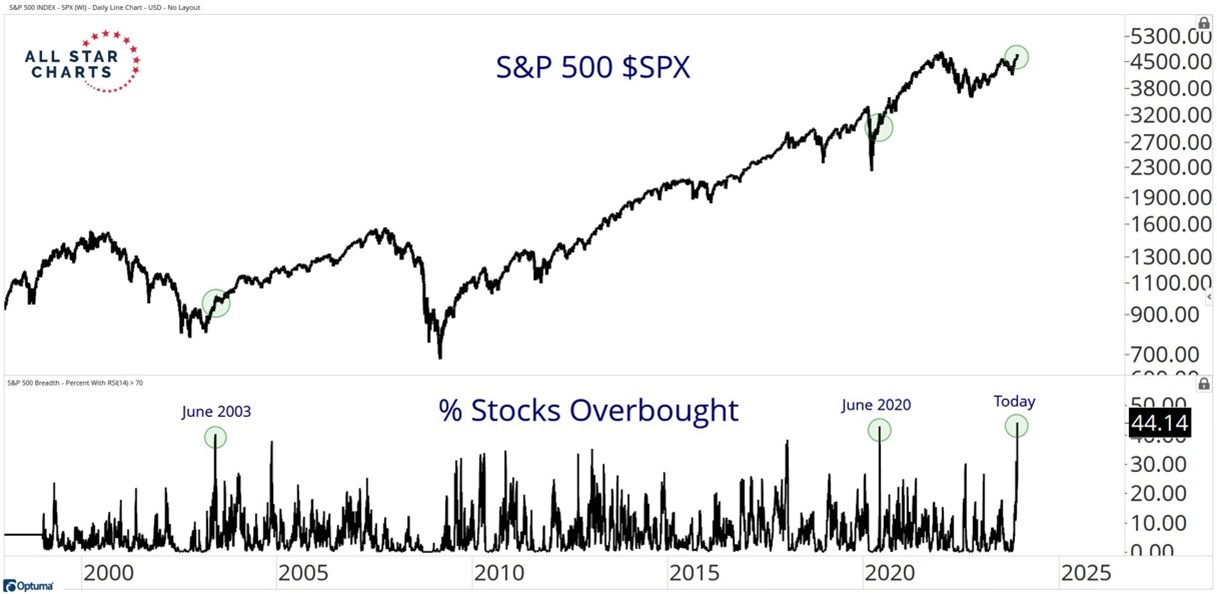
Late last week, Steven Strazza of All Star Charts tweeted, “At 44%, the percentage of stocks that are overbought in the S&P 500 is at its highest level on record.” He then added, “The only other readings above 40% were in June 2003 and June 2020. It’s not bearish ...”
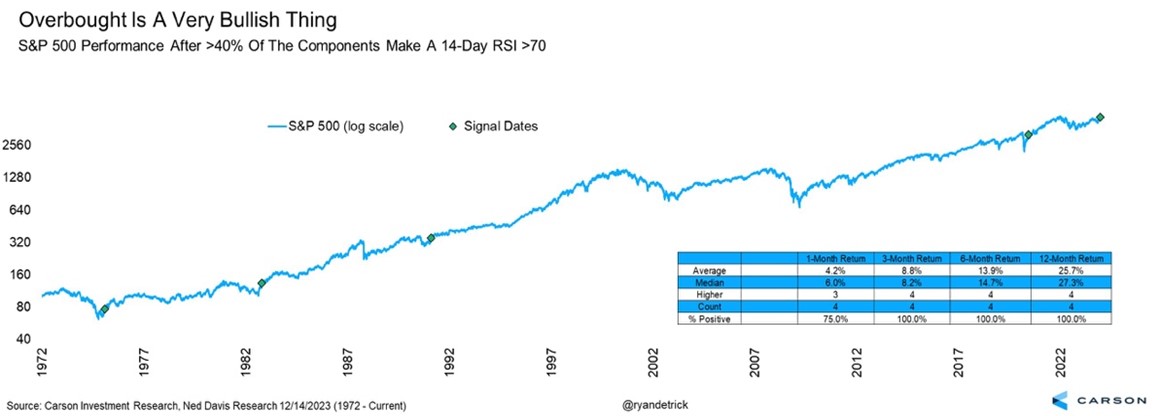
Ryan Detrick, chief market strategist at the Carson Group, shared a similar statement. He tweeted, “More than 40% of the components in the S&P 500 hit [a relative strength index greater than 70] last week. Yes, we are super overbought, but we also see this type of action at the start of VERY strong moves.”
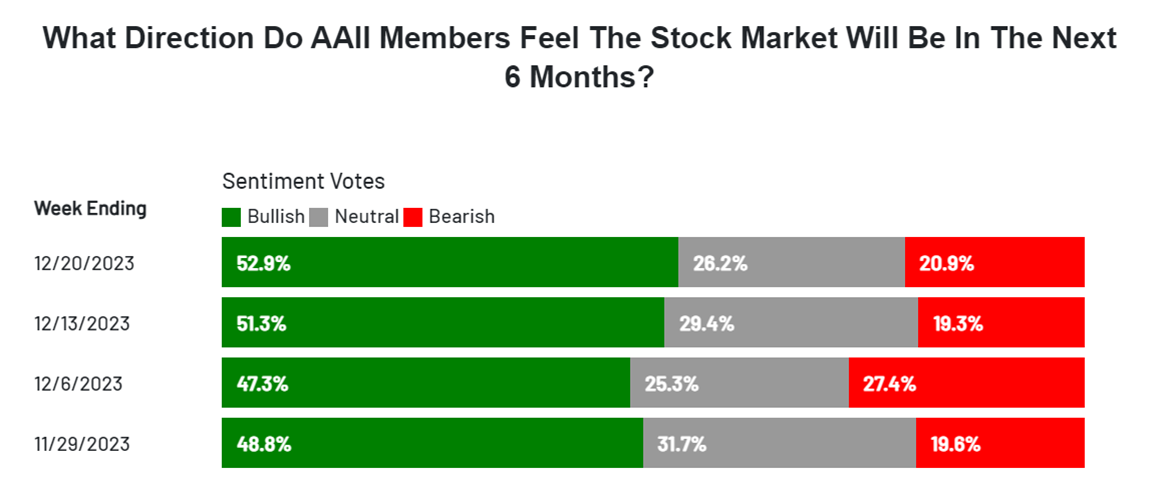
I’ll note that these observations came as bullish sentiment in our weekly AAII Sentiment Survey rose to 52.9%. This is just the third time it has topped 50% since the spring 2021.
Small-Cap Stocks Got Some Love Too
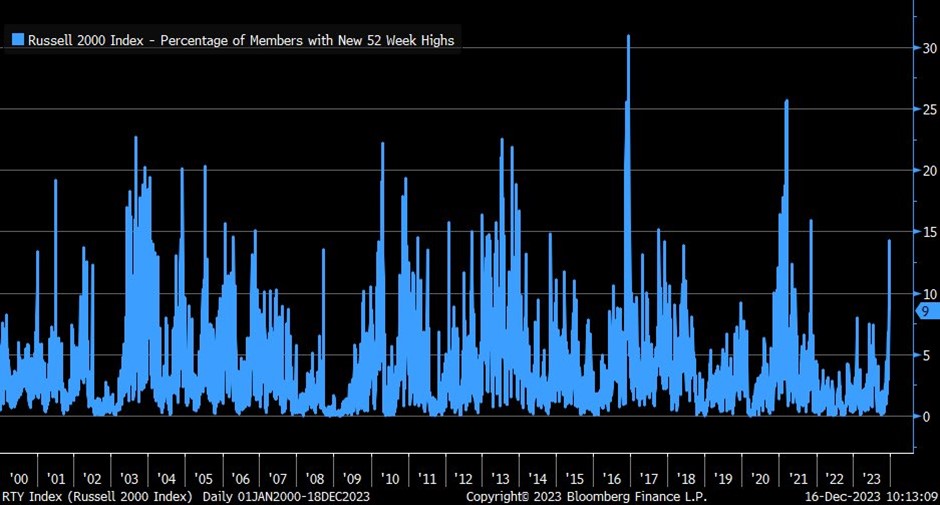
Staying on the subject of new highs, Charles Schwab’s Liz Ann Sonders notes that 14% of Russell 2000 index companies hit a new 52-week high last week. As she wrote, it’s “not [the] largest spike during prior bull markets, but still a positive sign.”
S&P 500 Valuations Are Higher Than Average
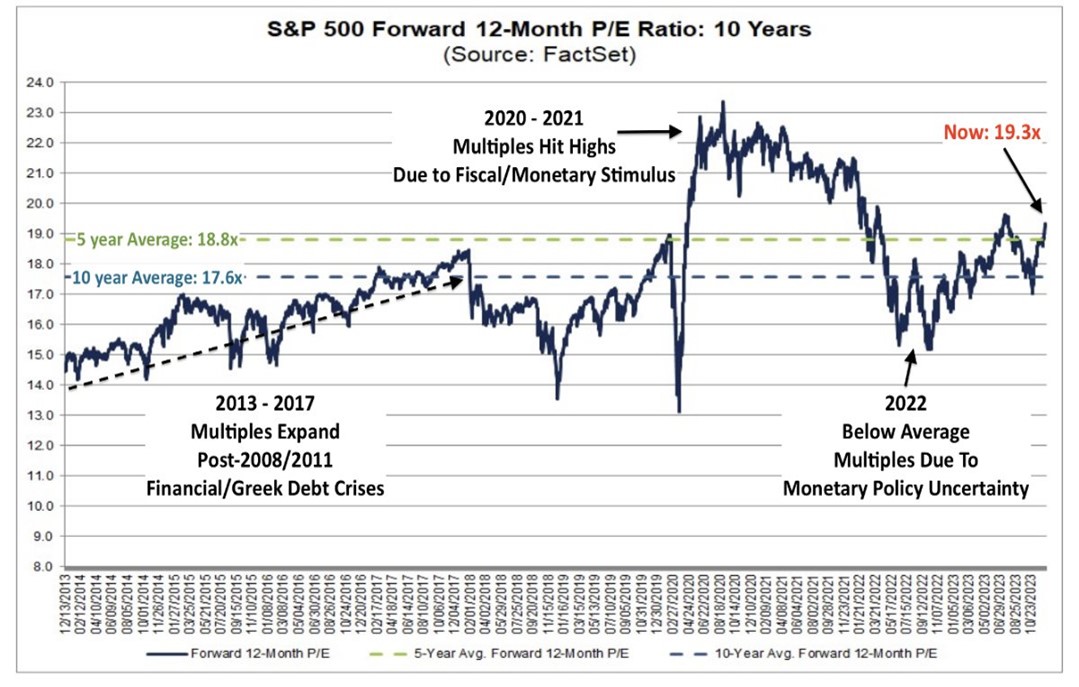
The S&P 500 index’s price-earnings (P/E) ratio is now above both its five- and 10-year averages, note the folks at DataTrek. This year’s stellar performance of the Magnificent Seven stocks is driving up the valuation of the market-capitalization-weighted index. At the same time, not all stocks in the S&P 500 are pricey. Cheaper valuations can be found in small-cap stocks.
A tailwind from a pullback on interest rates and the avoidance of a recession would help to support higher valuations.
Stock Ownership Is Rising Among Americans
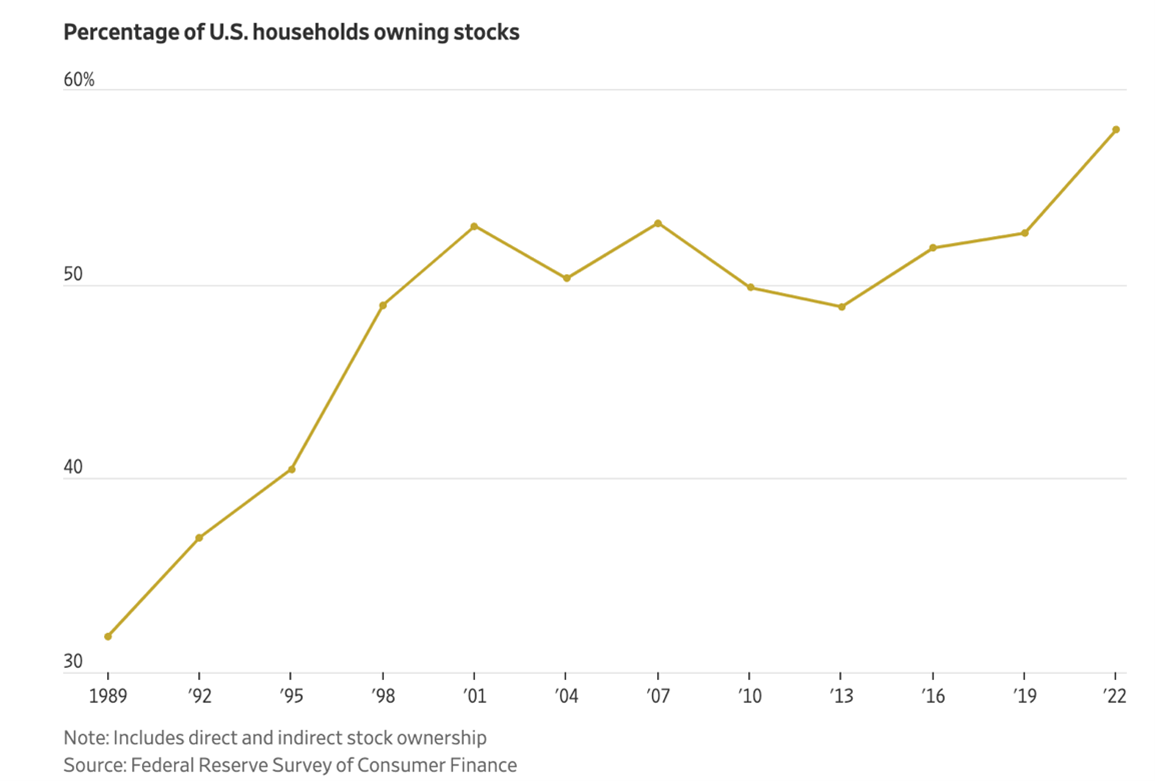
Household ownership of stocks reached a record 58% in 2022. This is the highest level of participation in the stock market—either through direct ownership of equities or through funds, retirement accounts or other managed accounts—reported in the Federal Reserve’s survey of consumer services, according to The Wall Street Journal.
Direct ownership of stocks rose to 21% of households, which is also a survey record. The median value of stockholdings fell, however, signaling more participation by smaller investors.
Time For High-Quality and Low Beta Stocks to Outperform?
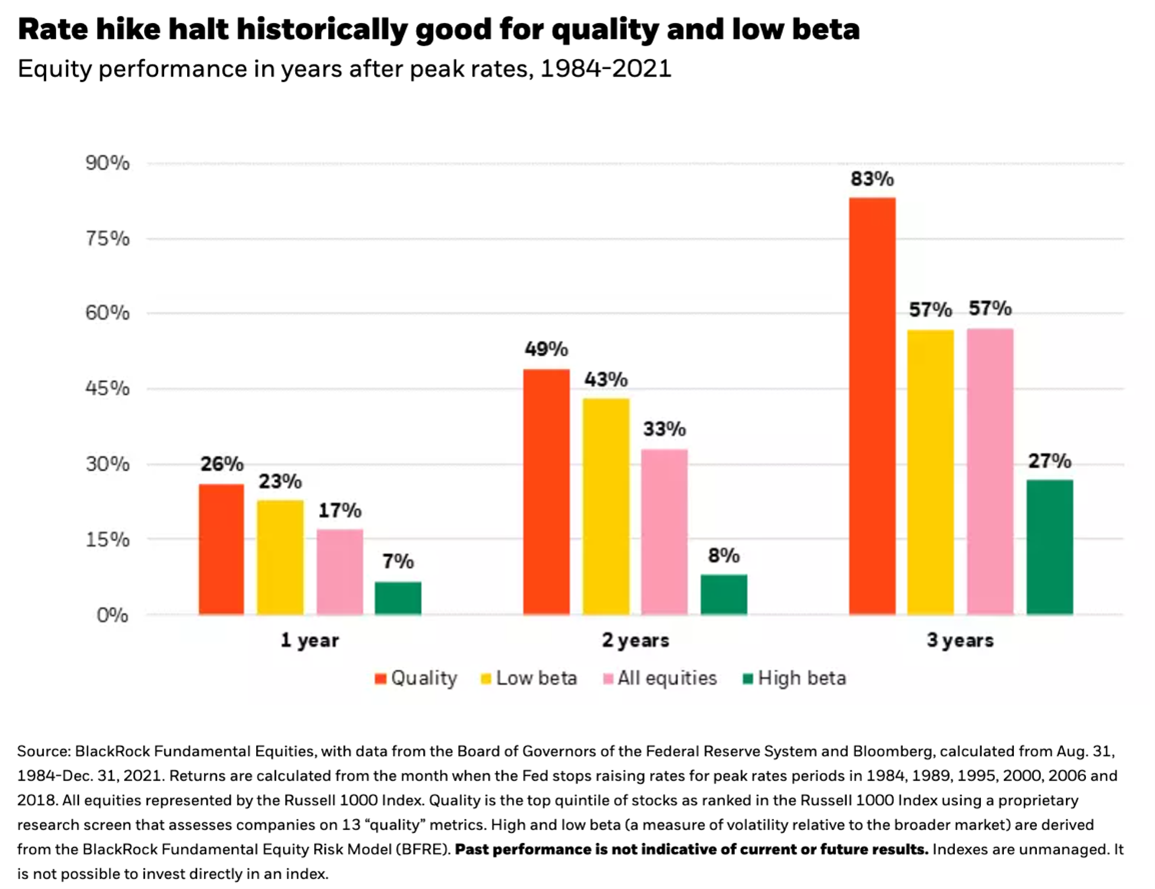
My expectation is that we’ll hear quite a bit in the coming months about what types of stocks have historically performed well after an interest rate hike. BlackRock says to keep an eye on higher-quality and low beta stocks. Quality stocks have done particularly well after past interest rate hike cycles have ended. (A+ Investor and Platinum subscribers have access to our Quality Grades. Our VMQ Stocks newsletter also incorporates the Quality Grade into its approach.)
Are Several Interest Rate Cuts Coming?
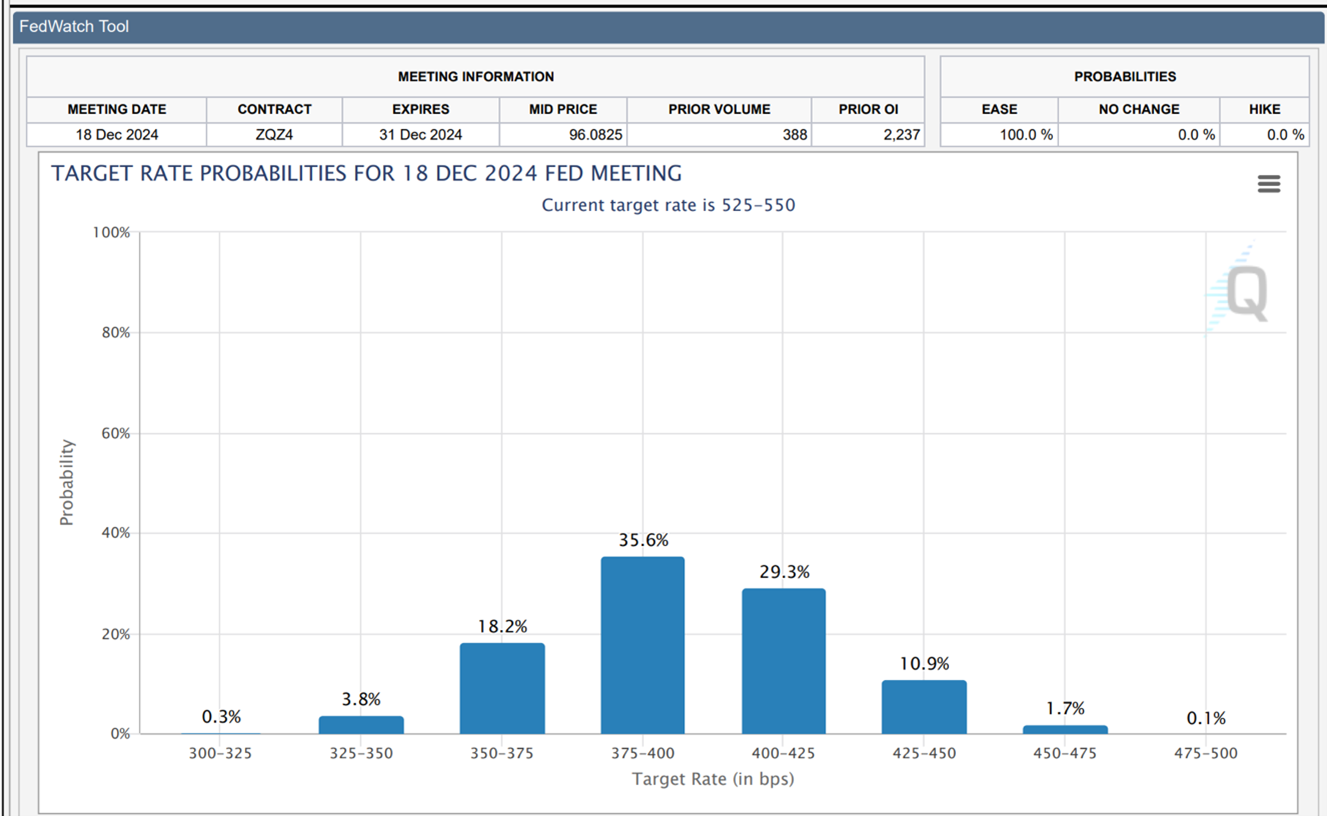
Federal funds futures traders are pricing the possibility of several interest rate cuts occurring in 2024. This morning, the CME FedWatch Tool signaled a 72% probability of interest rates being 125 to 175 basis points (bps) lower following the December 2024 Federal Open Market Committee (FOMC) meeting than they are now. This equates to between five and seven quarter-point (0.25%) interest rate cuts. The CME FedWatch Tool tracks fed fund futures contracts.
As I’ve said many times before, these odds are very much subject to change.
Mortgage Rates Are Coming Back Down
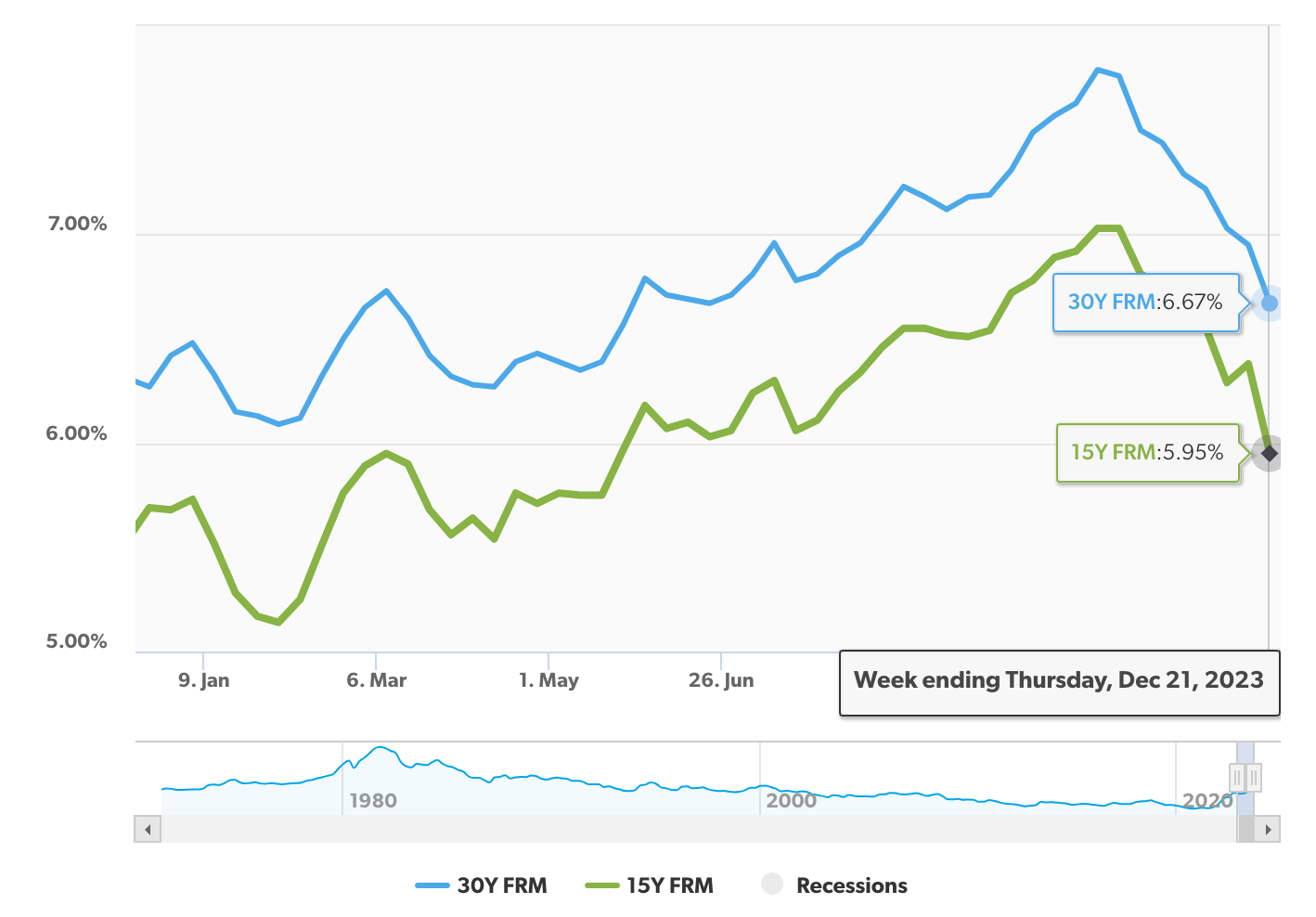
After the sharp spike we saw in October, mortgage rates are coming back down. Freddie Mac calculates that the average 30-year mortgage is 6.67%. It was 7.79% on October 26. This is a positive sign for homebuyers. I just wish more of the decline occurred before I locked in the mortgage rate on the house we’re closing on in a couple of weeks. Refinancing, here we come.
A Smaller Bite Out of Renters’ Pockets
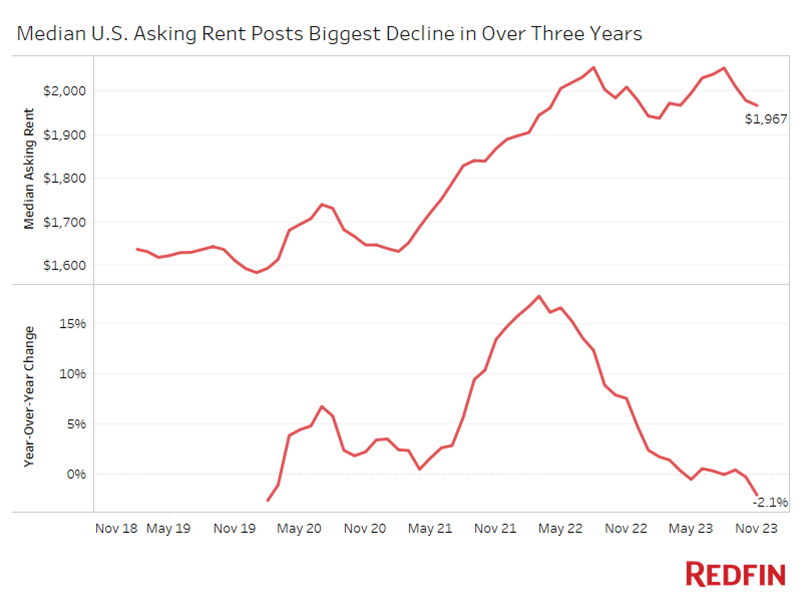
“The median U.S. asking rent declined 2.1% year over year in November to $1,967—the biggest annual drop since February 2020,” says Redfin. The main cause has been “a building boom” in apartment buildings in recent years. Economic concerns and affordability are also issues at play.
None of this seems to have caught the attention of the developers near me. The new apartment complex built about a half mile from my house includes a three bedroom/two bath 1,424 square feet floor plan with listed rental prices of $4,282–$6,909 per month. Those apartments seem nice, but it’s an awful lot to ask considering that it’s located in a northern Chicago suburb.

-
AAII’s Quality Grade Undergoes Expansion: Looking Behind the Curtain
Based on research into various components that reflect a company’s “quality,” we tweaked the quality grade for stocks. -
Follow the Fed, but Be Smart About It
Small-cap stocks thrive during periods of expansive monetary policy, while returns for large- and small-cap stocks are lower during restrictive periods. -
December Model Shadow Stock Portfolio Update and Changes
After the quarterly review of the Model Shadow Stock Portfolio at the beginning of December, two stocks are being removed and three stocks are being added. -
The Impact on the Standard Deduction of the Tax Cuts and Jobs Act
Larger standard deductions make it harder to itemize deductions. This is a double-edged sword. -
Different 12b-1 Fees Among a Fund’s Share Classes Create a Conflict of Interest
When a fund has a range of share classes with different 12b-1 fees, an incentive exists for distributors to steer investors to the class with the higher fee.
Members are looking for your input. Can you help with this question from the Income Investing Community?
What types of accounts do you hold master limited partnerships (MLPs) and real estate investment trusts (REITs) in, given their different tax treatment for distributions?
Tap the button and then choose the Join the Community button on the right to answer this question in the AAII Community
Answer This Question in the AAII Community »
AAII Sentiment Survey
Optimism among individual investors about the short-term outlook for stocks rose to its highest level in over two and a half years in the latest AAII Sentiment Survey. Meanwhile, pessimism increased slightly but is still at an unusually low level.
Bullish sentiment, expectations that stock prices will rise over the next six months, increased 1.6 percentage points to 52.9%. Optimism is unusually high for the second week in a row and is at its highest level since April 15, 2021 (53.8%). Bullish sentiment is above its historical average of 37.5% for the seventh consecutive week and the eighth time in 11 weeks.
Neutral sentiment, expectations that stock prices will stay essentially unchanged over the next six months, decreased 3.2 percentage points to 26.2%. Neutral sentiment is below its historical average of 31.5% for the third consecutive week and the 11th time in 12 weeks.
Bearish sentiment, expectations that stock prices will fall over the next six months, increased 1.6 percentage points to 20.9%. Pessimism is unusually low for the third time in four weeks. Bearish sentiment is below its historical average of 31.0% for the seventh consecutive week and the seventh time in 14 weeks.
The bull-bear spread (bullish minus bearish sentiment) remained unchanged at 32.0%. The bull-bear spread is above its historical average of 6.5% for the seventh consecutive week and the eighth time in 16 weeks.
This week’s special question asked AAII members what they think about the Federal Reserve’s decision to keep interest rates unchanged.
Here is how they responded:
- It was the right decision: 73.1%
- They should have raised rates: 10.1%
- They should have cut rates: 3.6%
- Not sure/no opinion: 12.3%
Bullish: 52.9%, up 1.6 points
Neutral: 26.2%, down 3.2 points
Bearish: 20.9%, up 1.6 points
Bullish: 37.5%
Neutral: 31.5%
Bearish: 31.0%
See more Sentiment Survey results.

December 14, 2023 How Inflation Expectations and Bond Yields Have Changed
December 7, 2023 Four Strategies for Reducing Capital Gains Taxes on Investments
November 30, 2023 Remembering Charlie Munger
November 23, 2023 Seven Reasons for Investors to Be Grateful in 2023

Discussion
Barry from TX posted over 2 years ago:
Charles, thanks for all the eye candy for Christmas. Your diligence in scanning the horizon for data that might help AAII members plan for the future is appreciated. The data mashup you curated for us displays contradictory crosscurrents and it points to several possible near-term inflection points. As I went from chart to chart, I tried to piece together the messages they sent. This task is a lot tougher than the Winky Dink secret messages I excelled at in my early youth. Here are my tracings. Headings #1- #4 and the related factoid that AAII Member Bullish Sentiment is up 1.6% @ 52.9% and 15.4 pts > its 37.5% HA are related. Still, they don’t tell us whether or not 52.9% of AAII members are invested in overbought stocks (like the M7, AI, techs) or oversold stocks (like small/large cap value/growth stocks). Heading #5 and # 6, Fed interest rate plans and their “trickle down” effects on the economy, are the jokers in this deck (to mix metaphors). The Fed says 2 in 2024. The market expects 4. This is why the market is overbought. The market expects the low-interest rates punch bowl to be refilled and the party will continue. That was William McChesney Martins’s 2013 metaphor for the cause of the last recession (aka The Great Recession). Whether you get home safely after this party depends on if and what you are drinking. The market’s 180-proof "party on" tequila shooters are to be avoided. The Fed's "you can trust me " Kool-Aid is not a safe choice either. After all, they are economists (Insert rim shot here). And they use "dot plots" to make decisions ... and never agree (Rim shot.). Use your head. Sit in the corner. Find someone to talk to who is not a broker. Then go home early. As we say in golf, “Every putt looks good (meaning it looks like it’s going into the hole this time) … until it doesn’t.”
You need to log in as a registered AAII user before commenting.
Create an account