

AAII Members Expect Stocks to Rise and Bond Yields to Fall in 2024
by Charles Rotblut | December 28, 2023
Individual investors, in aggregate, expect the S&P 500 index to post modest gains in 2024. They also anticipate yields on the 10-year Treasury bond to pull back next year.
These forecasts were gathered from a questionnaire that we sent to a random group of AAII members. We purposely sought out their insights to coincide with a special milestone reached by our weekly Sentiment Survey. This week marked the 1,900th consecutive week that the AAII Sentiment Survey has been conducted. The Sentiment Survey started in July 1987.
 The average among surveyed members’ forecasts calls for the S&P 500 to end 2024 at a value of 4,801. This represents a 4.7% gain from the December 8, 2023, close of 4,585 that was given as a point of reference in the questionnaire. The median forecast called for the large-cap index to end 2024 at 4,900, which would be a 6.9% increase from the December 8 close. The most bearish respondent expects the S&P 500 to fall to 3,000, a 34.6% drop. The most bullish respondent projected the S&P 500 to rise to 6,500, a 41.8% gain.
Most responses were in a 10% range of each other. Forecasts at the 20th percentile were at 4,585. Forecasts at the 80th percentile called for the S&P 500 to reach 5,100 in 2024. Most responses were gathered during the second full week of December (December 11–17).
Many respondents gave expected interest rate cuts as a reason for the S&P 500’s movement. Some AAII members anticipate economic and/or earnings growth. Others expect the economy to slow or fall into a recession next year. Respondents also mentioned next year’s elections or otherwise referenced political issues.
Here is a sampling of the rationale members gave for their forecasts:
- “The economy continues to weaken as high rates slow spending,” said Steve Edson.
- “Considering how far [stocks have] run and the leveling off of inflation, I don’t believe [the S&P 500] will go much higher,” thought Steve Moses.
- “If inflation continues to drop, [Federal Reserve chairman Jerome] Powell will reduce rates enough to make stocks reach some new highs,” noted Barry Gluck.
- “I think fears of inflation are subsiding and money on the sidelines will gradually flow into the market,” said Robert Dolin.
Best and Worst Sectors
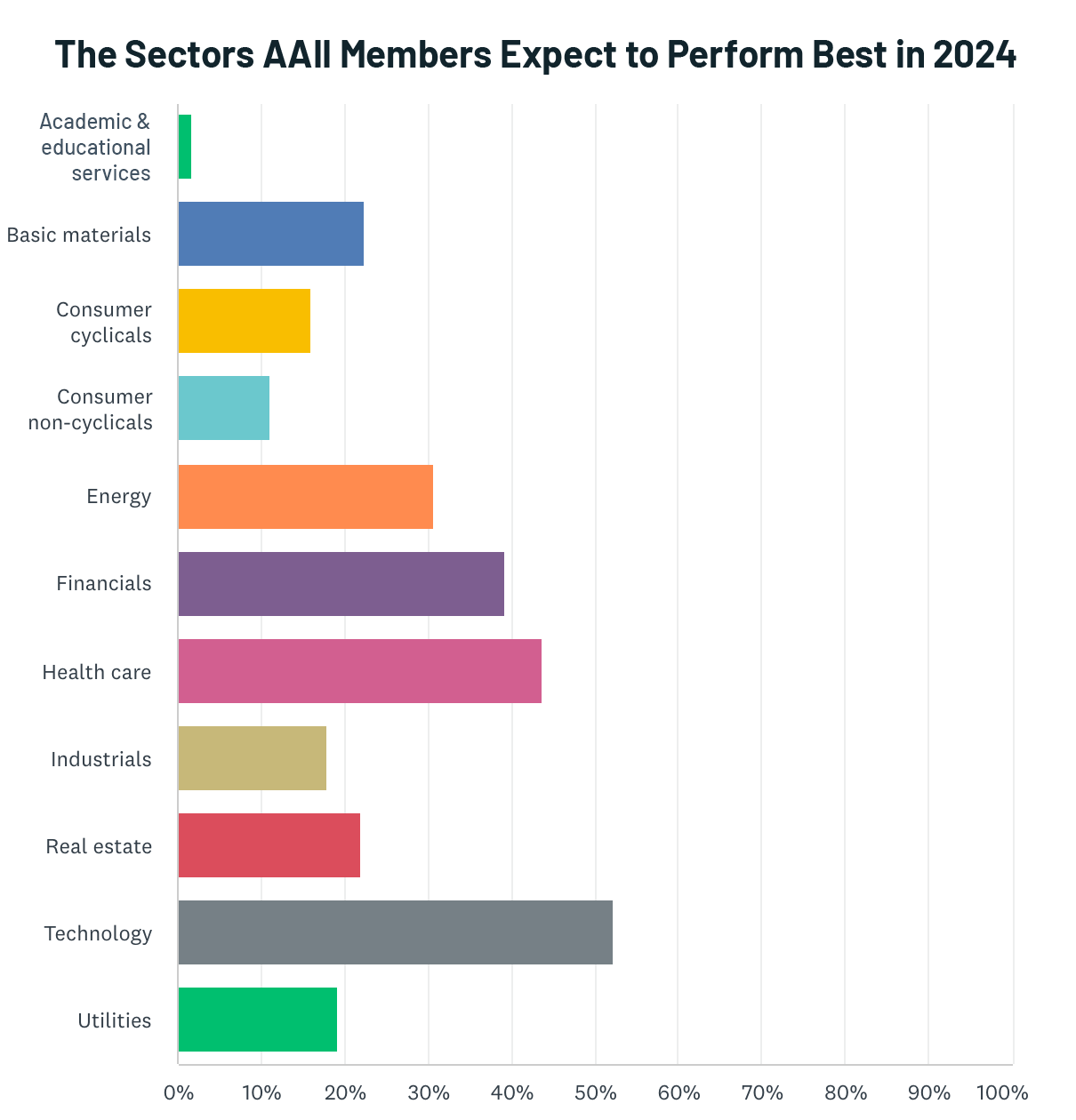
Technology is predicted to maintain its dominance next year. More than half of all respondents (53%) picked tech for the best-performing sector in 2024. Health care followed at 44%. Financials were third at 40%. (Respondents had the option of picking more than one sector, and many did.)
Academic & educational services was the most unloved sector. Not only did it receive the fewest votes to be next year’s top performer, two out of five respondents (40%) believe it will be 2024’s worst-performing sector. Real estate was close behind, with 39% of surveyed AAII members saying it would be the worst-performing sector. Utilities were a distant third at 28%.
Notably, 15% of respondents expect technology to realize the lowest returns of all sectors in 2024. In contrast, just 6% of surveyed AAII members said industrials would be the worst-performing sector. (Again, more than one sector was able to be chosen.)
Bond Yields Are Expected to Pull Back Modestly
The average year-end 2024 forecast for the 10-year Treasury bond’s yield is 3.91%. The median expectation is 3.80%. Both reflect modest pullbacks from the December 8, 2023, yield of 4.26% that was given as a point of reference in the questionnaire. The lowest yield target given was 1.50%. The highest forecasted yield was 7.00%.
Overall, there was a greater dispersion among expectations for the benchmark bond yield than there was for the stock market. Forecasts at the 20th percentile were at 3.50%. Forecasts at the 80th percentile called for the 10-year Treasury bond to trade with a yield of 4.20%.
The Fed and expected interest rate cuts were cited by many respondents as reasons for their forecasts. Perceptions of inflation played a role. Some AAII members pointed to the election and/or the federal debt when explaining the reasoning behind their forecasts.
Here is a sampling of the rationale given by AAII members for their forecasts:
- “Yields will come down as inflation abates and our economy stabilizes,” noted Gerry Higgs.
- “Economic conditions are good, and I expect the interest rates to fall in step with [federal funds] rate decreases in 2024,” said Ted Hennessy.
- “Inflation will be more durable than people expect,” thought John Leupold.
- “The yield curve can’t remain inverted on and on,” said Donald G. Thomas Jr.

-
Analyzing the AAII Sentiment Survey Without Hindsight
Based on the values that existed at past periods of time, above-market returns occurred after unusually high levels of neutral and low levels of bullish sentiment. -
Viewing the Sector Exposure of Dividend Stocks Through the Aristocrats
One factor that dividend investors often overlook is asset allocation, or the type of firms being invested in. -
What You Need to Know About Bond Yields to Determine Your Returns
Current yield is simplistic to calculate, but other measures of yield can help you make better investment decisions. -
Systematic Investing Offers More Discipline But Also More Challenges
Following data-driven strategies allows investors to avoid behavioral errors in decision-making, but these tools are frequently misused and lack adaptability to changing circumstances. -
The Year in AAII SIG-nificant Community Discussions
Our Special Interest Groups (SIGs) in the online AAII Community have been a hive of activity.
Members are looking for your input. Can you help with this question from the Allocation Strategies Community?
AAII members expect technology and health care to be the best-performing sectors in 2024, and the academic & educational services sector among the weakest. What factors do you think would bring about these outcomes during the new year?
Tap the button and then choose the Join the Community button on the right to answer this question in the AAII Community
Answer This Question in the AAII Community »
AAII Sentiment Survey
This is the 1,900th consecutive week that the AAII Sentiment Survey has been conducted! Our weekly survey started in late July 1987. To coincide with this milestone, we sent out a separate questionnaire asking AAII members for their year-end 2024 forecasts. In this week’s AAII Sentiment Survey, optimism and pessimism moved back into their respective typical ranges.
Bullish sentiment, expectations that stock prices will rise over the next six months, decreased 6.6 percentage points to 46.3%. Optimism is back in its typical range for the first time in three weeks. Bullish sentiment is above its historical average of 37.5% for the eighth consecutive week. (Optimism was 36.0% during the survey’s first week on July 24, 1987.)
Neutral sentiment, expectations that stock prices will stay essentially unchanged over the next six months, increased 2.4 percentage points to 28.6%. Neutral sentiment is below its historical average of 31.5% for the fourth consecutive week and the 12th time in 13 weeks. (Neutral sentiment was 50.0% on July 24, 1987.)
Bearish sentiment, expectations that stock prices will fall over the next six months, increased 4.2 percentage points to 25.1%. Pessimism is back in its typical range for the first time in three weeks. Bearish sentiment is below its historical average of 31.0% for the eighth consecutive week. (Pessimism was 14.0% on July 24, 1987.)
The bull-bear spread (bullish minus bearish sentiment) decreased by 10.8 percentage points to 21.3%. The bull-bear spread is above its historical average of 6.5% for the eighth consecutive week. (The bull-bear spread was 22.0% on July 24, 1987.)
This week’s special question asked AAII members how their portfolios performed this year relative to their expectations at the start of the year.
Here is how they responded:
- Much better than I expected: 19.6%
- Better than I expected: 46.9%
- Close to what I expected: 23.0%
- Worse than I expected: 8.8%
- Much worse than I expected: 1.4%
Bullish: 46.3%, down 6.6 points
Neutral: 28.6%, up 2.4 points
Bearish: 25.1%, up 4.2 points
Bullish: 37.5%
Neutral: 31.5%
Bearish: 31.0%
See more Sentiment Survey results.

December 21, 2023 December Charts of Interest: Stocks Are Overbought
December 14, 2023 How Inflation Expectations and Bond Yields Have Changed
December 7, 2023 Four Strategies for Reducing Capital Gains Taxes on Investments
November 30, 2023 Remembering Charlie Munger

Discussion
Barry from TX posted over 2 years ago:
Taking the AAII survey data about the 2024 SPX performance at face value, how should someone allocate/balance a portfolio to achieve the expected 4.7% return? #1 Using a conveniently rounded $100,000 as our total portfolio in this example, how should we DIVERISFY our portfolio so that we can expect a total return of 4.7% or $4,700 which is equivalent to the expected return from a 100% allocation to SPX stocks? #2 Notice that entering 2024 we have access to higher returns from Fixed Income investments (5.0%) than SPX (4.7%). #3 Thus, we COULD “beat the market’ by $300 by investing all $100,000 in MMFs earning 5.0%. #4 We can expect NOT to earn 2.5% on every dollar invested in SPX. #5 $25,000 (25% of our portfolio) invested in FI at 5.0% produces $1,250 #5 $75,000 invested in SPX at 4.7% produces $3,525. #6 Total overall return for this portfolio is expected to be $4,775. Close enough to 4.7%. #7 Thus, in 2024, you can “BEAT the AAII survey average” --- and “BEAT the SPX average” -- with a 25/75 portfolio. #9 Yep, that's how low this forecast is.
You need to log in as a registered AAII user before commenting.
Create an account