

Some Thoughts on the New Buyback Tax
by Charles Rotblut | August 11, 2022
As you have likely heard by now, the Inflation Reduction Act of 2022 will institute a new 1% tax on share buybacks. This tax will be placed on corporations, not shareholders. I share some of my thoughts as well as a few takeaways from the legislation.
Corporations that repurchase shares will be assessed a 1% tax on the fair market value of shares purchased during a taxable year. Exemptions include share repurchases made as part of a reorganization, those whose total value is under $1 million for a given year or those that are contributed to an employer-sponsored retirement plan or an employee stock ownership plan (ESOP). 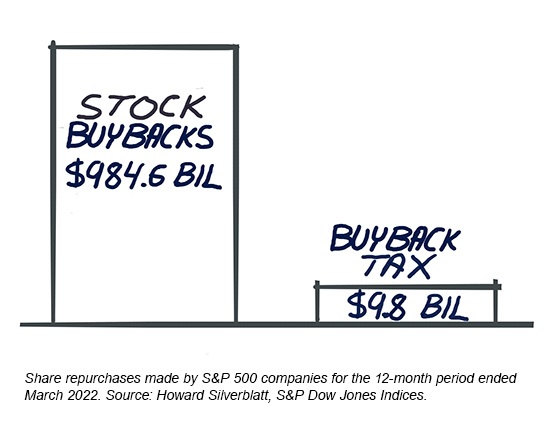
Also exempt, notably, are share repurchases by a real estate investment trust (REIT). Good lobbyists, perhaps.
More than 1,100 corporations in our Stock Investor Pro fundamental stock screening and research database have a buyback yield equal to or greater than 1%. Most of these companies (1,022) are exchange-listed firms. The buyback yield measures the change in average shares outstanding for the latest fiscal quarter (Q1) relative to the average shares outstanding in the same fiscal quarter a year ago (Q5).
Stock buybacks affect all investors who hold shares in the repurchasing company, either directly through share ownership or indirectly through mutual funds, exchange-traded funds (ETFs), closed-end funds, ESOPs, etc. Every net reduction in the number of shares outstanding increases the proportionate ownership that every share still outstanding represents.
Whether the tax has any meaningful impact on buybacks going forward remains to be seen. Share repurchases set a 12-month record of $984.6 billion this past March. Howard Silverblatt, the senior index analyst at S&P Dow Jones Indices, currently calculates second-quarter buybacks running 17.4% lower than the first quarter but 1.4% higher on a year-over-year basis. If we just use the 12-month figure, corporations would have faced a total surcharge of $9.8 billion. While large on an absolute basis, it is very small on a proportionate basis.
Therefore, it seems likely—but not certain—that impact of taxing buybacks will be hard to discern once the influence that other factors (cash flows, earnings, capital expenditures, etc.) have is taken into account.
Other Parts of the Legislation Affecting Individual Taxpayers
Here are a few other items in the legislation applicable to individual investors.
A $2,000 cap on out-of-pocket costs for prescription medications will go into effect for those enrolled in Medicare. The effective date is 2025. There is also a 6% cap on annual Medicare Part D premiums through 2029.
There will also be a credit for electric vehicle purchases. The headline amount given is $7,500, but there are some variances within the legislative text. A limit of one vehicle “per taxpayer per taxable year” is specified in the legislation. A phaseout exists for married joint filers with modified adjusted gross income (MAGI) above $500,000 and singles with MAGI above $250,000 [lowered to $300,000/$150,000 in the version of the legislation signed into law].
The Internal Revenue Service (IRS) will get more funding. Objectives for dollars allocated in the legislation include improving taxpayer services, boosting enforcement and designing an IRS-run free e-file tax return system. The agency has been underfunded for years and hopefully these dollars will be used to make long-overdue improvements.

- Whether buybacks are beneficial or harmful is dependent on several factors, as New York University professor Aswath Damodaran explained in this 2015 AAII Journal article.
- Both the buyback yield and the dividend yield can be used to assess which stocks are cheap and which are expensive.
- If the ongoing news headlines have you feeling uneasy about the stock market, fund manager John Deysher offers six ways to lessen the pain of investing.
Members are looking for your input. Can you help with this question from the Income Investing Community?
“Hildy and Stan Richelson’s recent article discusses the bond strategy of utilizing a custom ladder. If you own bonds, what do you typically do when interest rates are rising?”
Tap the button and then choose the Join the Community button on the right to answer this question in the AAII Community.
Answer This Question in the AAII Community »
AAII Sentiment Survey
Pessimism among individual investors about the short-term direction of the stock market fell to its lowest level in almost five months in the latest AAII Sentiment Survey. Optimism, meanwhile, rose to its highest level since late March.
Bullish sentiment, expectations that stock prices will rise over the next six months, increased 1.6 percentage points to 32.2%. Optimism was last higher on March 24, 2022 (32.8%). Despite recent increases, bullish sentiment remains below its historical average of 38.0% for the 38th consecutive week.
Neutral sentiment, expectations that stock prices will stay essentially unchanged over the next six months, increased 0.6 percentage points to 31.2%. Neutral sentiment is below its historical average of 31.5% for the 14th time in 16 weeks.
Bearish sentiment, expectations that stock prices will fall over the next six months, declined 2.2 percentage points to 36.7%. Pessimism was last lower on March 31, 2022 (27.5%). Bearish sentiment is above its historical average of 30.5% for the 37th time out of the past 38 weeks.
Both bullish and bearish sentiment as well as the bull-bear spread are currently within their typical ranges.
Continued volatility in the major stock indexes along with inflation, corporate earnings and increased chatter about the possibility of a recession are all likely weighing on individual investors’ short-term expectations for the stock market. Also influencing sentiment are monetary policy, the coronavirus pandemic, politics and the ongoing invasion of Ukraine by Russia.
Bullish: 32.2%, up 1.6 points
Neutral: 31.2%, up 0.6 points
Bearish: 36.7%, down 2.2 points
Bullish: 38.0%
Neutral: 31.5%
Bearish: 30.5%
See more Sentiment Survey results.

August 4, 2022 Mutual Fund and ETF Investors Continue to Lower Their Returns
July 28, 2022 Fed Rate Hikes and Economic Hard Landings
July 21, 2022 Small-Cap Stocks Are Still on Sale
July 14, 2022 10 High-Yielding Stocks With Risky Dividends

Discussion
Toby from NM posted over 4 years ago:
As far as the buyback tax goes, I would of preferred it to be more like 5-10%, but congress GOP would not allow it. It does however, it can help the deficit by putting more money back in the coffers. We all know that the companies not inc Berkshire will fight that but the deficit needs all the help it can get. It was not that longer ago that Trump(ugh) had the gop pass the stupid tax law which only benefits the rich.
Barry from CA posted over 4 years ago:
The Inflation Reduction Act seems like smoke and mirrors. The title is fine; but if you read into it, why are they adding 87,000 IRS agents? Nothing in there is for inflation reduction that I can see.
Barry from CA posted over 4 years ago:
The Inflation Reduction Act seems like smoke and mirrors. The name sounds good, but I don't see how this Act does anything to reduce inflation. Does adding 87,000 IRS agents accomplish this goal. How?
Patrick from NJ posted over 4 years ago:
All these Politicians think about is how to raise money through taxes. Prefer that they cut back on spending. The deficit will only increase no matter how much they tax....there is zero fiscal responsibility.
Tom from MI posted over 4 years ago:
Hey Toby Trump's stupid tax law lowered my federal income tax bill. I can assure you we are not rich!! You need a new tax pro.
Dee Ess from MN posted over 4 years ago:
Please be aware of the fact checks on the claim of 87,000 new IRS agents. For example: https://apnews.com/article/inflation-ap-fact-check-congress-government-and-politics-11eae023a3dc3a04584371843234cab7 The number represents possible hires between now and 2030. During that time an estimated 50,000 retirees will need to be replaced which come out of that number. The budget also covers operation and technology improvements. There are no plans to alter the auditing scheme for those making less than $400,000.
Peter from CA posted over 4 years ago:
The Act should be renamed the Inflation Tax Act of 2022. Please explain how the provisions impact inflation. I expect that investors will be taxed on stock purchases next just like state sales taxes.
Ken Armstrong from Montana posted over 4 years ago:
The idea of hiring more auditors and spending so little on taxpayer service is ridiculous. The backlog of unresolved taxpayer issues is nearly insurmountable and has caused untold amounts of grief to small businesses and lower to middle income taxpayers. At the same time, the whole IRS processing software and hardware are seriously antiquated. Where is the IRS going to find 87,000 competent auditors? How long will it take to train them? How able will they be to correctly examine returns?
Ed from NC posted over 4 years ago:
I am really disappointed in AAII for the incredibly misleading graphic that is attached to this article. The tax is 1%. The graphic looks a lot more like 10%. Yes, the numbers are published with the graphic and it is "hand drawn". But a quick glimpse will really mislead investors on the size of the tax. I know that AAII can do better and I expect better accuracy from a source I use for investment decisions.
Eric from WA posted over 4 years ago:
"The agency has been underfunded for years and hopefully these dollars will be used to make long-overdue improvements." Seems like wishful thinking to me, and since when has the IRS ever been considerate of improving tax payer services?
Paul R from New York posted over 4 years ago:
Charles, thanks for highlighting the 2015 article, which I hope AAII will update in light of the corporate tax changes in the 2017 Tax Cuts and Jobs Act (TCJA). A lot of people (Warren Buffett and a few commenters on the article), noted that buybacks could be the easiest (and most tax-efficient) way for corporations to return profits to shareholders. Did the corporate tax cut fuel research or capital investment and hiring (as was argued in passing the legislation) OR buybacks? It would also be interesting to see if those buybacks fueled (in part) the rise in the market since the law's passage or helped mitigate the market's volatility during Covid. (I had hoped, both with the TCJA and the Inflation Reduction Act, that corporations would be incentivized to invest in research, capital constructions, and hiring [say through tax credits], as an aid to the broader economy.) Incidentally, and Charles you have mentioned this in the past, the AAII comments section on the March 2015 Damodaran article exemplifies some of the best aspects of comments in raising related issues or things not considered.
Barry from TX posted over 4 years ago:
Charles, I am going to recommend you for an Air Medal for flying an O1A mission (being in first wave over the target) into an active combat zone (an election year) in an unarmed surveillance vehicle (AAII has no political point of view as near as I can tell) … and having all the bad guys shoot and miss (in the couple of off topic comments). The bad news is you need to earn 5 Air Medals to earn a ride to somewhere safer.
Michael Daillak, CPA from CA posted over 4 years ago:
The bad new about the 1% tax is that it will be in its entirety paid by the shares that didn't participate in the buyback. Those remaining shares will have to bear the burden of that tax expense cash outflow, in addition to the cash outflow of the buyback - and of course if any of the buyback cash outflows are financed by debt then the remaining shares will also be paying the interest expense to service that debt. As an example see the 2018 10-K of the railroad CSX Corp. (ticker: CSX). To accomplish a $ 4.6 billion stock buyback, approximately $ 3 billion was borrowed long-term at an average interest rate of 4+% (per the Notes area; at various maturities, up to 60 years, with total extra interest cost/expense to be paid, possibly as high as $ 11+ billion). Essentially none of the borrowed funds were used to purchase fixed assets. Because in 2018 total fixed-assets/property/capital-improvements only increased $ 0.5 billion (i.e., ½ of a billion!), and the total dividends paid in 2018 to all stockholders were only $ 0.75 billion (i.e., ¾, of a billion!). Finally, please note that CSX is a company that will more than likely never be allowed to fail. Consequently, similar to GM during the 2008 financial crisis - which required its subsequent “restructuring” with a “government bailout” - the first level to “pay” for the consequences of a “government bailout” - required because GM didn't have enough cash - will be the common stockholders! In the GM example the then existing common stockholders lost everything! The GM shares currently being traded were all newly issued after 2008, as part of paying the government back! Be warned if your shares aren't bought as part of a buyback, you may just have a "larger proportionate share" of a potential deficit-equity, or a future insolvency!!
Jim from WA posted over 4 years ago:
65% of federal spending is for entitment programs and social security could run out of funds by 2033; Medicare funds don't cover expenditures and the U.S. defense spending is more than the next 9 countries combined at almost 1 trillion dollars. Throw in another 300 billion for interest on our debt. If you want a lower deficit, the government must cut spending (please add your pet projects here and be specific) or increase taxes. The recent legislation earmarks corporate taxes to deficit reduction. Companies are not required to buy back shares. When the new tax goes into effect, they will do so or not based on the economic benefit to the company (or the CEO). I am not a fan of corporate taxes and cheered for the corporate tax cuts made by the last administration. However, the temporary personal tax cuts (expire in 2025) were irresponsible (yes, we all like more money). But they compounded the deficit problem. I would much rather see our dividends and capital gains taxed higher than increase taxes on corporations. Why should we get a tax break when those who just use savings acoounts or CDs have to pay a higher rate? If we don't tax corporations, then we need to increase our personal income tax rates. Or figure out how to cut into our non-required programs like the defense budget. Good luck with that!
You need to log in as a registered AAII user before commenting.
Create an account