

Growth Stocks Are Being Helped by Inflation Expectations
by Charles Rotblut | August 18, 2022
Inflation is high. The yield curve remains inverted. The Federal Open Market Committee (FOMC) is expected to raise rates by at least 50 basis points (bps) for a fourth consecutive time at its next meeting. Growth estimates for full-year S&P 500 index earnings are being reduced.
Yet, the stock market is in the midst of a very strong summer rally.
Mr. Market never tells you when it’s time to get back in. Rather, he looks forward. Current sentiment and prevailing stock prices are weighed against what could be coming over the horizon. If gloom is currently being perceived and sunnier skies are expected to appear in the future, stocks often rally in anticipation of a change.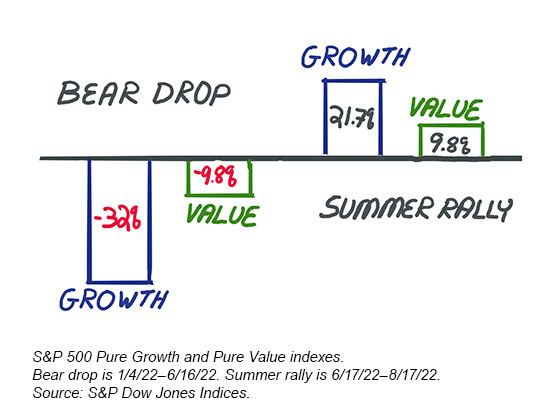
One such anticipated change is inflation. June’s 9.1% increase in the consumer price index (CPI) is being perceived as a peak. July’s 8.5% increase in the CPI, while still high, was a welcome step in the right direction.
But it’s not just the CPI that is suggesting the rate of inflation could be coming down. Yields on the benchmark 10-year Treasury note peaked on June 14, 2022. Since then, they’ve pulled back. The 10-year note’s yield has not exceeded 3% for five consecutive weeks.
On the equity side, there has been a shift in favoritism. Growth, which had been underperforming most of the year, has been outperforming this summer. Value, which had been a leader, has become a laggard.
Consider the returns of the S&P 500 Pure Growth and the S&P 500 Pure Value indexes. From the start of the bear market on January 4, 2022, to the bottom set on June 16, the growth index plunged by 32.1%. The value index declined by just 9.8% over the same period.
Since then, the pendulum has swung in the other direction. S&P 500 Pure Growth has rebounded by 21.7% (though Wednesday’s close) while S&P 500 Pure Value has rebounded by just 9.8%.
While one could, rightfully, argue that growth stocks were more oversold, interest rate expectations cannot be ignored either. Lower expected interest rates boost what future earnings are worth today. Investors will demand less compensation in terms of expected returns when they perceive a comparatively lower rate of inflation (and thereby interest rates) in the future.
Consider a company expected to earn $100 per share five years from now. If you apply a 15% discount rate to them (as compensation for investing in such a company), the present value of those earnings is approximately $50. Let’s say inflation expectations change and you are now willing to apply a 12% discount rate instead. The present value of those earnings would increase to about $57. The higher present value will justify a higher price for the stock assuming the multiple (e.g., the price-earnings ratio) you base your valuation on stays unchanged.
This is an overly simplistic example, but it can help to explain why growth has experienced a bigger rebound. Since growth stocks, by definition, have stronger growth rates, their valuations are more dependent on the present value of those future earnings relative to value stocks. When the assessed present value of future earnings increases, so should the stocks’ prices—all else being equal.
None of this means we’re out of the woods. Many consumers are struggling under the weight of still-high gas prices and big grocery bills. The yield curve is on pace to be inverted, on average, for the entire quarter—a harbinger of a recession. Supply issues are continuing. One month’s deceleration in the CPI’s rate of increase does not guarantee that inflation has peaked. And, as noted above, full-year earnings estimates are being reduced.
Yet, there are reasons to be optimistic. The benchmark 10-year Treasury note’s yield again failed to stay above 3% for an extended period. (The last such attempt prior to this year was in 2018.) The S&P 500 has recouped more than 50% of its bear market losses. According to Sam Stovall at CFRA Research, the large-cap index has “never set a lower low in any post-WWII bear market” following such rebounds. The large-cap index is also on pace to record a double-digit percentage gain for the months of July and August for only the fourth time since 1989. Ryan Detrick of the Carson Group noted that the previous three similar summer rallies (1989, 2009 and 2020) were all followed by additional double-digit gains during the final four months of the year. The fourth quarter of midterm election years has previously been good for stocks.
Plus, it is possible that the “inflation has peaked” narrative is correct with future price increases being smaller. Only time will tell, but fingers crossed …

- The PEG ratio can help you determine if a growth stock is trading at an attractive valuation.
- If the ongoing uncertainty over inflation, the direction of the markets and other headlines have you a bit nervous, fund manager John Deysher offers six tips to lessen the pain of investing.
- Also in the August AAII Journal, Hildy and Stan Richelson make the argument for why you should consider bonds in a rising interest rate environment.
- Anine Sus discusses how she created her investing strategy using two AAII resources in her latest My Investing Discoveries blog post.
Members are looking for your input. Can you help with this question from the Allocation Strategies Community?
“In a recent AAII Journal article, Wayne Thorp discusses the ‘three bears’ approach to risk that can help investors understand how much risk to take on at a given period. What is your current strategy when it comes to knowing how much portfolio volatility you are able to weather and has that changed for you over the last several years?”
Tap the button and then choose the Join the Community button on the right to answer this question in the AAII Community.
Answer This Question in the AAII Community »
AAII Sentiment Survey
Optimism among individual investors about the short-term direction of the stock market is at its highest level of the year. The latest AAII Sentiment Survey also shows pessimism rising for just the second time in seven weeks.
Bullish sentiment, expectations that stock prices will rise over the next six months, increased 1.2 percentage points to 33.3%. This is the highest level of optimism recorded since December 30, 2021 (37.7%). Despite recent increases, bullish sentiment remains below its historical average of 38.0% for the 39th consecutive week.
Neutral sentiment, expectations that stock prices will stay essentially unchanged over the next six months, declined 1.7 percentage points to 29.5%. Neutral sentiment is below its historical average of 31.5% for the 15th time in 17 weeks.
Bearish sentiment, expectations that stock prices will fall over the next six months, increased 0.5 percentage points to 37.2%. Bearish sentiment is above its historical average of 30.5% for the 38th time out of the past 39 weeks.
Both bullish and bearish sentiment as well as the bull-bear spread are currently within their typical ranges.
Optimism has improved as the stock market has rebounded, but the year’s declines along with inflation, corporate earnings and concerns about the possibility of a recession are weighing on individual investors’ short-term expectations for the stock market. Also influencing sentiment are monetary policy, the coronavirus pandemic, politics and the ongoing invasion of Ukraine by Russia.
Bullish: 33.3%, up 1.2 points
Neutral: 29.5%, down 1.7 points
Bearish: 37.2%, up 0.5 points
Bullish: 38.0%
Neutral: 31.5%
Bearish: 30.5%
See more Sentiment Survey results.

August 11, 2022 Some Thoughts on the New Buyback Tax
August 4, 2022 Mutual Fund and ETF Investors Continue to Lower Their Returns
July 28, 2022 Fed Rate Hikes and Economic Hard Landings
July 21, 2022 Small-Cap Stocks Are Still on Sale

Discussion
Barry J from TX posted over 4 years ago:
Charles, good article. Very timely. To me, the net of your Ben Franklin argumentation seems to come down in favor of optimism. I wish to add more validity to the overall "Hang in there, there's a rainbow across the hill" theme running through this article by using the data in your example and the accompanying chart to make a few supporting points. If SPX Growth went down -32.1% before 06/16 then back up +21/7%, the fund settled at 82.6% is -- down a net 17.4%. The SPX Value fund went down -9.8% and then back up +9.8% settling at 99.0 -- only down 1% net. Lessons: (1) It always pays to do the math for yourself. You could "learn" the wrong lessons. (2) This example supports a buy-and-hold strategy. The value investor came out a net 17.4 percentage points HIGHER. Not a trivial amount. It kept his/her base intact, which lessen the false "trauma" buried in the numbers. (3) The value stock had a MUCH lower variance over this period. Growth range was 32.1 points. Value range was 9.8 points. Again, not a trivial amount. And yet another reason to buy-and-hold VALUE over Growth, unless you are a "volatility junkie." (Not my style. I like to walk in the fairway, and not chase balls in the weeds. Even Phil the Thrill finally admitted he could have won 5-10 more tournaments if he had not been a "rip it and go find it" bigot.) I didn't do the variances or standard deviations. It would be meaningless due to the small sample size. The rainbow I see outside the Ark right now is that being a Buy-and-Hold Value investor helps smooth rocking of the boat, minimizes sea sickness, and eliminates a lot of unnecessary praying. God has Her hands full right now. Do not be an unnecessary burden to Her. She will reward you for that.
You need to log in as a registered AAII user before commenting.
Create an account