

What Faster Trade Settlements Mean for Investors
by Charles Rotblut | May 23, 2024
Starting on Tuesday, May 28, 2024, the settlement period following the execution of a buy or sell order will shorten to one day for many types of investments. Referred to as T+1, it will impact several things.
Here is a brief overview of the impacts on individual investors:
- Stocks, bonds, municipal securities, exchange-traded funds (ETFs), certain mutual funds and master limited partnerships that trade on an exchange will be affected;
- The record date and the ex-dividend date for dividends and stock splits will now be the same;
- Proxy voting deadlines will similarly be affected;
- Proceeds from the sale of an investment will be available sooner; and
- Automated clearing house (ACH) transfers and margin accounts may need to be monitored more closely.
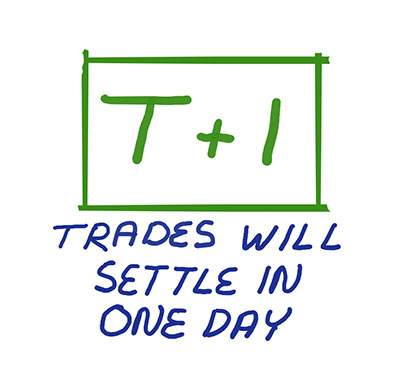 The settlement cycle is currently T+2. This stands for trade date plus two days. T+2 went into effect in September 2017. T+1 shortens the cycle to trade date plus one day. So, a trade placed on Tuesday, May 28, will be settled on Wednesday, May 29. Treasury bonds already operate on a T+1 basis.
Investors holding dividend-paying stocks in taxable accounts should take note of the change. For the dividend to be eligible for the discounted qualified dividend tax rate, a common stock must be owned for more than 60 days during the 121-day period that begins 60 days before the ex-dividend date. Since the ex-dividend date will be the same as the record date starting on May 28, the 121-day clock will start one day later under T+1. For preferred stocks, the holding period is more than 90 days out of a 181-day period, with dividends attributable to periods aggregating more than 366 days. See our 2023 tax guide for more information.
Similarly, the shorter settlement period moves the date for determining eligibility for participating in a stock split forward by one day. The same applies to eligibility for shares or cash settlements resulting from the divestiture of a business unit. T+1 should also give you an additional day to participate in proxy votes.
From an account management perspective, you will have access to the proceeds from the sale of an investment one day sooner. What will not be sped up are ACH deposits. You will still have to wait for your broker to clear such deposits in a cash (non-margin) account or at least treat them as cash available for trading. Check with your broker if you have questions about this.
Similarly, those with margin accounts should be aware of the timing of when cash will be available. Here is what Charles Schwab told its clients about T+1: “Margin account investors who place a trade but need to sell money market funds (MMFs) to cover their purchase need to make sure those MMF proceeds are available before or on the same day as settlement to avoid a margin interest charge.” This means that for margin account trades in bonds, equities or other securities, money market funds will need to be sold by 4:00 p.m. Eastern Time.
Why T+1 Is Being Implemented
There are a few reasons why the settlement cycle is being shortened to one day. Capital requirements and liquidity are one. Robinhood found itself in a precarious spot during the meme stock craze of 2021 because it didn’t have the liquidity to handle the large surge in trading. Trades were occurring in large volumes and at a faster pace than the discount broker could cover with its reserves.
A shorter settlement cycle improves liquidity among brokerages by moving money around faster. This reduces, but does not eliminate, the risk of a broker collapsing.
Technology is another reason. The current financial system is better able to quickly settle trades and move money around.
There are also investor preferences. Most investors transact electronically. Exchanging paper certificates that need to be physically moved around is a thing of the past. Many corporations have stopped issuing paper stock certificates altogether. Even if you own paper certificates, many brokers charge a fee for handling them.
Plus, since we can transfer money by Zelle or Venmo quickly, it seems silly to have to wait two days for the funds from a trade to be available. It doesn’t make sense to the average investor why they must wait two days for a trade to settle even if there isn’t a desire or need to withdraw the proceeds.

-
Guide to Tax on Your Personal Investments 2023
This supplement to our annual tax guide provides an explanation of the tax rules regarding the buying and selling of securities. -
For Qualified Charitable Distributions, Timing Is Everything
The May 2024 AAII Journal explains that with careful planning, a QCD can be a smart tax-planning strategy for an IRA holder taking distributions. -
Digging for VanEck Sustainable ETFs
In her latest My Investing Discoveries blog post, Anine Sus looks into the performance record and expense ratios of the VanEck exchange-traded funds that meet her sustainability criteria.
AAII Sentiment Survey
Neutral sentiment among individual investors about the short-term outlook for stocks significantly decreased in the latest AAII Sentiment Survey. Meanwhile, both optimism and pessimism rose.
Bullish sentiment, expectations that stock prices will rise over the next six months, increased 6.2 percentage points to 47.0%. Bullish sentiment is above its historical average of 37.5% for the 28th time in 29 weeks.
Neutral sentiment, expectations that stock prices will stay essentially unchanged over the next six months, decreased 9.2 percentage points to 26.6%. Neutral sentiment is below its historical average of 31.5% for the third time in seven weeks.
Bearish sentiment, expectations that stock prices will fall over the next six months, increased 3.1 percentage points to 26.3%. Bearish sentiment is below its historical average of 31.0% for the third time in six weeks.
The bull-bear spread (bullish minus bearish sentiment) increased 3.1 percentage points to 20.7%. The bull-bear spread is above its historical average of 6.5% for the third time in six weeks.
This week’s special question asked AAII members about their perception of first-quarter 2024 earnings.
Here is how they responded:
- They were better than I expected: 45.7%
- They approximately matched my expectations: 37.9%
- They were worse than I expected: 2.3%
- No opinion: 14.1%
Bullish: 47.0%, up 6.2 points
Neutral: 26.6%, down 9.2 points
Bearish: 26.3%, up 3.1 points
Bullish: 37.5%
Neutral: 31.5%
Bearish: 31.0%
See more Sentiment Survey results.

May 16, 2024 May Charts of Interest: Buybacks Are Rising
May 9, 2024 Does It Make Sense for BlackRock to Add Annuities to Retirement Plans?
May 2, 2024 Reasons for Not Selling Stocks This May
April 25, 2024 The Benefits and Costs of Diversification in My 403(b)

Discussion
Barry from TX posted over 2 years ago:
Settlement periods are getting faster for industry reasons, not to serve you better. The menu at Antoine's, New Orleans' oldest restaurant, home of the Pommes de Terre Souffles (puffed potatoes) says, "Good cooking takes time. If you are made to wait, it is to serve you better, and to please you." Faster isn't always better. Have you ever noticed how a roller coaster speeds up just before its deepest descent? Raise your hands over your heads, scream, and hang on.
Barry from TX posted over 2 years ago:
Another small observation. The AAII Sentiment Survey spread is becoming increasingly NEGATIVELY skewed, out of balance toward the bullish side – 47.0% to 26.3%. One survey is “point” observation; several surveys may demonstrate a trend. In a distribution, negative skewness indicates investors should expect markets with small gains and a few large losses. Strategies based on negative skewness (aggressively bullish, short-dated options for example) may provide quick profits, but investors should be aware that there is an INCREASING probability of larger losses. the related children’s verse for this is “Pop Goes the Weasel.” “All around the mulberry bush; The monkey chased the weasel; The monkey thought it was all in fun... Pop! goes the weasel.” This is a Cockney song about having to pawn (“pop” goes) your coat (the weasel”) to have enough money to eat.
Donald G. Thomas, Jr. from MI posted over 2 years ago:
Thanks Charles. Maybe I won't get restricted in my accounts as often now.
You need to log in as a registered AAII user before commenting.
Create an account