

The Benefits and Costs of Diversification in My 403(b)
by Charles Rotblut | April 25, 2024
Featured Tickers: VFIAX
VFIDX
VFSAX
VGSLX
VSIAX
VFIAX
VFIDX
VFSAX
VGSLX
VSIAX
Since the semiannual review of my 403(b) account showed no need to rebalance, I’m going to discuss the benefits and costs of diversifying. I’ll use my portfolio as an example for this.
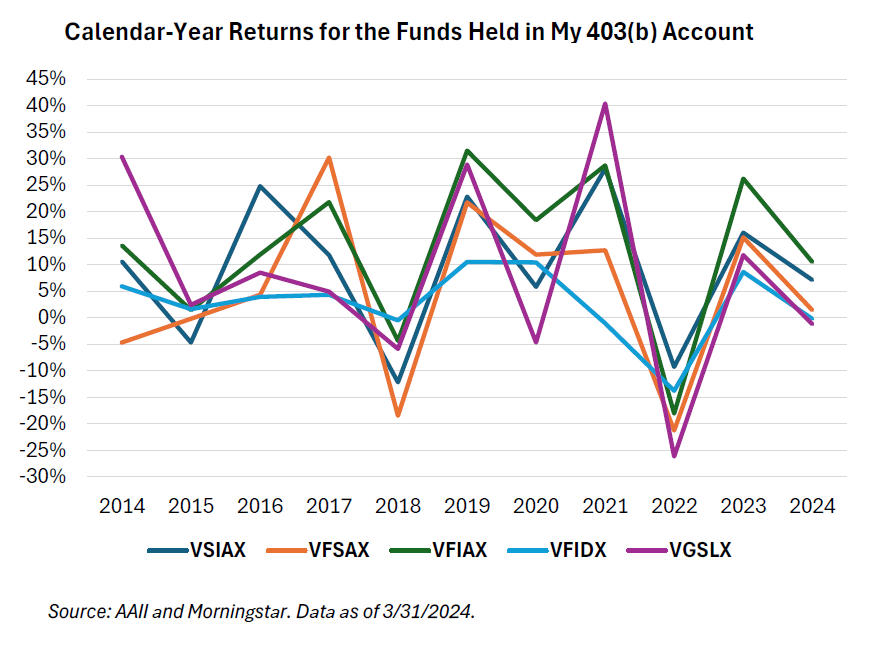
I diversify because it increases the odds of being allocated to the right asset class and asset class category at the right time.
The chart below demonstrates this. It shows the calendar-year and 2024 year-to-date returns for the funds I hold in my 403(b) account. I purposely plotted calendar-year returns instead of showing compounded growth to illustrate each fund’s volatility. The funds are:
-
Vanguard 500 Index Admiral fund
 (VFIAX)
 -
 Vanguard Small Cap Value Index Admiral fund (VSIAX)
 -
Vanguard FTSE All-World ex-U.S. Small Cap Index Admiral fund (VFSAX)
-
Vanguard Real Estate Index Admiral fund (VGSLX)
-
Vanguard Intermediate-Term Investment-Grade fund (VFIDX)
An additional benefit is having a stash of conservative assets I can pull from to put money into stocks during steep corrections and bear markets. I did this is in March 2020 to buy stocks during the pandemic stock market crash.
The benefits of diversification are not costless. As with anything involving investing, there are trade-offs.
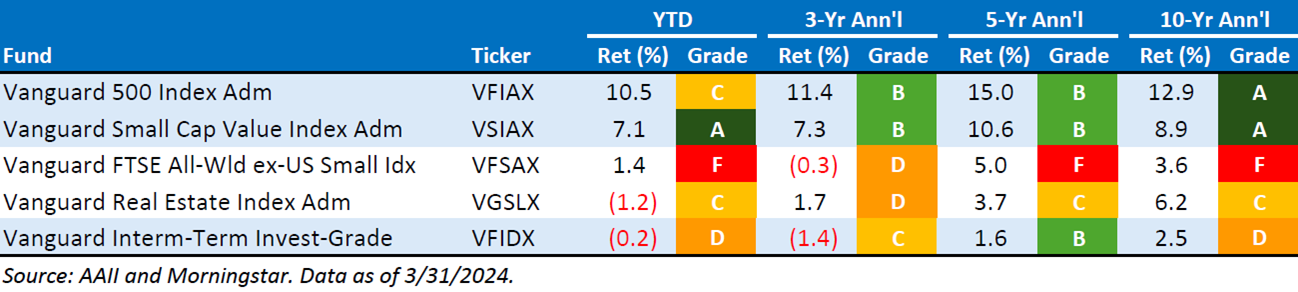
Portfolios that diversify across asset classes and asset class groups are going to hold some lower-returning investments. The Vanguard Intermediate-Term Investment-Grade has a 10-year return of 2.5%. It is the price I’m paying to have the ability to rebalance back into stocks during bear markets as well as to sleep at night.
Diversification will often cause you to second-guess your decisions. Perfect hindsight shows I should have put everything into the Vanguard 500 Index fund. Its 12.9% 10-year return is well above that of the other four funds I own. Over the same time period, the Vanguard FTSE All-World ex-U.S. Small Cap has been a dud.
So why not just put everything into the Vanguard 500 Index fund now? Two words: hindsight bias. Just because we know with certainty what worked over the past 10 years does not mean we know what will work over the next 10 years.
Plus, there are factors that could favor my allocation going forward. Domestic small-cap value stocks are very undervalued relative to large-cap stocks. International stocks are incurring an unusually long period of underperformance relative to domestic stocks. Intermediate-term bonds will benefit from a drop in interest rates.
And if the S&P 500 index continues to outperform, I have exposure to that too.
My goal is not to put all of my chips into one basket. I sleep well at night knowing that I have not made any single big bets and am using rebalancing to keep any one fund from becoming too overweight.

-
Clarifying the Purpose of Diversification
Broad, multi-asset-class diversification allows us to produce an equity-like return while substantially reducing the volatility of returns in the portfolio. -
Design Your Portfolio With the Worst 2% of Times in Mind
A “suboptimal portfolio” that you can tolerate is better than an “optimal” one that you can’t stick with. -
How to Protect Yourself From Social Security Clawbacks
The Social Security Administration is demanding repayment of benefits it erroneously overpaid over the years, with little recourse available to recipients. -
My Payday Routine
In her latest My Investing Discoveries blog post, Anine Sus shows how she calculates the amount available for savings and then distributes it among her goals.
AAII Sentiment Survey
Neutral sentiment among individual investors about the short-term outlook for stocks surged in the latest AAII Sentiment Survey. Meanwhile, optimism decreased and pessimism was unchanged.
Bullish sentiment, expectations that stock prices will rise over the next six months, decreased 6.1 percentage points to 32.1%. Bullish sentiment is below its historical average of 37.5% for the first time in 25 weeks.
Neutral sentiment, expectations that stock prices will stay essentially unchanged over the next six months, increased 6.2 percentage points to 33.9%. Neutral sentiment is above its historical average of 31.5% for the second time in six weeks.
Bearish sentiment, expectations that stock prices will fall over the next six months, was unchanged at 33.9%. Pessimism is above its historical average of 31.0% for the second time in 25 weeks.
The bull-bear spread (bullish minus bearish sentiment) decreased 6.1 percentage points to –1.8%. The bull-bear spread is below its historical average of 6.5% for the second time in 25 weeks.
This week’s special question asked AAII members about their perception of the current state of the housing market.
Here is how they responded:
- Strong: 19.0%
- Mixed: 51.6%
- Weak: 21.9%
- Not sure/no opinion: 7.5%
Bullish: 32.1%, down 6.1 points
Neutral: 33.9%, up 6.2 points
Bearish: 33.9%, down 0.0 points
Bullish: 37.5%
Neutral: 31.5%
Bearish: 31.0%
See more Sentiment Survey results.

April 18, 2024 April Charts of Interest: The S&P 500's Streak Ends
April 11, 2024 Why Large-Cap Super Micro Computer Is Still in the Small-Cap Russell 2000 Index
April 4, 2024 Five Retirement Challenges and Solutions for Them
March 28, 2024 Remembering Daniel Kahneman

Discussion
Barry from TX posted over 2 years ago:
Charles, your semi-annual reflections are my favorite series of ALL articles AAII publishes. I learn so much from your insights. You taught me not to be afraid to be critical of my past investment choices. Brian Portnoy famously observed, "Diversification means ALWAYS having to say you're sorry" referring to the need to accept that SOME investment decisions WILL ALWAYS underperform SOME of the time. I have commented in several posts on the AAII Community exactly how I used your portfolio as a prototype for constructing my portfolio. It inspired me on a continuing journey to understand the arcane nuances of constructing a portfolio that APPLIES the key principles. I prefer to learn from real-life examples versus hypothetical models. Thank you for sharing your example. In “The Mythical Man-Month” Fred Brooks used quotations to introduce the principles of his famous book on managing large-scale projects. Two apply here. The Dutch proverb: “Een schip op strand is een baken in zee” (“A ship on the beach is a lighthouse to the sea.”) means you can learn the magnitude of the risks from observing others’ prior mistakes, and “No scene in prehistory is quite so vivid as that of the mortal struggles of great beasts in the tar pits. The fiercer the struggle, the more entangling the tar, and no beast is so strong or so skillful, but that he ultimately sinks” means struggling against greater forces like the market forces is ultimately futile.
You need to log in as a registered AAII user before commenting.
Create an account