

Profit Margins Have Gained in Importance
by Charles Rotblut | September 15, 2022
Tuesday’s 5.2% plunge in the Nasdaq composite marked the seventh time this year that the index has closed down by at least 4%. There have only been four other years with daily drops of 4% or more in the Nasdaq composite’s 51-year history, according to Bespoke Investment Group.
Technology stocks were particularly hit hard on Tuesday, especially those with high valuations. This isn’t surprising given that higher inflation and higher interest rates reduce the present value of future earnings. Blame the latest consumer price index (CPI). After the August numbers were released, traders began pricing in the possibility of a full-percentage-point rate hike being announced at next week’s Federal Open Market Committee (FOMC) meeting. 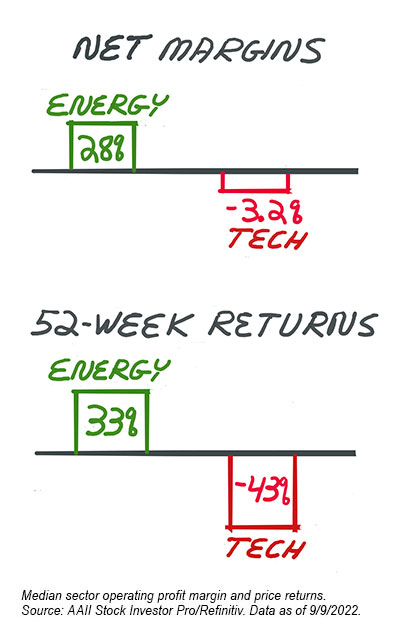
It’s not just future growth. Investors are also asking companies, “What have you done for me lately?” In cases where profit margins are the equivalent of a “not much” answer, investors have responded accordingly.
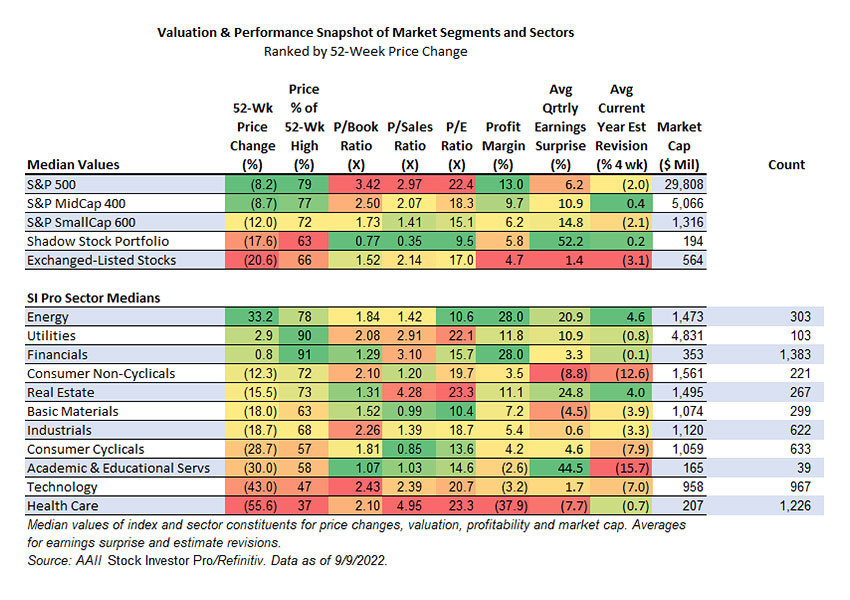
Recent analysis done by AAII president John Bajkowski for the Model Shadow Stock Portfolio Update found that the sectors with lower median net profit margins also have worse-performing stocks. The median net profit margin for technology companies is –3.2%. The median 52-week price return for technology stocks is –43.0% as of September 9.
The energy sector has the highest median net profit margin at 28.0%. Energy stocks have a median 52-week return of 33.2%.
Only two other sectors had positive median 52-week returns when the data was run: utilities and financials. The gains were 2.9% and 0.8%, respectively. Those sectors’ median net profit margins are 11.8% and 28.0%, respectively.
Higher oil prices, a comparatively low level of sensitivity to economic fluctuations and widening interest rate spreads have helped those three sectors. Also playing a role is how investors tend to react to downside volatility: Flights to quality occur. Or as O’Shaughnessy Asset Management observed in a recent report, “When prices are falling, however, investors meticulously study the merits of an investment and make sure they have strong conviction in its prospects.”
There will be a time when the markets go back to a “risk-on” mode. Greater confidence in peak inflation being reached along with expectations of the Federal Reserve transitioning toward less aggressive monetary policy are the highest probability catalysts for such a shift.
Traders who were expecting that peak inflation had been met were left feeling like they were waiting for Godot when the CPI report came out. We’ll get to and below peak inflation, but the timing will be data-dependent.
Regardless of when the pendulum swings back to a risk-on environment, we know the playbook to follow now and in the future. Profits and cash flow matter. Not overpaying for a stock boosts the odds of positive returns. Avoiding stocks with unreasonable growth expectations is always prudent.

-
16 Financial Ratios for Analyzing a Company’s Strengths and Weaknesses
These 16 ratios enable investors to compare the fiscal strength, profitability and efficiency of two or more companies. -
Pains and Gains From Small-Cap Value Stocks
Combining small-cap value and the S&P 500 can provide higher returns and a less painful ride over the long term. -
Getting a Fix on Jim Cullen’s Approach to Long-Term Value
The key valuation measurements of low price to earnings, low price to book value and high dividend yield are used to find stocks that have long-term value. -
Value Investing’s Differing Short- and Long-Term Performance Record
Does value investing still work? An in-depth look at the numbers shows that the answer is more nuanced than you might think. -
A (Very) Brief History of Women in Finance
Anine Sus highlights a few trailblazers from the 20th century and where we stand today in her latest My Investing Discoveries blog post.
Members are looking for your input. Can you help with this question from the Allocation Strategies Community?
“I have a question about monitoring portfolio asset and sector allocations using the Excel Stock Market Functions (SMF) add-in.”
Tap the button and then choose the Join the Community button on the right to answer this question in the AAII Community.
Answer This Question in the AAII Community »
AAII Sentiment Survey
The latest AAII Sentiment Survey results show a large reversal from last week. Pessimism dropped while optimism jumped.
Bullish sentiment, expectations that stock prices will rise over the next six months, rebounded by 8.1 percentage points to 26.1%. Despite recent increases, optimism remains below its historical average of 38.0% for the 43rd consecutive week. Bullish sentiment is also unusually low for the third consecutive week and the 26th time in 37 weeks.
Neutral sentiment, expectations that stock prices will stay essentially unchanged over the next six months, declined 0.8 percentage points to 27.9%. Neutral sentiment is below its historical average of 31.5% for the 19th time in 21 weeks.
Bearish sentiment, expectations that stock prices will fall over the next six months, pulled back by 7.3 percentage points to 46.0%. Bearish sentiment is above its historical average of 30.5% for the 42nd time out of the past 43 weeks and is at an unusually high level for the 27th time out of the last 35 weeks. The breakpoint between typical and unusually high readings is currently 40.5%.
The bull-bear spread (bullish minus bearish sentiment) is –19.9% and is unusually low for the 28th time in 34 weeks. The breakpoint between typical and unusually low readings is currently –10.9%.
Approximately three-quarters of responses to this week’s survey were recorded before Tuesday’s large drop in the major indexes.
Historically, the S&P 500 index has gone on to realize above-average and above-median returns during the six- and 12-month periods following unusually low readings for bullish sentiment and the bull-bear spread. Unusually high bearish sentiment readings historically have also been followed by above-average and above-median six-month returns in the S&P 500.
Continued volatility in the major stock indexes along with inflation, corporate earnings and increased chatter about the possibility of a recession are all likely weighing on individual investors’ short-term expectations for the stock market. Also influencing sentiment are monetary policy, the coronavirus pandemic, politics and the ongoing invasion of Ukraine by Russia.
Bullish: 26.1%, up 8.1 points
Neutral: 27.9%, down 0.8 points
Bearish: 46.0%, down 7.3 points
Bullish: 38.0%
Neutral: 31.5%
Bearish: 30.5%
See more Sentiment Survey results.

September 8, 2022 401(k) Tips and Useful Information
September 1, 2022 New Innovations: Single Stock and BuyWrite Bond ETFs
August 25, 2022 The Large-Cap Equity Premium Has Become Less Persistent
August 18, 2022 Growth Stocks Are Being Helped by Inflation Expectations

Discussion
Charles Rotblut from Illinois posted over 4 years ago:
The doodle included in the email was incorrect. it should have said net margins. A corrected version is shown above. -Charles
You need to log in as a registered AAII user before commenting.
Create an account