

Balancing Longevity Risk With Late-in-Life Care Expenses
by Charles Rotblut | July 11, 2024
“If you can tell me when she is going to die, the math gets much easier.” This is a line I’ve been repeating to my wife lately as my mother-in-law has unexpectedly begun to need caretakers with her 24/7. It is not financially sustainable, but it is our only option while we find higher-level care for her.
Some of you have gone through a similar situation. Beyond the emotional costs, late-in-life care points to one of the toughest challenges in retirement: longevity. If we could predict the date of death in advance, retirement planning would be much easier.
We obviously can’t. This is why longevity risk is a big consideration in retirement planning. Longevity risk is the chance of outliving your money.
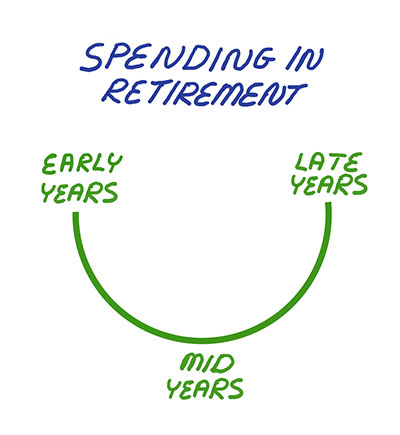 Beyond the uncertainty of longevity is the pattern in which spending in retirement typically occurs. Early in retirement, people tend to be active. This results in greater spending (e.g., from going out for meals, shopping, playing pickleball, etc.). Spending decreases during mid-retirement as people become less active but still experience relatively decent health. Medical and daily care expenditures rise during the later years as more health and ambulatory issues occur. The pattern resembles a U-shaped curve.
Guaranteed sources of cash flow like Social Security (along with the higher benefits from delaying claiming), pensions and annuities are among the ways to help ward off longevity risk.
Starting early with saving, consistently saving and investing those savings in a disciplined manner also helps to fight longevity risk. Lots of money and prudent spending diminish longevity risk. Not everyone is fortunate to have enough saved because of layoffs, health problems, family care issues, etc.
Long-term care insurance is a double-edged sword from the aspect of longevity risk: It can help pay for activities of daily living, but the rising premiums reduce wealth. Whole life insurance is similar in that the premiums paid into the policy could have been invested directly in lower-cost index mutual funds or exchange-traded funds (ETFs) instead.
While one should avoid overspending, underspending has its downsides too. Experiences add to one’s quality of life, be it time with family and friends or engaging in fun activities. Skimping on health care early in retirement—and in the decades before it—can also lead to higher expenses later.
Plus, there is the challenge of figuring out how much can be spent to provide care without draining savings at too rapid of a pace as one’s health worsens. My wife and I are wrestling with this now. We don’t want to preemptively drain my mother-in-law’s savings, but we also don’t want to end up with an inheritance that could have been spent on her instead.
It’s a challenge, and one my wife and I are doing our best to navigate given the uncertainty of not having a date to work backward from.

-
How Big Is Longevity Risk?
The uncertainty of how long a person will live poses negligible risk at younger ages and substantial risk at older ages. -
What Is a Longevity Annuity?
Longevity annuities provide a guaranteed source of income starting at a future date. One type, QLACs, can be held in 401(k) plans. -
Summer Portfolio Refresher: Swapping Five Shadow Stocks
After conducting the quarterly review of the Model Shadow Stock Portfolio, five deletions and five additions are discussed in the July AAII Journal. -
Midyear Portfolio Review: Rebalancing for Sustainability
Anine Sus reveals what’s on the chopping block and how she identified a replacement that fits her strategy in her latest My Investing Discoveries blog post.
AAII Sentiment Survey
Optimism among individual investors about the short-term outlook for stocks increased in the latest AAII Sentiment Survey. Meanwhile, both neutral sentiment and pessimism decreased.
Bullish sentiment, expectations that stock prices will rise over the next six months, increased 7.4 percentage points to 49.2%. Bullish sentiment is unusually high and is above its historical average of 37.5% for the 35th time in 36 weeks.
Neutral sentiment, expectations that stock prices will stay essentially unchanged over the next six months, decreased 3.1 percentage points to 29.1%. Neutral sentiment is below its historical average of 31.5% for the 10th time in 17 weeks.
Bearish sentiment, expectations that stock prices will fall over the next six months, decreased 4.4 percentage points to 21.7%. Bearish sentiment is below its historical average of 31.0% for the ninth time in 10 weeks.
The bull-bear spread (bullish minus bearish sentiment) increased 11.8 percentage points to 27.5%. The bull-bear spread is above its historical average of 6.5% for the 10th consecutive week.
Over the Fourth of July holiday week, we asked AAII members how the stock market’s year-to-date returns compare to their expectations at the start of 2024. The majority of members (66.7%) find them better than expected.
This week’s special question asked AAII members if they were concerned about the concentration—meaning the influence of a small number of stocks—in the S&P 500 index.
Here is how they responded:
- Yes, it is very concerning to me: 23.9%
- It is somewhat concerning to me: 54.8%
- It does not concern me: 16.8%
- Not sure/no opinion: 4.6%
Bullish: 49.2%, up 7.4 points
Neutral: 29.1%, down 3.1 points
Bearish: 21.7%, down 4.4 points
Bullish: 37.5%
Neutral: 31.5%
Bearish: 31.0%
See more Sentiment Survey results.

June 27, 2024 Seven Steps for Picking the Right Fund
June 20, 2024 June Charts of Interest: High Concentration Is Covering Market Undercurrents
June 13, 2024 What Two Bond Market Indicators Are Telling Investors at Midyear
June 6, 2024 Revisiting the Meme Stock Craze

Discussion
Berry from TX posted over 2 years ago:
Medical decisions for our aging loved ones are fraught with unknowns. LTC insurance seems to promise to alleviate some of the financial concerns. Unfortunately, the devil is in the details. Qualifying for (and maintaining) LTC benefits is no walk in the park with how ADLs are defined. Elimination periods of 90 days (or more), inflation cap riders, maximum payouts and a myriad of other “features” limit the insurance company’s exposure at the policy holder’s expense. Oh, and let’s not forget the premiums have a history of substantial increases at every contractually allowed time for policy holders not currently receiving benefits. I am not stating LTC insurance is a bad choice for everyone; if you are considering purchasing LTC insurance, caveat emptor. Perhaps a review of the current state of the LTC industry and typical policies by an unbiased expert would make a good AAII Journal article.
Robert from Missouri posted over 2 years ago:
This is a terrible dilemma which many have to face. I decided long ago not to do long term insurance because of all the details and instead built up enough income from investments to pay for this care for myself (age 83) if ever needed. Prefer the money to go to my children and grandchildren of course. At the moment income will cover nursing care if needed. My mother who passed away at 101 had to be in full nursing care for two and half years before her passing and it was expensive but again fortunately build up in investment income covered to large extent as well as sale of her home Also the high costs can be used as itemized deduction though you have to beware of the rules on that. You need doctor's certificate updated annually to support the deduction. I have friend and former law partner dealing with this with is wife who is bed and wheelchair ridden at the moment and has been for several years. Still at home with limited care but he knows that longer term will need full nursing. He took out long term insurance but the company went bankrupt. Our state does have a fund that provides some back up in that case. I wish you luck with your mother in law and hope you find a good solution that works for you. It is not easy.
John L from NJ posted over 2 years ago:
Charles - You need to consult with an elder care attorney ASAP. Medicaid will pay for nursing care after an individual exhausts all of their money. With a skilled elder care attorney, there are legal ways to shield some assets from Medicaid. Funeral arrangements (for example) can be paid for in advance and be exempt from Medicaid. The skillful use of an annuity can preserve 50% of the assets from Medicaid. If there is a family home this can also be partially protected. When my mother needed nursing care I found the book "How to Protect Your Family's Assets from Devastating Nursing Home Costs--Medicaid Secrets (18th ed.)" by K Gabriel Heiser to be very helpful. But you also need an attorney as every state's Medicaid rules are different and some of the strategies mentioned in the book were not available in Pennsylvania. This is not a finance problem; you need a legal strategy to protect the assets from Medicaid in case your mother in law lingers for years and years!
Barry J from TX posted over 2 years ago:
Charles, you and I somewhat share a common task - ensuring that aging loved-ones receive the medical care they need when they need it and that they die with dignity. The problem magnifies considerably when you happen to be "the golden child" in the family that won "the birth lottery," earned a full 4-year scholarship to a top university, and became the most financially successful sibling, and the number of aging family members multiplied over time. Planning ahead EARLY always helps, but time and inflation are ALWAYS your most potent foes. (OK, maybe the IRS, too.) What we did was this. If the family member had a home, we paid off the mortgage and created a lien on the property so they could live there as long as the wanted (with no rent) and recruited nearby family members to assume the role of paid caregiver. This worked fine until the numbers grew and none of them owned property to make the plan work. The agony is what I call the "Other Side of The Three Little Pigs." In this version, the littlest pig who learned, worked hard, invested, and planned winds up being "the responsible party" for the LTC of the very fertile "profligate little piggies." While he lassoed a balanced portfolio and rode the compound interest curve bronco for much longer than 8 seconds, the PLPs "took the roads more taken." Now, the burdens are growing due to the factors you outlined in your article plus the "real disease" of aging (a derivative of Cloonan's "real risk") that prematurely kills most aging Americans - the high costs of "organized greed" -- the incorporation of LTC as a profit center to milk government largesse (and pass the costs on to taxpayers). My "updated and rebalanced' new plan is to identify LTC care public corporations (or units thereof) and build my own LTC PF to try to create a cash inflow to cover the cash outflow. (I recommend that you offer Cynthia the opportunity to write an article on this to verify its practicality). This time the ride will be shorter, but much tougher. I am on the wrong side of the compound interest curve. I am also on the steep downside of the SSA Life Expectancy Curve. It says I should expect to have 8.7 years, which somehow seems to be much less than 8 seconds). These are worthy foes. This is a worthy challenge. I will have to step up my game. Game on, (common plural derisive normative omitted).
Barry J from TX posted over 2 years ago:
If you are interested in some scientific research findings on what you can expect about your life expectancy, WSJ has a contemporaneous article on the propitiousness of your odds in its 07/11/24 titled, "Think You Will Live to 100? These Scientists Think You’re Wrong." Here is an open source link https://www.wsj.com/health/wellness/aging-science-life-expectancy.
Barry J from TX posted over 2 years ago:
Here are 9 other links at the end of the WSJ article referenced above. I cannot guarantee these links work without a subscription, but you can try them if you want. 1. The latest guidance on aging, selected by the editors 2. The Clues to Longer Life That Come From Dogs 3. They Made It to the Top 0.2%—in Age 4. Downside of a Longer Life: More Time Sick 5. How Scientists Are Working to Turn Back the Clock 6. The Secret to Living to 100 Isn't Good Habits 7. The Favorite Doctor of the Longevity-Obsessed 8. What If the Most Powerful Way to Live Longer Is Just Exercise? 9. Would You Pay $100,000 a Year to Join a Longevity Clinic?
Charles Rotblut from IL posted over 2 years ago:
Thank you, everyone.
Barry--My parents eventually had to reduce their LTC benefits given the ever increasing premiums.
John--My in-laws previously met with an elder law attorney and set up the appropriate documents. But, we want to make sure she has enough money to move into a private care facility and pay for it first before she gets to the point of needing to rely on Medicaid.
-Charles
Barry from TX posted over 2 years ago:
Although Charles chose not to comment on my suggestion for AAII to investigate a "longevity industry" portfolio, sometimes, I act on my own advice. (I have to stop doing that. It usually ends up costing me money.) In a comment above, I suggested that AAII research potential ETFs that track “the longevity industry” as a way to use those returns as a risk premium to defray the cost of any “longevity risk.” So, I decided to conduct a gedankenexperiment to see how much merit my idea holds. (I can’t control this foible. It’s a bad character flaw that started with Santa Claus on Christmas Eve long ago.) I did a quick Google search. (Note, I cannot access the AAI ETF search function. If I did, I would have. “Frugality” is yet another character flaw.) This is what I found. Google returned a list of 10 potential "longevity industry" ETFs -- OLD, LNGR, FHLC, VHT, VIG, REZ, KIE, GENY, AGNG, and ARKK. The first clue that something was amiss was that ALL articles were from 2019. None newer. Then I entered these candidates into one of my broker's EFT Compare functions. (That frugality flaw again.) The results indicated that 6 of the10 (60%) - OLD, LNGR, FHLC, REZ, KIE, and GENY -- do not exist 5 years later in 2024. This small sample is probably a reasonable estimate of a 5-year 60% half-life function in the ETF industry. (Note: The order of the returns says a lot about how Google Search functions are heavily influenced by Google founders Larry Page and Sergey Brin's embedded "page rank" function that elevates the pages with the most searches.) So, I entered the 4 "survivors" (on survivor island) -- AGNG, VHT, VIG, and ARKK -- into the ETF Compare function. These 5 resemble the menagerie in a small European traveling circus -- some large, some small, some hybrid, and some exotic. #7 AGNG invests 80% of AUM in the Indxx Aging Population Thematic Index which follows the “longevity industry” in large developed nations. AGNG is a Star (referencing BCG’s famous four-quadrant investment matrix. Shout out to Bruce Henderson, one of my favorite minds who taught me so many useful razors to sort things out.) AGNG is a pure “longevity industry” play. It would be a good solo baseline ETF for entering the “longevity industry.” 2 Vanguard offerings -- #8 VHT and #9 VIG -- may be “Cash Cows” They have the lowest ERs and acceptable AUMs and volumes, my standard criteria for making ETF choices. VHT surveys the healthcare sector. VIG is a well-diversified dividend appreciation ETF with similar credentials. Together VHT and VIG in proportions appropriate for your risk tolerance and planning horizon, could provide a reasonably diversified "longevity industry" starter portfolio and they complement and balance AGNG in a three-ETF portfolio. #10 ARKK, Cathie Wood's very large, diversified, but highly volatile, speculative flagship Innovation ETF. It could be used to ADD risk to an AFFGESSIVE "longevity industry" ETF portfolio if you are willing to roll the dice with the INCREASING the overall portfolio risk-return ratio.
JAL from PA posted over 2 years ago:
Medicaid is a lottery after blowing up your asset or not saving for old age . Let else pay for it ! !! ??
You need to log in as a registered AAII user before commenting.
Create an account