

Seven Steps for Picking the Right Fund
by Charles Rotblut | June 27, 2024
Featured Tickers: FCNTX
FCNTX
In AAII’s new Essential Investing (EI) Course, I lead discussions on foundational investing, investment selection and wealth management. Also, check out countless other industry experts like Raymond Rondeau, Wayne Thorp, Bruce Johnstone, Paul Merriman and Ken Fisher as they dive into a wide array of different investing topics. Discover what the EI Course has to offer.
It can be challenging to pick the right mutual fund. There are approximately 23,000 funds available. Even after eliminating the many funds that aren’t easily accessible to individual investors, there are still over 6,000 mutual funds to choose from.
 The good news is that you can quickly narrow down your investment options to the candidates most suitable for your portfolio. Better yet, most of these steps can also be applied to selecting exchange-traded funds (ETFs). I give you the high-level steps here. The more detailed steps, plus much more, can be found in my “Mutual Funds 101” segment of our new Essential Investing Course.
- Determine What Hole You Are Trying to Fill in Your Portfolio: The very first step is deciding what kind of fund you want. Are you looking for growth of capital, portfolio income or a mix of both? How about size and market? Are domestic large-cap stocks your preference? Do you want to add international exposure to your portfolio instead?
- Is There a Style of Investing You Prefer?: Many investors find comfort in owning index mutual funds or ETFs. Others prefer active managers who have the potential to beat the market benchmarks. When it comes to stocks, are you a growth or value enthusiast? Bond fund investors may want the safety of government debt or the larger distributions made by high-yield funds. Identifying your preferred style will narrow down the list of funds you will want to consider.
- Consider the Fund’s Expense Ratios: The higher the expense ratio, the higher the gross return a fund must realize just to match the performance of a lower-cost fund. This holds true for funds of all types. We suggest favoring mutual funds with A+ Investor expense ratio grades of A or B. These are mutual funds whose expense ratios rank in the cheapest 20% and 40%, respectively, for their category. (The same guidance applies to ETFs.)
- Analyze the Fund’s Returns Against Its Peers: We recommend doing category peer analysis when analyzing funds because a manager’s performance is tied to the category of investments they are required to own. Even the most talented fund manager will struggle if their category is underperforming.
-
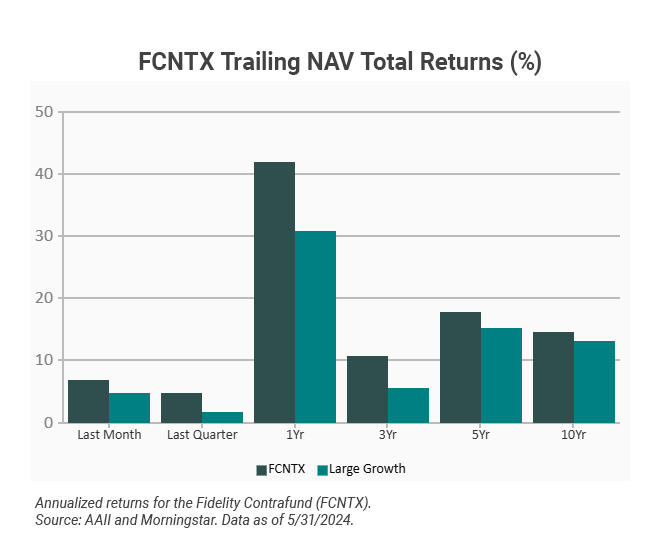
Look at Both Annual and Annualized Performance: Annual (calendar year) returns show whether a fund had a few years with large gains or losses that would affect its annualized returns. Annualized returns show how a fund has performed over time and smooths year-by-year volatility. The above chart, which is from our Fund Evaluator, displays annualized returns for the Fidelity Contrafund
 (FCNTX).
 - Take the Tax-Cost Ratio Into Consideration: Fund distributions are taxable even if your fund holdings have decreased in value. This is why you should take the tax-cost ratio into consideration if you are seeking mutual funds to hold in a taxable account. The tax-cost ratio shows how much of returns are lost to taxes when assuming the highest marginal tax bracket. Lower is better. (Note that some ETFs also have high tax-cost ratios.)
- Read the Fund’s Objective and Prospectus: Never judge a fund by its name; look at the prospectus. It will tell you whether the fund’s actual strategy and objective match your expectations. The golden rule here is to never buy a fund if you don’t understand its strategy.
I provide additional steps for finding the right mutual fund and give rules for determining when to sell in our new Essential Investing Course. The course also includes expert insights on ETFs, dividend investing, building retirement portfolios, technical analysis and more. Learn more about the Essential Investing Course.
No Investor Update on July 4
The AAII office will be closed on Thursday, July 4, and Friday, July 5 for the Independence Day holiday. The next Investor Update will be published on July 11.

-
Tips for Choosing the Right Funds for Your Needs
Simple guidelines for deciding which funds are right for you. Plus, AAII’s tools and resources that can make your decision a cinch. -
Suggestions for Analyzing Mutual Fund and ETF Performance
How to more effectively use return data to help determine whether a fund is a worthy investment. -
How Best to Mitigate Sequence Risk at Retirement
The June AAII Journal includes a few modest guidelines for naturally insulating your retirement portfolio from both sequence and size of returns risk during the early years of portfolio withdrawals.
AAII Sentiment Survey
Neutral sentiment among individual investors about the short-term outlook for stocks decreased in the latest AAII Sentiment Survey. Meanwhile, both optimism and pessimism increased.
Bullish sentiment, expectations that stock prices will rise over the next six months, increased 0.1 percentage points to 44.5%. Bullish sentiment is above its historical average of 37.5% for the 33rd time in 34 weeks.
Neutral sentiment, expectations that stock prices will stay essentially unchanged over the next six months, decreased 6.0 percentage points to 27.2%. Neutral sentiment is below its historical average of 31.5% for the ninth time in 15 weeks.
Bearish sentiment, expectations that stock prices will fall over the next six months, increased 5.8 percentage points to 28.3%. Bearish sentiment is below its historical average of 31.0% for the seventh time in 11 weeks.
The bull-bear spread (bullish minus bearish sentiment) decreased 5.7 percentage points to 16.1%. The bull-bear spread is above its historical average of 6.5% for the eighth consecutive week.
This week’s special question asked AAII members what information they think is most important as companies report second-quarter 2024 earnings.
Here is how they responded:
- Guidance on future revenues and earnings: 34.1%
- Sales and/or earnings growth: 26.9%
- Whether earnings were better or worse than expected: 19.7%
- Fundamentals such as the balance sheet or cash flow: 16.8%
- Other: 1.4%
Bullish: 44.5%, up 0.1 points
Neutral: 27.2%, down 6.0 points
Bearish: 28.3%, up 5.8 points
Bullish: 37.5%
Neutral: 31.5%
Bearish: 31.0%
See more Sentiment Survey results.

June 20, 2024 June Charts of Interest: High Concentration Is Covering Market Undercurrents
June 13, 2024 What Two Bond Market Indicators Are Telling Investors at Midyear
June 6, 2024 Revisiting the Meme Stock Craze
May 30, 2024 Answers to Common Questions About QCDs

Discussion
Barry J from TX posted over 2 years ago:
Charles, is the new AAII Fund/ETF Premium screen program is an additional annual expense from the $399 for the EI Course. How much?
Charles Rotblut from Illinois posted over 2 years ago:
Hi Barry,
The mutual fund and ETF screeners are part of A+ Investor and AAII Platinum. The screenshot I showed above is from our mutual fund evaluator, which is available to all members and can be accessed by typing in a fund's name or ticker into the search box above. All of the analysis I discussed above--with the exception of reading the prospectus--can be done on the evaluator. The Essential Investing course focuses on investment education--it is comprehensive with much good content.
Hope this helps,
Charles
You need to log in as a registered AAII user before commenting.
Create an account