

Answers to Common Questions About QCDs
by Charles Rotblut | May 30, 2024
Many AAII members asked questions in response to Brian Dobbis’ article on qualified charitable distributions (QCDs) in the May 2024 AAII Journal. QCDs are donations made from an individual retirement account (IRA). In today’s Investor Update, I answer several of those questions.
1. When Can I Start Making QCDs? You can start them once you turn 70½. This start date is before the required beginning date (RBD) for taking required minimum distributions (RMDs), which is currently the year you turn 73.
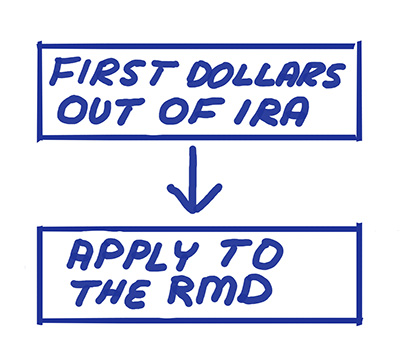 2. In What Order Must QCDs and RMDs Be Taken? The key here is the first-dollars-out rule. The first amounts withdrawn from an IRA satisfy the RMD rule for that calendar year. Using the example in Dobbis’ article, Tanya has a $5,000 RMD. If she withdraws all $5,000 first, her RMD is satisfied for the year. She cannot go back later in the year, make a $5,000 QCD and then assume it offsets the first withdrawal of the year. She still owes taxes on the first $5,000 distribution. If she only makes a $5,000 QCD and takes no other distributions from her IRA for the calendar year, she will reduce her taxable income by $5,000.
If you intend to take both QCDs and taxable distributions, do the QCD first. Then allow enough time for the QCD transaction to be completed. (Check with the charity to be sure the donation has been received.) Wait to take your taxable distributions until after the QCD transaction is completed.
3. Why Would I Make a QCD Before I Start an RMD? There is no immediate tax benefit to making a QCD before your RBD other than moving money out of your IRA on a tax-free basis.
The big reason for making a QCD before reaching your RBD is the reduction in future taxable income. RMDs are based on an IRA’s calendar-year-ending balance. Any distributions made before the year you turn 73 will reduce the balance that the first RMD will be calculated on. Those distributions will also reduce all future RMDs by creating a smaller balance on which to realize compounded returns.
4. Why Opt for a QCD Instead of Directly Donating to a Charity? QCDs reduce your adjusted gross income (AGI) dollar-for-dollar. If you take the standard deduction, this is a big benefit. If you itemize, QCDs still lower your AGI dollar-for-dollar. AGI is used in determining certain tax credits and deductions. Modified forms of AGI are used for calculating how much of your Social Security benefits are taxed and what you will pay in Medicare premiums two years from now.
Charitable donations made from a taxable account do not reduce your taxable income until after your AGI has been calculated. They will not reduce how much of your Social Security benefits are taxed or what you will pay in Medicare premiums two years from now like QCDs do.
5. Which IRA Accounts Qualify for QCDs? QCDs can be made from IRA accounts, including inherited IRAs. If you roll over a 401(k), 403(b) or 457(b) plan account to a traditional IRA, then you can make a QCD from that “rollover” IRA. QCDs can also be made from inactive Simplified Employee Pension (SEP) IRAs or Savings Incentive Match Plan for Employees (SIMPLE) IRAs, meaning no employer contributions were made during the plan’s year ending with or within the IRA’s taxable year in which the charitable contribution would be made (per Fidelity). Roth IRAs are generally not eligible for QCDs.

-
Exploring Charitable Giving Strategies: QCDs vs. Other Options
Join an active discussion among AAII members about how they incorporate QCDs and other charitable giving strategies into their financial and estate planning. -
The Importance of Considering Marginal Taxes When Taking Withdrawals
Your withdrawal strategy should be optimized to take into account potential spikes in marginal tax rates caused by factors like taxation of Social Security benefits and income-based Medicare premiums. -
What Vanguard Looks for in Innovative Global Growth Stocks
Learn from a fund manager about how Vanguard uses a bottom-up approach to pinpoint companies set to be much bigger in five to 10 years—in the May 2024 AAII Journal feature article.
AAII Sentiment Survey
Optimism among individual investors about the short-term outlook for stocks significantly decreased in the latest AAII Sentiment Survey. Meanwhile, neutral sentiment and pessimism rose.
Bullish sentiment, expectations that stock prices will rise over the next six months, decreased 8.0 percentage points to 39.0%. Bullish sentiment is above its historical average of 37.5% for the 29th time in 30 weeks.
Neutral sentiment, expectations that stock prices will stay essentially unchanged over the next six months, increased 7.6 percentage points to 34.2%. Neutral sentiment is above its historical average of 31.5% for the fifth time in 11 weeks.
Bearish sentiment, expectations that stock prices will fall over the next six months, increased 0.4 percentage points to 26.7%. Bearish sentiment is below its historical average of 31.0% for the fourth time in seven weeks.
The bull-bear spread (bullish minus bearish sentiment) decreased 8.4 percentage points to 12.3%. The bull-bear spread is above its historical average of 6.5% for the fourth time in seven weeks.
This week’s special question asked AAII members how they think the meme stock comeback will affect investors’ asset allocation decisions.
Here is how they responded:
- It will influence investors to prefer stocks and assets that are risky: 13.8%
- It will have no influence on investors’ asset allocation decisions: 56.1%
- It will influence investors to prefer less risky stocks and assets: 8.4%
- No opinion: 20.9%
Bullish: 39.0%, down 8.0 points
Neutral: 34.2%, up 7.6 points
Bearish: 26.7%, up 0.4 points
Bullish: 37.5%
Neutral: 31.5%
Bearish: 31.0%
See more Sentiment Survey results.

May 23, 2024 What Faster Trade Settlements Mean for Investors
May 16, 2024 May Charts of Interest: Buybacks Are Rising
May 9, 2024 Does It Make Sense for BlackRock to Add Annuities to Retirement Plans?
May 2, 2024 Reasons for Not Selling Stocks This May

Discussion
David Good from Illinois posted over 2 years ago:
A QCD counts as *part* of the RMD, doesn't it? I'm confused about the sequencing (QCD first) requirement. If I have (e.g.) a $50,000 RMD requirement, and I plan to do $25,000 as a QCD and $25,000 as a regular distribution to fund current spending, does it really matter which I take first, as long as they add up to the $50,000? (and all complete before year's end)
David from New Jersey posted over 2 years ago:
When I made my QCD this year to satisfy my RMD, Vanguard to me my RMD was satisfied when Vanguard cut the check, not when the charity cashed it. The IRS needs to clarify this for those folks who make both QCD as well as additional withdrawals.
Charles Rotblut from Illinois posted over 2 years ago:
David from IL--The first dollars distributed up to the full RMD amount count towards the RMD. So, in your example, both distributions would count since you have not met the RMD with the first distribution.
David from NJ--The timing issue gets tricky when a person has check writing privileges on their IRA. The broker will not know that a distribution has been made until the check is cashed. This is why the safest thing to follow up with the charity.
Jim from New Jersey posted over 2 years ago:
It is not clear to me why sequencing the QCD and other withdrawal matter? Can you give an example when sequencing mattrs, and when it does not.
Jim from TX posted over 2 years ago:
You state that "You can start them the year you turn 70½", however IRS Pub 590-B (and every other resource I've read) states "You must be at least age 70½ when the distribution was made". Note the significant difference.
vic smyth from illinois posted over 2 years ago:
Great article and follow-up questions and answers! Thank-you!
Joseph from Massachusetts posted over 2 years ago:
I have established quarterly withdrawals from traditional IRA accounts. In between the quarterly date of withdrawals, I take QCD's. I make sure I make my final QCD BEFORE the last quarterly withdrawal of the year. This last withdrawal for the year is calculated to assure the amount satisfies the RMD for the year.
You need to log in as a registered AAII user before commenting.
Create an account