

Five Moves to Stay Calm When the Market Isn't
by Charles Rotblut | May 01, 2025
Uncertainty remains high, and day-to-day political and economic headlines continue to drive financial market volatility. Concerns about tariffs, inflation and government cutbacks are weighing on both institutional and individual investors. While the stock market has rebounded from its recent low—with the S&P 500 index now 10% above its trough—concerns about the future persist. The Conference Board’s latest consumer confidence survey shows economic expectations at their lowest point since 2011.
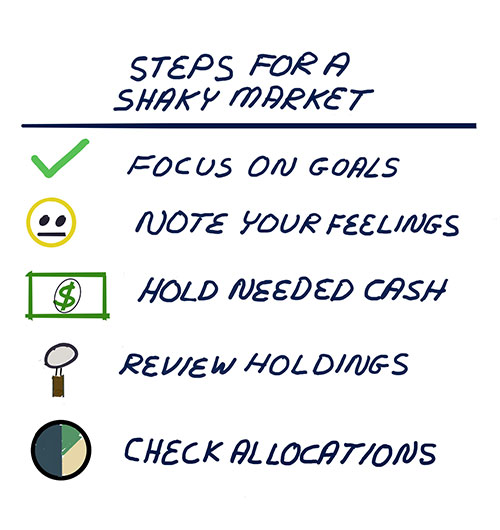 In times like these, it’s natural to feel uneasy. That’s why it’s important to focus on what you can control. Here are five portfolio moves you can take now.
- Continue to Invest Based on Your Goals and Timeline: Whether your goal is to maximize wealth, leave a financial legacy or, if you’re younger, fund retirement, continue following a long-term approach to investing. Over time, stocks have realized higher returns than inflation and bonds. Realizing this equity premium has required staying disciplined—and not panicking.
- Write Down How You’ve Felt This Month: The best time to assess your risk tolerance is when the market is down. This is when your true tolerance reveals itself. Think about a roller coaster. Your level of fear (or, in my case, excitement) always spikes just after you crest the first hill and start speeding downward. The same thing happens during market downturns. If you slept soundly last month, great. Your allocation is appropriate. If you were restless or felt a pit in the bottom of your stomach, it could mean that your portfolio risk needs to be dialed down. A higher allocation to bonds could help you avoid panicking should the next market drop be steeper.
- Plan for Short-Term Withdrawals: AAII founder James Cloonan recommended that retirees have up to four years’ worth of planned withdrawals in cash equivalents such as money market funds. This safe asset allocation allows investors to avoid selling stocks when they are down. Four years is also a reasonable time frame to base cash allocations upon for those who are working but have planned withdrawals they cannot risk incurring a shortfall on (e.g., a down payment on a house).
- Stress Test Your Portfolio: Look at how your portfolio has performed over the past month. If you own individual stocks, were there any large positions that drove your portfolio’s returns and/or volatility? If you rely on dividend and/or interest income, did anything fundamentally change with those investments? Scan through the financial statements released as part of first-quarter 2025 earnings season. Are there any significant changes between last quarter’s numbers compared to one year ago? A fallen stock price does not necessarily mean the dividend is in trouble.
- Check Your Allocation: Does your current allocation match your desired allocation? Small fluctuations are normal. If your mix of stocks versus bonds or your mix of domestic stocks to foreign stocks is off target by five or more percentage points, consider rebalancing. Doing so will bring your allocation back in line with your targets. Unsure of what your allocation should be? Our Asset Allocation Models can provide a guide.
Most importantly, remember that while plenty of pundits project confidence, no one can say with certainty how the ongoing tariff situation will evolve.
What we can say with confidence is that taking these five steps will help you focus on what you can control. They will also keep you on track to achieve your financial goals—whether that means funding a specific need or maximizing long-term wealth.

-
Using the Level3 Withdrawal Strategy to Achieve Growth and Stability
Protecting the assets needed in the near future from market downturns allows you to balance risk and return in a rational way. -
PRISM Risk Assessment Worksheet
Use this simple worksheet to help you determine how much risk you can handle based on your goal and your psychological and financial ability to withstand market volatility. -
An Intro to AI-Powered Investing: How Individual Investors Can Leverage LLMs
Our new AAII Journal series begins by showing you how artificial intelligence, if used with care, can enhance your investment research and decision-making.
AAII Sentiment Survey
Pessimism among individual investors about the short-term outlook for stocks increased in the latest AAII Sentiment Survey. Meanwhile, optimism and neutral sentiment decreased.
Bullish sentiment, expectations that stock prices will rise over the next six months, decreased 1.0 percentage points to 20.9%. Bullish sentiment is unusually low and is below its historical average of 37.5% for the 16th time in 18 weeks.
Neutral sentiment, expectations that stock prices will stay essentially unchanged over the next six months, decreased 2.7 percentage points to 19.8%. Neutral sentiment is unusually low and is below its historical average of 31.5% for the 41st time in 43 weeks.
Bearish sentiment, expectations that stock prices will fall over the next six months, increased 3.7 percentage points to 59.3%. Bearish sentiment is unusually high and is above its historical average of 31.0% for the 22nd time in 24 weeks. Bearish sentiment has now been above 50% for 10 consecutive weeks, the longest period over 50% in the survey’s history.
The bull-bear spread (bullish minus bearish sentiment) decreased 4.7 percentage points to –38.3%. The bull-bear spread is below its historical average of 6.5% for the 17th time in 19 weeks and is below –20.0% for the 10th consecutive week. This is the longest streak below –20.0% since a 12-week stretch between September 14 and November 30, 1990.
This week’s special question asked AAII members how they expect market volatility to change over the next six months.
Here is how they responded:
- Significantly increase: 20.5%
- Moderately increase: 25.9%
- Remain about the same: 31.6%
- Moderately decrease: 19.0%
- Significantly decrease: 3.0%
Bullish: 20.9%, down 1.0 points
Neutral: 19.8%, down 2.7 points
Bearish: 59.3%, up 3.7 points
Bullish: 37.5%
Neutral: 31.5%
Bearish: 31.0%
See more Sentiment Survey results.

AAII Asset Allocation Survey
Individual investors’ allocations to stock decreased while bond and cash allocations increased in the April Asset Allocation Survey.
Stock and stock fund allocations decreased 2.1 percentage points to 64.1%. Stock and stock fund allocations are above their historical average of 61.5% for the 59th consecutive month but have fallen to their lowest level since December 2022.
Bond and bond fund allocations increased 0.7 percentage points to 16.2%. Bond and bond fund allocations are above their historical average of 16.0% for the first time in 15 months.
Cash allocations increased 1.4 percentage points to 19.7%. Cash allocations are below their historical average of 22.5% for the 29th consecutive month.
- Stocks and Stock Funds: 64.1%, down 2.1 percentage points
- Bonds and Bond Funds: 16.2%, up 0.7 percentage points
- Cash: 19.7%, up 1.4 percentage points
- Stocks: 28.6%, down 1.2 percentage points
- Stocks Funds: 35.5%, down 0.9 percentage points
- Bonds: 5.1%, up 1.0 percentage points
- Bond Funds: 11.1%, down 0.2 percentage points
- Stocks/Stock Funds: 62.0%
- Bonds/Bond Funds: 16.0%
- Cash: 22.0%
Take the Asset Allocation Survey.
April 24, 2025 April Charts of Interest: The Bond Market Gets Jittery
April 17, 2025 All-Time High Trend Strategies Are Not Without Costs and Risks
April 10, 2025 Winning and Losing Stocks During the Current Downturn
April 3, 2025 Staying Invested When Tariffs Rattle the Market

Discussion
Barry J from TX posted over 1 year ago:
James Cloonan is right for a third time in the past 25 years (2000, 2008, and 2025). Dr. Bob and the "buy and hold" set are right too. Ignore the headlines. We are facing a “REAL” risk situation. To get through to the "recovery" phase will take require some Hudspath. This is a good time to (Step 1) turnoff your cellphone, (Step 2) find your copy of “Investing at Level 3,” (Step 3) pour a beverage of choice, and (Step 4) re-highlight the good parts of L3, and (Step 5) say thank you to the nice AAII people. Note: Your AAII lifetime membership just paid for itself. After you finish these 5 Steps, get busy on the data gathering to execute Charles' 5 steps. See you on the other side.
Charles M Rotblut from Illinois posted over 1 year ago:
Good suggestions Barry, especially steps 1-4. We always try to earn step 5.
You need to log in as a registered AAII user before commenting.
Create an account