

Staying Invested When Tariffs Rattle the Market
by Charles Rotblut | April 03, 2025
Stock markets across the globe plunged today in reaction to new tariffs enacted by President Donald Trump.
Fear about the economic impacts of the new tariffs had an immediate impact on the financial markets. Asian and European markets fell between 2% and 3%. The major U.S. indexes plunged right after the open and ended down between 4% and 7%.
The headlines may differ, but we’ve seen this type of volatility many times before. Mr. Market has a knack for taking the high-speed elevator down. Bouts of sharp downward drops are the short-term price investors pay for long-term gains.
Market history provides us with both perspectives and guidelines for days like today.
Being greedy when others are fearful is a good strategy. Bearish sentiment, expectations that stock prices will fall over the next six months, is at its third-highest level (61.9%) in the 38-year existence of the AAII Sentiment Survey. The S&P 500 index realized a six-month gain of 25.6% following the October 19, 1990, bearish reading of 67.0%. It rebounded 56.9% following the March 5, 2009, bearish reading of 70.3%.
If you’re looking for bargains, start with our AAII Stock Screens. Prefer exchange-traded funds (ETFs)? Our Individual Investor’s Guide to the Top ETFs is a great resource.
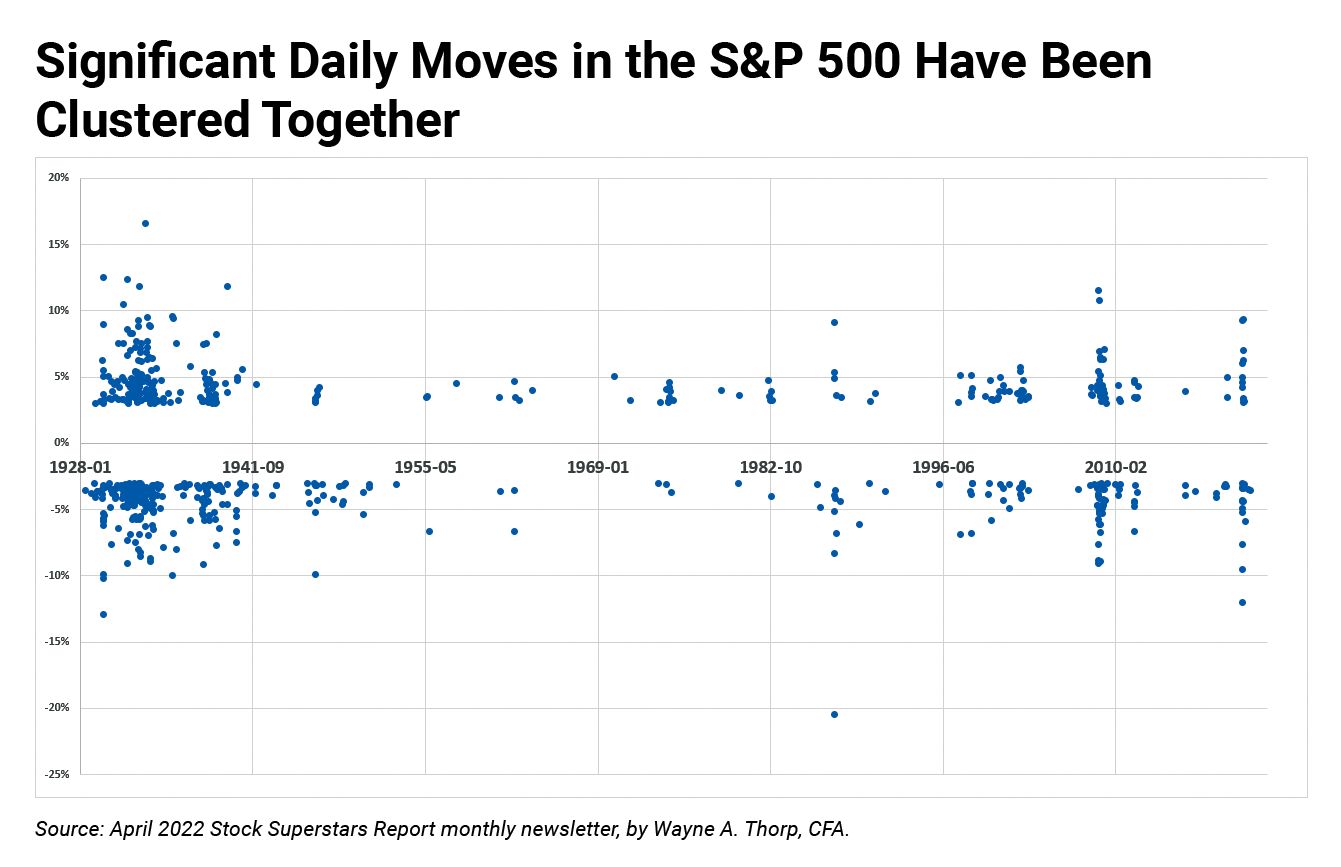
Significant moves in the market—both to the upside and downside—tend to group together. Pulling out of stocks when the major indexes have incurred a large decline puts you at substantial risk of missing the big rebound. The biggest up days have often followed the biggest down days. You can see this in the chart below put together by AAII’s Wayne Thorp. Missing out on the 10 biggest days results in a 70% decrease in long-term wealth relative to an investor who consistently stayed allocated to the S&P 500.
Match your portfolio to your time horizon. The biggest risk to the dollars you’ll need in 10+ years is long-term inflation, not short-term volatility. Selling now reduces your future purchasing power. On the other hand, dollars you need in the next few years—and can’t afford to lose—belong in cash, regardless of whether the market is going up or down.
Put your individual retirement account (IRA) and Roth IRA contributions to work. If you’ve recently made 2024 contributions to your IRA or Roth IRA, invest them. These are dollars you will need for the long term, and stocks are on sale. The best way to benefit from long-term capital appreciation is by investing early and staying invested.
Realize that no one has a working crystal ball. The market is trying to price in a complex political decision with broad economic implications. No stock market, economic or political prognosticator can accurately predict how the tariff situation will unfold. (The uncertainty of tariffs brings to mind the lack of response Ben Stein’s character in “Ferris Bueller’s Day Off” receives when he asks, “Anyone? Anyone?” about the Smoot–Hawley Tariff Act.)
If you’re nervous, step away. Acting when you feel nervous rarely leads to good decisions about your portfolio. The best thing you can do is take a break: Go for a walk, play with your pet, visit with a close friend, etc. If you are still nervous afterward, then make just a small allocation tweak to your portfolio, such as moving 5% out of stocks and into a money market fund. It will give you the peace of mind of having done something without severely wrecking your chances at realizing long-term capital appreciation.

-
How Much Risk Can You Handle and Still Meet Your Goals?
An investor’s overall tolerance can be determined both by the timing of their goals and financial and psychological factors. -
Rediscovering Sir John Templeton: Bargain-Hunter Extraordinaire
An updated look at the characteristics of AAII’s screening approach based on a legendary wise buyer of out-of-favor stocks. -
Replacing the Outdoors With Oil in the Model Shadow Stock Portfolio
The newly posted April 2025 AAII Journal reports the latest changes to the portfolio and also looks at how the portfolio performed during the best and worst months over its history.
AAII Sentiment Survey
Pessimism among individual investors about the short-term outlook for stocks increased in the latest AAII Sentiment Survey. Meanwhile, optimism and neutral sentiment decreased. Most of this week’s survey responses were captured prior to President Trump’s tariff announcement on Wednesday, April 2.
Bullish sentiment, expectations that stock prices will rise over the next six months, decreased 5.7 percentage points to 21.8%. Bullish sentiment is unusually low and is below its historical average of 37.5% for the 12th time in 14 weeks.
Neutral sentiment, expectations that stock prices will stay essentially unchanged over the next six months, decreased 4.1 percentage points to 16.3%. Neutral sentiment is unusually low and is below its historical average of 31.5% for the 37th time in 39 weeks. Neutral sentiment was last lower on April 1, 2020 (16.0%).
Bearish sentiment, expectations that stock prices will fall over the next six months, increased 9.8 percentage points to 61.9%. Bearish sentiment is unusually high and is above its historical average of 31.0% for the 18th time in 20 weeks. This is the third-highest bearish sentiment reading in the history of the survey and was last higher on March 5, 2009 (70.3%).
The bull-bear spread (bullish minus bearish sentiment) decreased 15.4 percentage points to –40.2%. The bull-bear spread is below its historical average of 6.5% for the 13th time in 15 weeks.
This week’s special question asked AAII members if they hold gold or other precious metals in their portfolio, either directly or through an exchange-traded fund (ETF).
Here is how they responded:
- No, I do not: 59.9%
- Yes, I own gold or other precious metals: 18.4%
- Yes, I own both precious metals and mining companies: 11.9%
- I just own mining companies that focus on precious metals: 7.4%
- I am considering adding gold to my portfolio: 2.1%
Bullish: 21.8%, down 5.7 points
Neutral: 16.3%, down 4.1 points
Bearish: 61.9%, up 9.8 points
Bullish: 37.5%
Neutral: 31.5%
Bearish: 31.0%
See more Sentiment Survey results.

AAII Asset Allocation Survey
Individual investors’ allocations to stock decreased while bond and cash allocations increased in the March Asset Allocation Survey.
Stock and stock fund allocations decreased 1.7 percentage points to 66.2%. Stock and stock fund allocations are above their historical average of 61.5% for the 58th consecutive month.
Bond and bond fund allocations increased 0.9 percentage points to 15.5%. Bond and bond fund allocations are below their historical average of 16.0% for the 14th consecutive month.
Cash allocations increased 0.9 percentage points to 18.3%. Cash allocations are below their historical average of 22.5% for the 28th consecutive month.
- Stocks and Stock Funds: 66.2%, down 1.8 percentage points
- Bonds and Bond Funds: 15.5%, up 0.8 percentage points
- Cash: 18.3%, up 0.9 percentage points
- Stocks: 29.7%, down 0.2 percentage points
- Stocks Funds: 36.4%, down 1.5 percentage points
- Bonds: 4.2%, down 0.2 percentage points
- Bond Funds: 11.3%, up 1.0 percentage points
- Stocks/Stock Funds: 62.0%
- Bonds/Bond Funds: 16.0%
- Cash: 22.0%
Take the Asset Allocation Survey.
March 27, 2025 Gold Is Glittering but May Not Be Right for Your Portfolio
March 20, 2025 March Charts of Interest: A Buying Opportunity?
March 13, 2025 Investing for the Long Term Despite Tariff-Driven Volatility
March 6, 2025 33 Top-Graded Mid-Cap Dividend Payers

Discussion
Rob from NC posted over 1 year ago:
When a storm rolls through town, I don't pack up all my belongings and leave town. Similarly, whenever the stock market is in turmoil, I don't sell my highly appreciated assets, pay gobs of taxes on the gain, and hide the remaining proceeds in my mattress (or buy bonds, which isn't much better). Stay the course!
Barry J from TX posted over 1 year ago:
Charles, #1 I want to thank you personally, ALL the AAII staff, and the generous members like “Dr. Bob” et al, who have worked so hard to instill a modest amount of investing skill into my thick head. I give my "AAII family" full credit for educating me to a level that enabled me to accrue the portfolio I currently have. #2 I am still the “poor kid” with a rural public-school education who was lucky enough to get full-boat academic scholarships that led to BA/BS/MBA/MS. #3 I guarantee I was the poorest kid in my class; I am still that “poor kid” inside this USA All-American Matryoshka doll. My wife laughs when she buys something at the store and I ask her, “How much was that? $5?” #4 This is our third trip through Mr. Market’s “Fun House of Horrors.” Nothing new to see here. As B. B. King crooned, "The Thrill Is Gone." Charles reminds every AAIIer to “stay the course.” As Yogi actually said. “It ain’t over ‘til it‘s over” (whether there’s a fat lady around or not). This wise advice is greatly appreciated, too. #5 I do not like the Liberation Day “haircut” I am receiving now almost as much as Louis XVI despised his 1783 Thermador “haircut.” I have bought houses for less. Ouch! #6 But I feel blessed, privileged, and thankful to be positioned to ENDURE the “correction” that “corrects” my net worth balance. This period of dramatic change shows that ANYONE who “stays the course” -- even bourgeois kids like me -- can share the financial thrills of the hoi polloi. The OPPORTUNITY to share in the “wins” AND “losses” (too) is what makes America great. That is what makes this opportunity equal.
vic smyth from illinois posted over 1 year ago:
Would today be a good day to re-balance, selling some bonds and buying stocks?
Charles M Rotblut from US-0-IL posted over 1 year ago:
Thank you, Barry!
Vic, as I told a friend yesterday, I will be able to tell you with 100% accuracy where the market bottom is after it is set. When it comes to buying on downturns, you have to be willing to accept the risks of being too early.
-Charles
Randall Dougherty from MO posted over 1 year ago:
Charles, Thank you for helping reassure everyone to maintain perspective!! Invaluable!!
Barry from TX posted over 1 year ago:
Mr. Market reminds me of playing "Let's Make a Deal," the game show where MC Monte Hall offered contestants a choice between 3 doors. The door you choose becomes your portfolio. You know its value, but you cannot be sure of its long-term value. Mr. Market offers you a chance to trade your portfolio for a portfolio behind one of the two other doors: one is a Big Prize; the other is a "zonk". As a trader (that's what contestants were called), your choices are to KEEP your current portfolio ... or ... TRADE it for one of the unknown portfolios. YOUR choice ends the game; you "leave the show" with it. Trade of don't trade? Deal or No Deal? Probability theory says don't trade. Your odds were 33% when you made your first choice. Those odds have not changed. Do not take the deal. Do not flee to cash. Do not "buy the dip" or "catch a falling knife." The odds favor the long-term investor. Stay the course.
You need to log in as a registered AAII user before commenting.
Create an account